

100 francs – Mali
Add to wishlist
Circulating commemorative coins
Commemoration: F.A.O.
Mali
Context
Material
Diameter: 27.8 mm
Weight: 8 g
Thickness: 2 mm
Shape: Round
Composition: Nickel brass
Magnetic: No
Technique: Milled
Alignment: Coin alignment
flip
References
KM: #
Numista: #1757
Value
Exchange value: 100 MLF
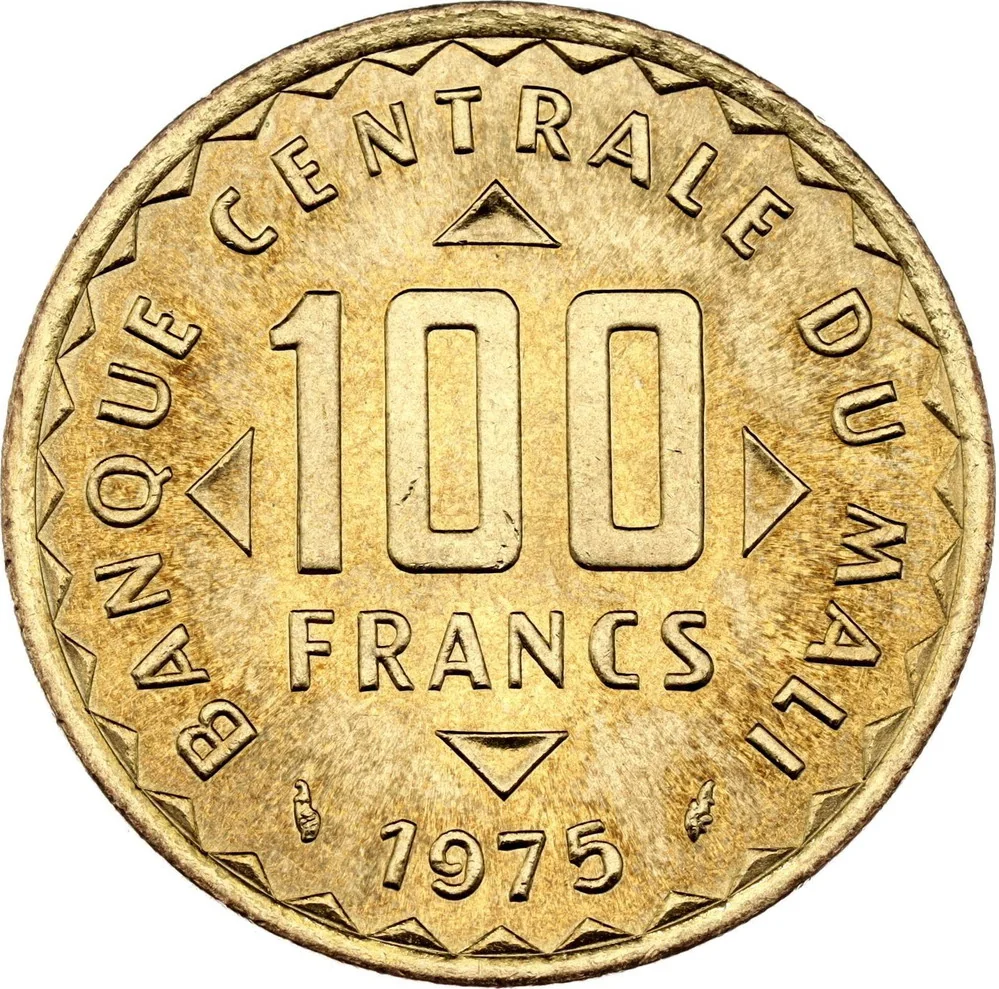
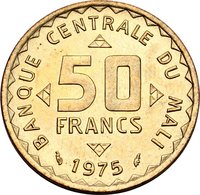
Obverse
Description:
Denomination and date below.
Inscription:
BANQUE CENTRALE DU MALI
▲
◀ 100 ▶
FRANCS
▼
1975
▲
◀ 100 ▶
FRANCS
▼
1975
Translation:
CENTRAL BANK OF MALI
▲
◀ 100 ▶
FRANCS
▼
1975
▲
◀ 100 ▶
FRANCS
▼
1975
Script: Latin
Language: French
Engraver: Raymond Joly
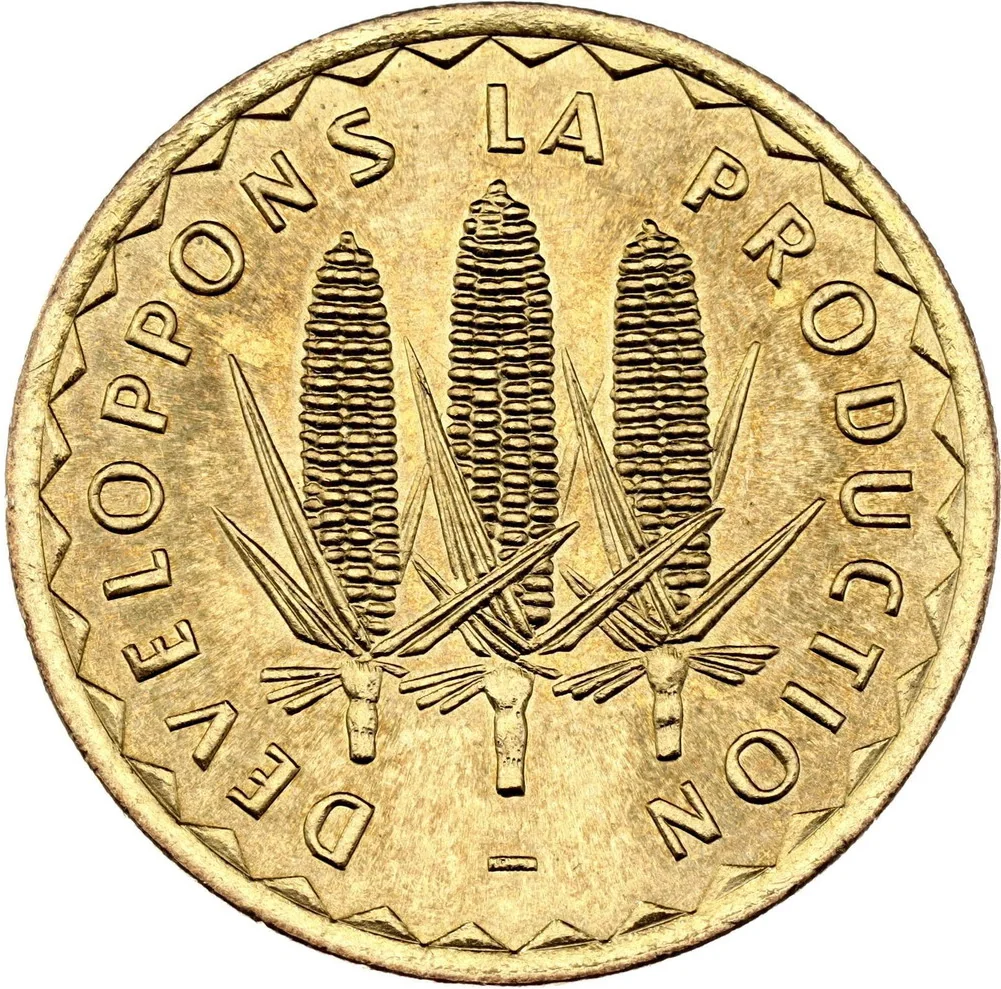
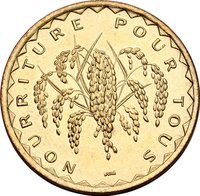
Reverse
Description:
Corn
Inscription:
DEVELOPPONS LA PRODUCTION
Translation:
Let's develop production.
Script: Latin
Language: French
Engraver: Raymond Joly
Edge
Reeded
Categories
| Organization> FAO |
Mints
| Name | Mark |
|---|---|
| Monnaie de Paris | — |
Mintings
| Year | Mint Mark | Mintage | Quality | Collection |
|---|---|---|---|---|
| 1975 | — | 23,000,000 |
Historical background
In 1975, Mali's currency situation was defined by its membership in the West African Monetary Union (UMOA) and its use of the CFA franc. The CFA franc, created in 1945, was (and remains) a currency pegged to the French franc with a guaranteed fixed convertibility. This arrangement provided monetary stability and facilitated trade with France and other UMOA members, but it also meant Mali's monetary policy was largely set externally by the union's central bank, the BCEAO, with significant influence from the French Treasury, which held the foreign exchange reserves.
This period followed a significant historical shift. From 1962 to 1967, Mali had exited the CFA zone and issued its own national currency, the Malian franc, in an attempt to gain greater economic sovereignty. However, the experiment led to inflation, isolation from regional trade, and economic difficulty. By 1967, Mali negotiated its return to the UMOA, a process completed in 1984, but in 1975 it was in the transitional phase of realigning its financial systems. Thus, the currency situation was one of re-established stability under the CFA franc, but within the context of recovering from the financial consequences of its earlier secession.
Economically, the fixed peg to the French franc provided predictability for imports and debt servicing. However, for a largely agricultural and developing nation like Mali, it also posed challenges, including limited flexibility to devalue its currency to boost export competitiveness. The broader economic conditions of the mid-1970s, marked by the aftermath of the Sahel droughts and global oil price shocks, put pressure on Mali's finances. Therefore, while the institutional currency framework was stable, the underlying economy faced significant strains that the fixed-exchange rate regime could not automatically resolve.
This period followed a significant historical shift. From 1962 to 1967, Mali had exited the CFA zone and issued its own national currency, the Malian franc, in an attempt to gain greater economic sovereignty. However, the experiment led to inflation, isolation from regional trade, and economic difficulty. By 1967, Mali negotiated its return to the UMOA, a process completed in 1984, but in 1975 it was in the transitional phase of realigning its financial systems. Thus, the currency situation was one of re-established stability under the CFA franc, but within the context of recovering from the financial consequences of its earlier secession.
Economically, the fixed peg to the French franc provided predictability for imports and debt servicing. However, for a largely agricultural and developing nation like Mali, it also posed challenges, including limited flexibility to devalue its currency to boost export competitiveness. The broader economic conditions of the mid-1970s, marked by the aftermath of the Sahel droughts and global oil price shocks, put pressure on Mali's finances. Therefore, while the institutional currency framework was stable, the underlying economy faced significant strains that the fixed-exchange rate regime could not automatically resolve.
🌱 Common