

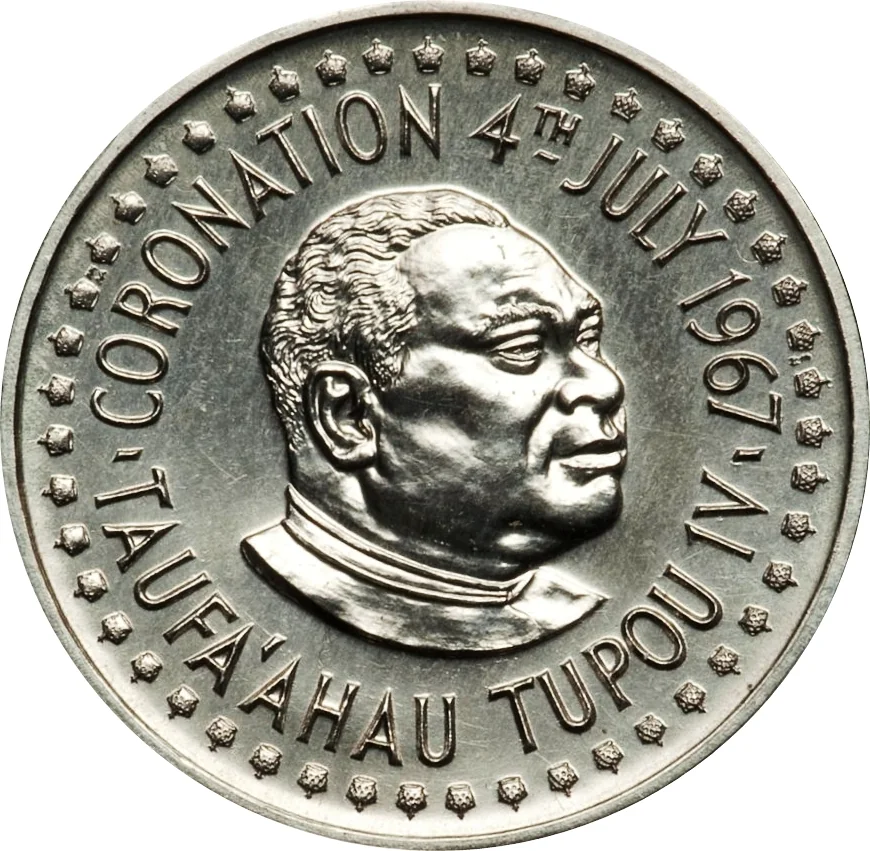
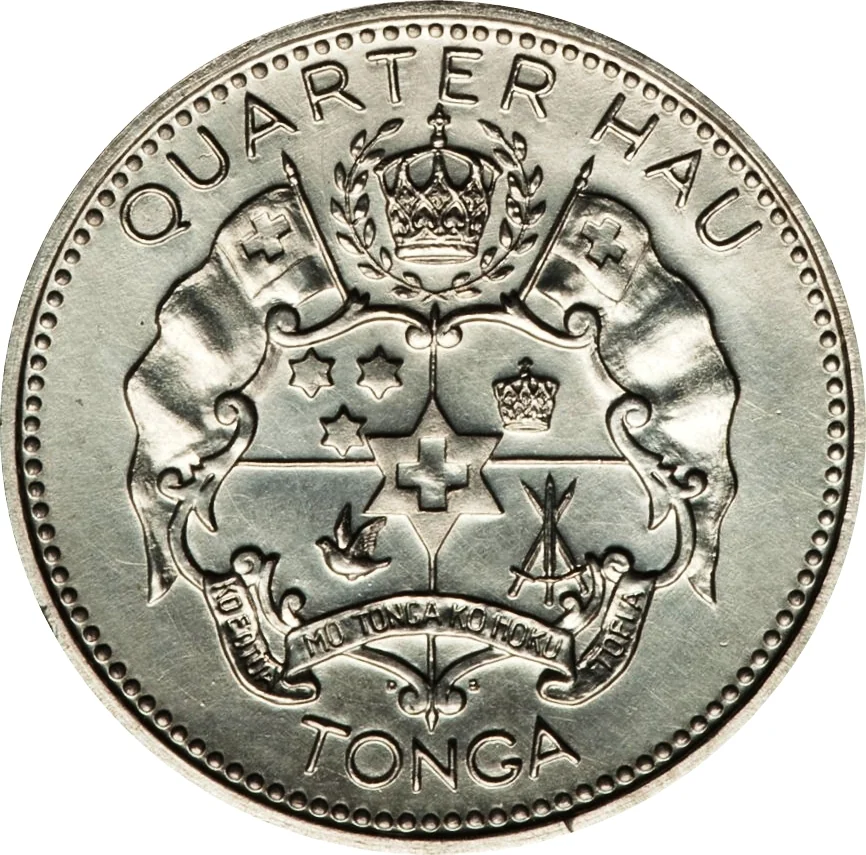
¼ Hau – Tonga
Non-circulating coins
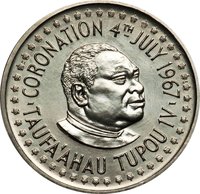
Commemoration: Coronation of Taufa’ahau Tupou IV
Tonga
Context

Material
Diameter: 26 mm
Weight: 16.2 g
Thickness: 2.9 mm
Shape: Round
Composition: Bimetallic (Palladium center)
Technique: Milled
References
KM: #Click to copy to clipboard21
Numista: #175547
Value
Exchange value: 25 TOP
Obverse
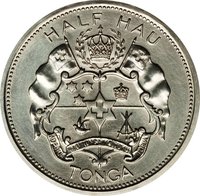
Reverse
Edge
Plain with incuse lettering – readable when obverse face is up
Legend:
HISTORICALLY THE FIRST PALLADIUM COINAGE
Mints
| Name | Mark |
|---|---|
| Pobjoy Mint | — |
Mintings
| Year | Mint Mark | Mintage | Quality | Collection |
|---|---|---|---|---|
| 1967 | — | 1,700 |
Historical background
In 1967, Tonga's currency situation was defined by its transition towards greater monetary autonomy while remaining within the sphere of British and Australian monetary influence. The nation did not yet have its own central bank or independent currency. Instead, the official legal tender was the Tongan Pound, which had been introduced in 1921 and was pegged at par with the British Pound Sterling. In practice, however, Australian currency circulated widely and was accepted interchangeably, reflecting the kingdom's deep economic and trade ties with Australia.
This period was one of preparation for a significant change. The Tonga Decimal Currency Act of 1967 was passed, laying the legislative groundwork to replace the old pound-shilling-pence system with a decimal-based currency. The new currency was to be the Pa'anga, subdivided into 100 seniti. This move aligned Tonga with the global trend towards decimalisation, notably following Australia's own switch to decimal dollars and cents in 1966, which simplified accounting and commercial transactions.
Therefore, the year 1967 was a pivotal juncture, marking the end of the colonial-era monetary system. While the physical introduction of the Pa'anga and seniti coins and notes would not occur until 1968, the decisions and laws enacted in 1967 set the course. The change was both symbolic and practical, affirming Tonga's post-independence (gained in 1970) sovereignty while modernising its financial infrastructure to better manage its evolving economy.
This period was one of preparation for a significant change. The Tonga Decimal Currency Act of 1967 was passed, laying the legislative groundwork to replace the old pound-shilling-pence system with a decimal-based currency. The new currency was to be the Pa'anga, subdivided into 100 seniti. This move aligned Tonga with the global trend towards decimalisation, notably following Australia's own switch to decimal dollars and cents in 1966, which simplified accounting and commercial transactions.
Therefore, the year 1967 was a pivotal juncture, marking the end of the colonial-era monetary system. While the physical introduction of the Pa'anga and seniti coins and notes would not occur until 1968, the decisions and laws enacted in 1967 set the course. The change was both symbolic and practical, affirming Tonga's post-independence (gained in 1970) sovereignty while modernising its financial infrastructure to better manage its evolving economy.
✨ Legendary