

30 euro (Prekmurje rejoining its homeland) – Slovenia
Add to wishlist
Non-circulating coins
Commemoration: Centenary of Prekmurje rejoining its homeland
Slovenia
Context
Material
References
KM: #
Numista: #175429
Value
Exchange value: 30 EUR
Bullion value: $34.63
Inflation-adjusted value: 38.60 EUR
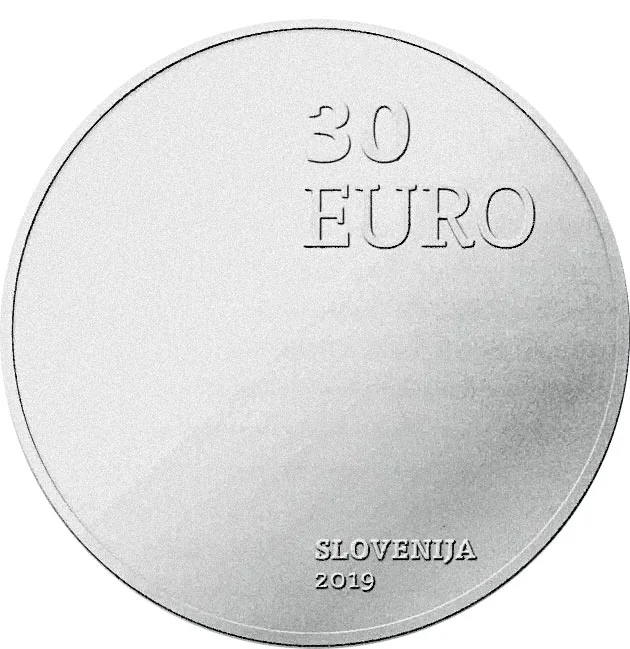
Obverse
Inscription:
30 EURO
SLOVENIJA
2019
SLOVENIJA
2019
Translation:
30 EURO
SLOVENIA
2019
SLOVENIA
2019
Script: Latin
Designer: Matej Ramšak
Reverse
Description:
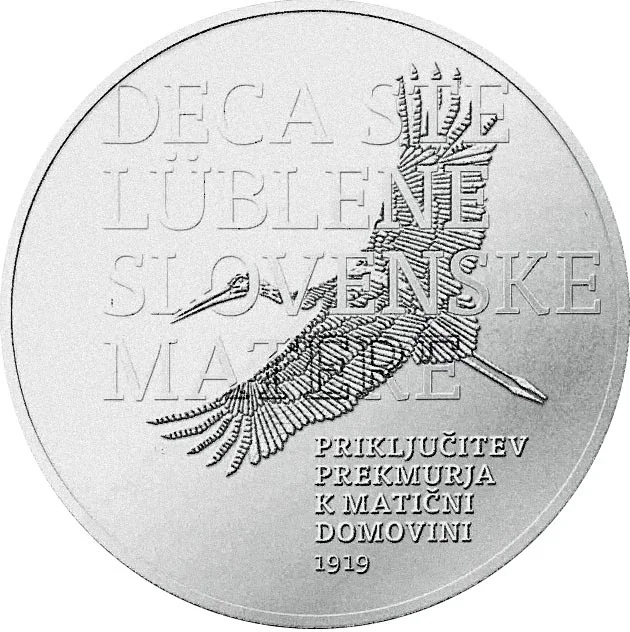
The Bank of Slovenia commemorates the centenary of Prekmurje's reunification with this coin. It features a westward-flying stork—symbolizing rebirth and a key emblem of the region—interwoven with a 1919 quote by Jožef Klekl the Elder: "You are children of the beloved Slovene mother."
Inscription:
DECE STE LÜBLENE SLOVANSKE MATERE
PRIKLUČITEV PREKMURJA K MATIČNI DOMOVINI
2019
PRIKLUČITEV PREKMURJA K MATIČNI DOMOVINI
2019
Translation:
DECE OF THE SLOVENIAN MOTHER OF LÜBLANA
THE ANNEXATION OF PREKMURJE TO THE MOTHER HOMELAND
2019
THE ANNEXATION OF PREKMURJE TO THE MOTHER HOMELAND
2019
Script: Latin
Designer: Matej Ramšak
Edge
Reeded
Mints
| Name | Mark |
|---|---|
| Rome | — |
Mintings
| Year | Mint Mark | Mintage | Quality | Collection |
|---|---|---|---|---|
| 2019 | — | 1,500 | Proof |
Historical background
In 2019, Slovenia remained a stable member of the Eurozone, having adopted the euro as its sole legal tender in 2007. The country's currency situation was therefore intrinsically tied to the monetary policy set by the European Central Bank (ECB). Domestically, the Slovenian economy experienced solid growth, low inflation, and a historically low unemployment rate, which provided a stable macroeconomic backdrop for the currency. The euro facilitated trade and investment flows, with Slovenia's key trading partners largely being other EU member states, and the country maintained strong fiscal discipline, further bolstering confidence in its economic management within the single currency area.
However, the national discourse occasionally featured nuanced discussions about the euro's impact. While the benefits of euro membership—such as eliminated exchange rate risk, lower transaction costs, and enhanced stability—were widely acknowledged, some economists and commentators pointed to persistent challenges. These included the loss of independent monetary policy, which meant Slovenia could not devalue its currency to boost competitiveness, and the perception that euro membership contributed to higher price levels in certain sectors compared to some neighboring non-Eurozone countries. Nevertheless, there was no significant political movement or public pressure to reconsider euro membership.
Overall, 2019 represented a period of currency normality and integration for Slovenia. The focus was not on exchange rate volatility or currency crisis, but on leveraging the stability of the euro to support continued economic convergence with the EU's core economies. The main financial conversations revolved around banking sector efficiency, structural reforms to improve productivity, and navigating the broader ECB monetary policy environment, rather than on the currency itself, which was seen as a settled and permanent feature of the economic landscape.
However, the national discourse occasionally featured nuanced discussions about the euro's impact. While the benefits of euro membership—such as eliminated exchange rate risk, lower transaction costs, and enhanced stability—were widely acknowledged, some economists and commentators pointed to persistent challenges. These included the loss of independent monetary policy, which meant Slovenia could not devalue its currency to boost competitiveness, and the perception that euro membership contributed to higher price levels in certain sectors compared to some neighboring non-Eurozone countries. Nevertheless, there was no significant political movement or public pressure to reconsider euro membership.
Overall, 2019 represented a period of currency normality and integration for Slovenia. The focus was not on exchange rate volatility or currency crisis, but on leveraging the stability of the euro to support continued economic convergence with the EU's core economies. The main financial conversations revolved around banking sector efficiency, structural reforms to improve productivity, and navigating the broader ECB monetary policy environment, rather than on the currency itself, which was seen as a settled and permanent feature of the economic landscape.

💎 Extremely Rare