

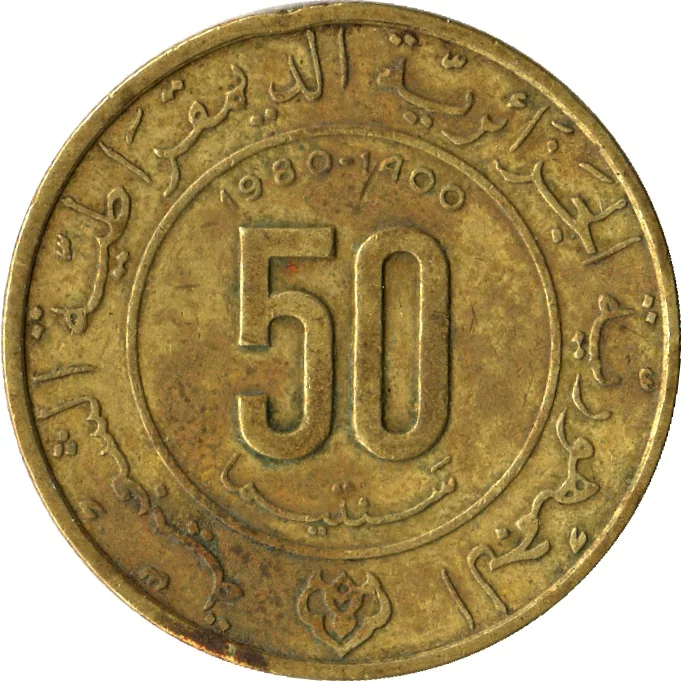
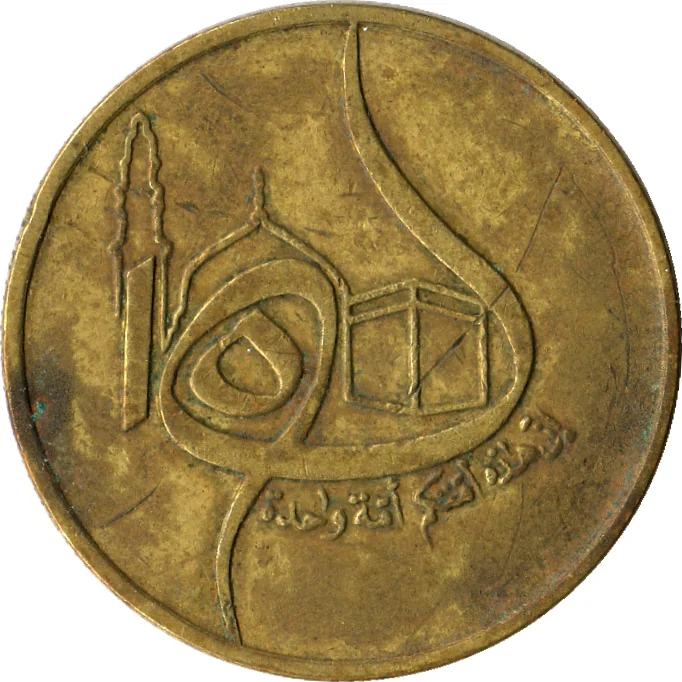
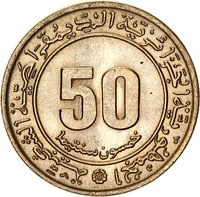
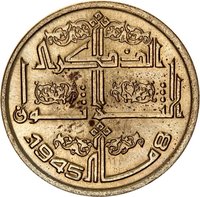
50 centimes (Prophet Mohammad's Flight) – Algeria
Add to wishlist
Circulating commemorative coins
Commemoration: 1400th Anniversary of Prophet Mohammad's Flight (Start of Hijra calendar)
Algeria
Context
Year: 1980
Islamic (Hijri) Year:: 1400
Issuer: Algeria
Period:
(since 1962)
Currency:
(since 1964)
Demonetized: Yes
Material
Diameter: 24 mm
Weight: 5 g
Thickness: 1.62 mm
Shape: Round
Composition: Aluminium bronze
Magnetic: No
Technique: Milled
Alignment: Coin alignment
flip
References
KM: #
Numista: #1752
Value
Exchange value: 0.50 DZD
Obverse
Reverse
Edge
Reeded
Categories
| Building> Religious building |
Mintings
| Year | Mint Mark | Mintage | Quality | Collection |
|---|---|---|---|---|
| 1980 | — | — |
Historical background
In 1980, Algeria's currency situation was characterized by a tightly controlled and overvalued dinar, operating within a complex framework of multiple exchange rates. The country, under the socialist-oriented rule of the National Liberation Front (FLN), maintained a fixed official exchange rate pegged to a basket of currencies. This official rate, however, did not reflect market realities, leading to a significant black market premium where the dinar traded for a fraction of its official value against hard currencies like the French franc and the US dollar. This system was a product of the state's centralized economic planning, import-substitution industrialization policies, and strict capital controls designed to conserve foreign exchange and direct resources toward state-led industrial projects.
The primary driver of this monetary policy was Algeria's heavy reliance on hydrocarbon exports (oil and gas), which provided over 95% of its foreign exchange earnings. The government used these revenues to finance a massive import program for capital goods, food, and consumer products, while shielding the domestic economy from external pressures. The overvalued dinar made these imports artificially cheap for state enterprises but simultaneously made non-hydrocarbon exports uncompetitive on the global market, stifling economic diversification. Furthermore, strict regulations made it difficult for citizens and businesses to access foreign currency for travel or international transactions, fueling the parallel market.
Consequently, the currency regime of 1980, while ensuring short-term stability and funding for development plans, entrenched long-term structural economic weaknesses. It created distortions between the formal and informal economies, encouraged corruption and rent-seeking around access to foreign currency, and masked growing inefficiencies. The situation was sustainable only as long as global oil prices remained high, a vulnerability that would be starkly exposed later in the decade when oil prices collapsed, leading to a severe economic crisis and eventual, though gradual, moves toward liberalization.
The primary driver of this monetary policy was Algeria's heavy reliance on hydrocarbon exports (oil and gas), which provided over 95% of its foreign exchange earnings. The government used these revenues to finance a massive import program for capital goods, food, and consumer products, while shielding the domestic economy from external pressures. The overvalued dinar made these imports artificially cheap for state enterprises but simultaneously made non-hydrocarbon exports uncompetitive on the global market, stifling economic diversification. Furthermore, strict regulations made it difficult for citizens and businesses to access foreign currency for travel or international transactions, fueling the parallel market.
Consequently, the currency regime of 1980, while ensuring short-term stability and funding for development plans, entrenched long-term structural economic weaknesses. It created distortions between the formal and informal economies, encouraged corruption and rent-seeking around access to foreign currency, and masked growing inefficiencies. The situation was sustainable only as long as global oil prices remained high, a vulnerability that would be starkly exposed later in the decade when oil prices collapsed, leading to a severe economic crisis and eventual, though gradual, moves toward liberalization.
🌱 Very Common