

20 euro (Algirdas Julien Greimas) – Lithuania
Add to wishlist
Non-circulating coins
Commemoration: 100th Anniversary of the Birth of Algirdas Julien Greimas
Lithuania
Context
Material
References
KM: #
Numista: #106868
Value
Exchange value: 20 EUR
Bullion value: $63.97
Inflation-adjusted value: 30.59 EUR
Obverse
Description:
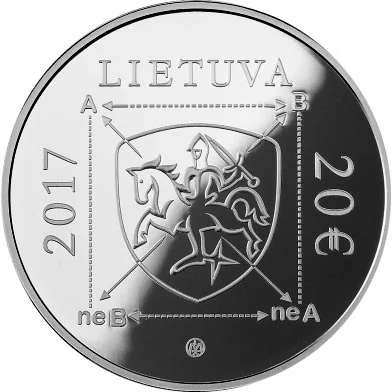
The obverse shows a stylized Vytis within the Semiotic Square, surrounded by "LIETUVA," the €20 denomination, 2017 date, and the Lithuanian Mint mark.
Inscription:
2017
LIETUVA
20 €
LMK
A B
ne B ne A
LIETUVA
20 €
LMK
A B
ne B ne A
Translation:
2017
LITHUANIA
20 €
LMK
Neither B nor A
LITHUANIA
20 €
LMK
Neither B nor A
Script: Latin
Languages: English, Lithuanian
Engraver: Rolandas Rimkūnas
Reverse
Description:
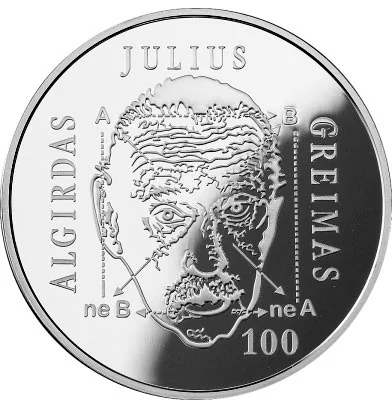
The reverse features Algirdas Julien Greimas and his centenary number, 100.
Inscription:
ALGIRDAS JULIUS GREIMAS
A B
ne B ne A
100
A B
ne B ne A
100
Script: Latin
Engraver: Rolandas Rimkūnas
Edge
Plain with incuse text
Legend:
BŪTI SEMIOTIKU – TAI KELTI PRASMĖS TIKSLĄ
Translation:
To be a semiotician – is to raise the aim of meaning.
Language: Lithuanian
Categories
| Symbols> Coat of Arms |
| Art> Literature |
| Event> Birth anniversary |
Mints
| Name | Mark |
|---|---|
| Lithuanian Mint | (LMK) |
Mintings
| Year | Mint Mark | Mintage | Quality | Collection |
|---|---|---|---|---|
| 2017 | LMK | 3,000 | Proof |
Historical background
In 2017, Lithuania was in its third year as a member of the Eurozone, having adopted the euro on 1 January 2015. This transition marked a significant milestone, replacing the former national currency, the litas, which had been pegged to the euro since 2002. By 2017, the changeover was considered complete and largely successful, with the euro firmly established as the everyday currency for transactions, savings, and pricing. The initial public skepticism had largely dissipated, replaced by general acceptance of the practical benefits of being part of the larger single currency area, particularly for trade and financial stability.
The macroeconomic context in 2017 was positive, with Lithuania experiencing robust economic growth, low unemployment, and rising wages. The use of the euro provided a stable monetary foundation during this period, shielding the country from potential currency volatility seen in other regions. However, a key ongoing discussion centered on the common monetary policy of the European Central Bank (ECB). While beneficial for stability, the ECB's low-interest-rate regime, designed for the entire Eurozone, was arguably too accommodative for Lithuania's rapidly growing economy, contributing to concerns about potential overheating and accelerating inflation in the domestic market.
Furthermore, 2017 saw Lithuania fully integrated into the Eurozone's banking and financial framework. The country was an active participant in the Banking Union and its Single Supervisory Mechanism. Domestically, the financial sector was stable, though households and businesses were still adapting to a new reality of euro-denominated mortgages and loans. Overall, the currency situation was characterized by normalization and integration, with the focus shifting from the adoption process itself to managing the opportunities and constraints of life within a shared currency union.
The macroeconomic context in 2017 was positive, with Lithuania experiencing robust economic growth, low unemployment, and rising wages. The use of the euro provided a stable monetary foundation during this period, shielding the country from potential currency volatility seen in other regions. However, a key ongoing discussion centered on the common monetary policy of the European Central Bank (ECB). While beneficial for stability, the ECB's low-interest-rate regime, designed for the entire Eurozone, was arguably too accommodative for Lithuania's rapidly growing economy, contributing to concerns about potential overheating and accelerating inflation in the domestic market.
Furthermore, 2017 saw Lithuania fully integrated into the Eurozone's banking and financial framework. The country was an active participant in the Banking Union and its Single Supervisory Mechanism. Domestically, the financial sector was stable, though households and businesses were still adapting to a new reality of euro-denominated mortgages and loans. Overall, the currency situation was characterized by normalization and integration, with the focus shifting from the adoption process itself to managing the opportunities and constraints of life within a shared currency union.
💎 Very Rare