

10000 dram (Armenian Army) – Armenia
Add to wishlist
Non-circulating coins
Commemoration: 20th Anniversary of the Armenian Army
Armenia
Context
Year: 2012
Issuer: Armenia
Issuing organization: Central Bank of Armenia
Period:
(since 1991)
Currency:
(since 1993)
Total mintage: 500
Material
References
KM: #
Numista: #174637
Value
Exchange value: 10000 AMD
Bullion value: $1186.53
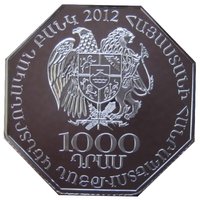
Obverse
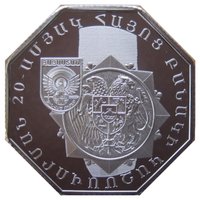
Reverse
Description:
Defense Ministry emblem, left of the "Homeland" medal (for defense, law enforcement, and exceptional service).
Inscription:
20 - ԱՄՅԱԿ ՀԱՅՈՑ ԲԱՆԱԿԻ ԿԱԶՄԱՎՈՐՄԱՆ
Translation:
20 - On the Occasion of the Formation of the All-Armenian Fund
Script: Armenian
Language: Armenian
Engraver: Haroutiun Samuelian
Edge
Reeded
Mints
| Name | Mark |
|---|---|
| Royal Dutch Mint | — |
Mintings
| Year | Mint Mark | Mintage | Quality | Collection |
|---|---|---|---|---|
| 2012 | — | 500 |
Historical background
In 2012, Armenia's currency, the dram (AMD), demonstrated notable stability against major foreign currencies, particularly the US dollar, following a period of significant volatility during the global financial crisis of 2008-2009. The Central Bank of Armenia (CBA) maintained a managed floating exchange rate regime, intervening in the foreign exchange market primarily to smooth excessive fluctuations rather than to target a specific rate. This relative stability was supported by improved macroeconomic indicators, including steady GDP growth and controlled inflation, as well by substantial remittance inflows from the Armenian diaspora, which provided a consistent source of foreign currency.
The economic backdrop was shaped by recovery in key trading partners, notably Russia, which is a crucial destination for Armenian exports and the source of a large share of remittances. However, the economy remained vulnerable to external shocks due to its small, open nature and heavy reliance on imports for many goods. The CBA's monetary policy focused on price stability, with inflation remaining within the target range for most of the year. This environment allowed the dram to trade within a narrow band, fostering predictability for businesses and households.
Nevertheless, underlying challenges persisted. The national economy was still grappling with the aftereffects of the crisis, including a high poverty rate and significant dollarization of the economy, where many savings and large transactions were conducted in US dollars rather than drams. This dollarization limited the effectiveness of the CBA's monetary policy. Furthermore, geopolitical factors, particularly the unresolved Nagorno-Karabakh conflict and the closed borders with Turkey and Azerbaijan, continued to pose long-term risks to investor confidence and economic stability, casting a shadow over the dram's medium-term prospects despite its calm performance in 2012.
The economic backdrop was shaped by recovery in key trading partners, notably Russia, which is a crucial destination for Armenian exports and the source of a large share of remittances. However, the economy remained vulnerable to external shocks due to its small, open nature and heavy reliance on imports for many goods. The CBA's monetary policy focused on price stability, with inflation remaining within the target range for most of the year. This environment allowed the dram to trade within a narrow band, fostering predictability for businesses and households.
Nevertheless, underlying challenges persisted. The national economy was still grappling with the aftereffects of the crisis, including a high poverty rate and significant dollarization of the economy, where many savings and large transactions were conducted in US dollars rather than drams. This dollarization limited the effectiveness of the CBA's monetary policy. Furthermore, geopolitical factors, particularly the unresolved Nagorno-Karabakh conflict and the closed borders with Turkey and Azerbaijan, continued to pose long-term risks to investor confidence and economic stability, casting a shadow over the dram's medium-term prospects despite its calm performance in 2012.

✨ Legendary