

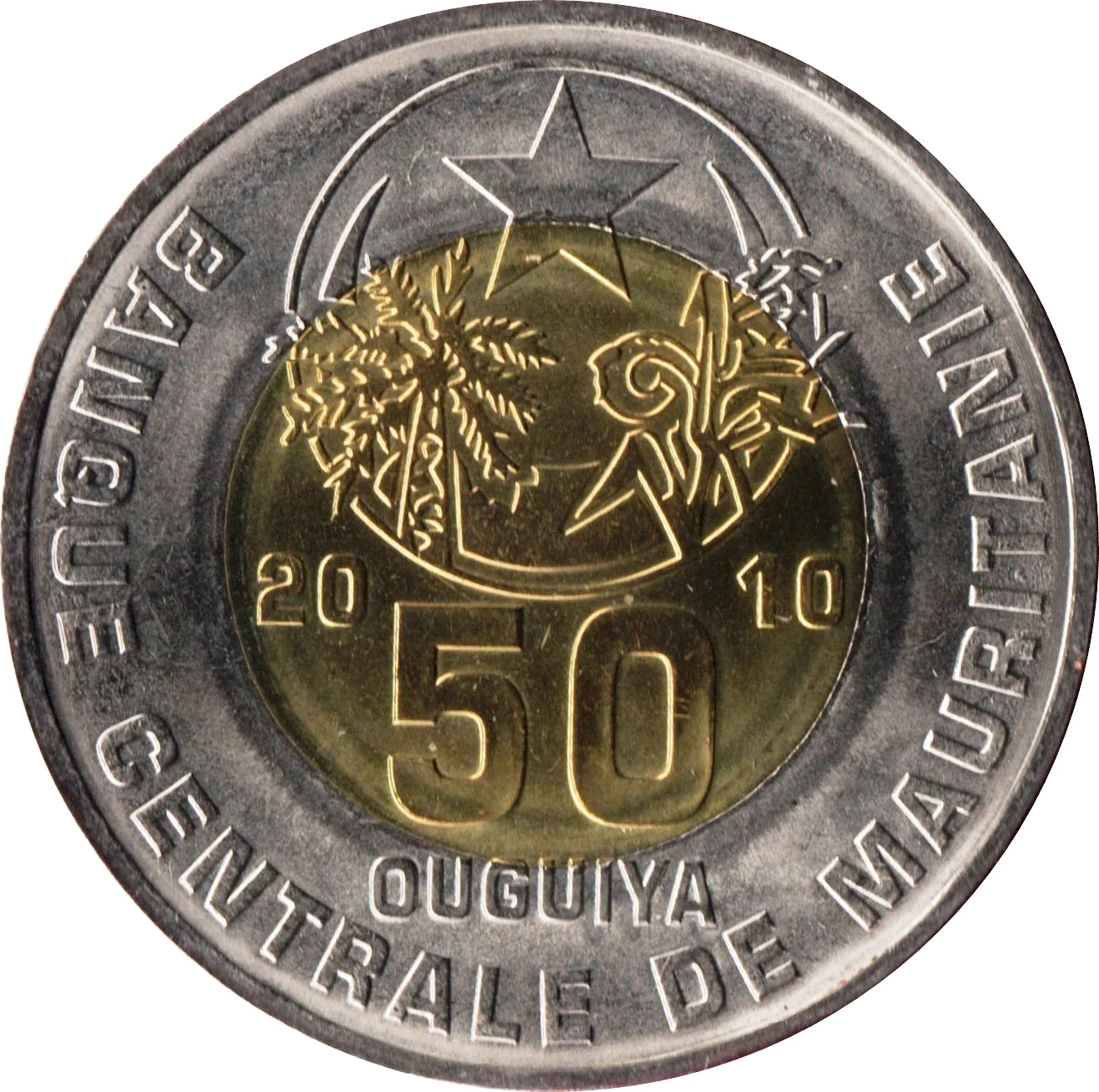
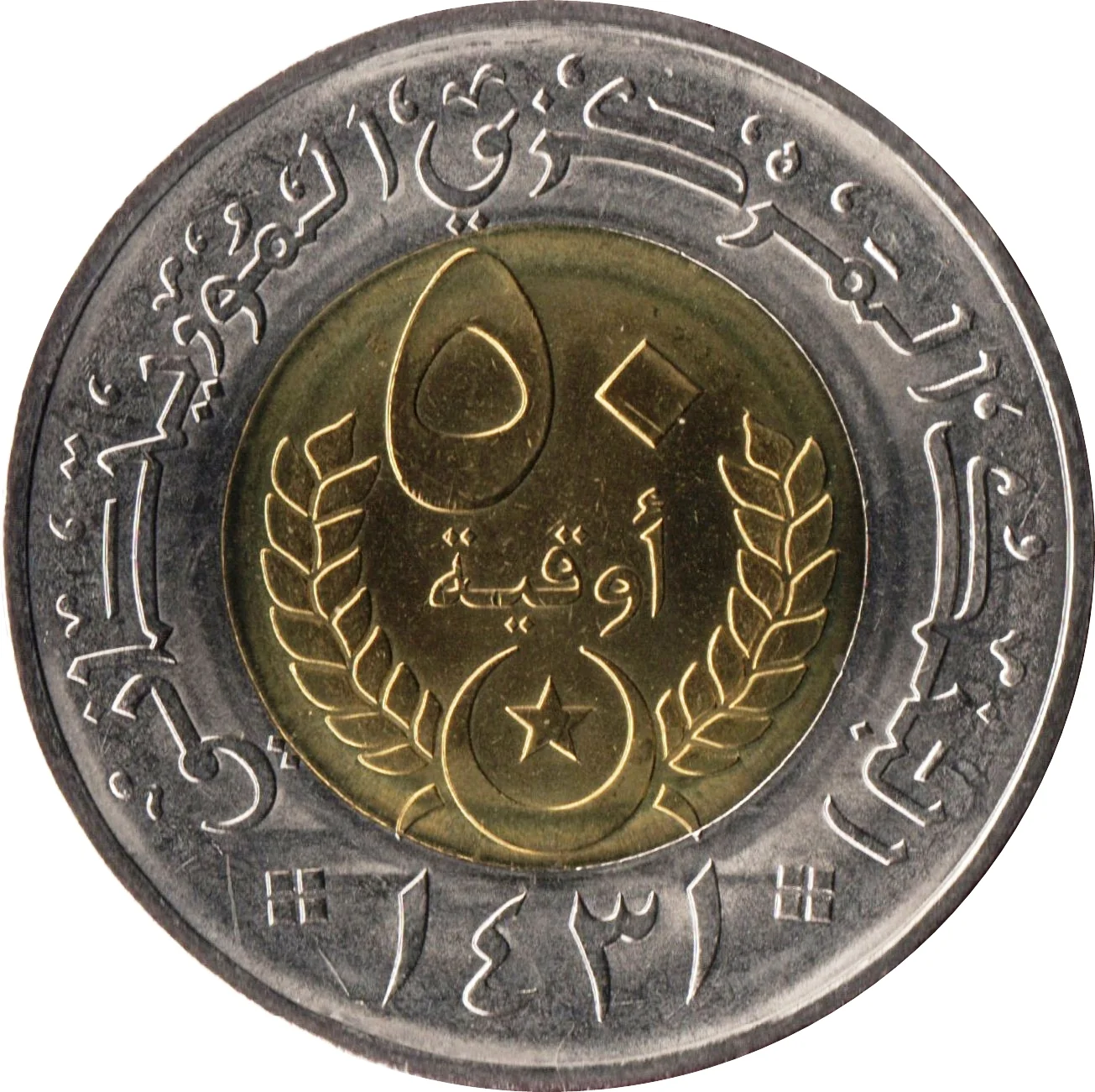
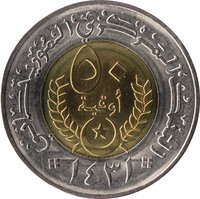
50 Ouguiya – Mauritania
Mauritania
Context
Years: 2010–2014
Issuer: Mauritania 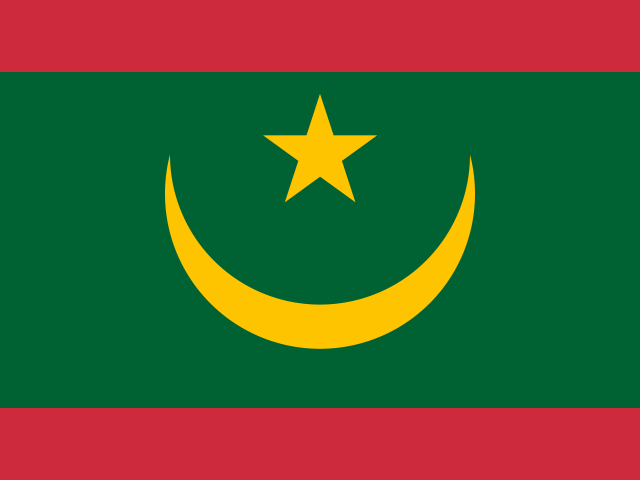
Issuing organization: Central Bank of Mauritania
Period:
(since 1960)
Currency:
(1973—2018)
Demonetization: 30 June 2018
Material
References
KM: #Click to copy to clipboard9
Numista: #17454
Value
Exchange value: 50 MRO
Obverse
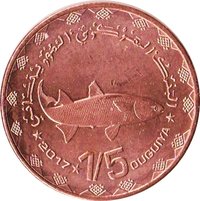
Reverse
Edge
Alternate reeded and plain sections.
Mintings
| Year | Mint Mark | Mintage | Quality | Collection |
|---|---|---|---|---|
| 2010 | — | — | ||
| 2014 | — | — |
Historical background
In 2010, Mauritania's currency situation was characterized by the stability of the Ouguiya (MRO), which was uniquely a non-decimal currency divided into 5 khoums. The country maintained a managed float exchange rate regime, where the Central Bank of Mauritania (BCM) intervened to control volatility while allowing the currency's value to be broadly influenced by market forces. This period followed a significant reform in 2009 when the BCM ceased its direct foreign exchange auctions and moved towards a more liberalized interbank market, aiming to improve efficiency and attract foreign investment. The official exchange rate hovered around 270 MRO to 1 US Dollar, with a modest and controlled depreciation trend.
The macroeconomic context was shaped by strong performance in the extractive sectors, particularly iron ore and the nascent offshore oil industry, which generated crucial foreign currency inflows. However, the economy remained vulnerable to external shocks from volatile global commodity prices. Furthermore, a significant gap often existed between the official exchange rate and the parallel market rate, driven by limited access to foreign currency for importers and restricted convertibility, reflecting underlying structural issues in the economy and limited foreign exchange reserves.
Overall, while the formal currency regime appeared stable in 2010, it masked deeper challenges. The economy's heavy dependence on a few primary commodities, a large informal sector, and persistent trade deficits created underlying pressures. The managed float system aimed to provide stability, but the existence of a parallel market highlighted constraints in liquidity and access to hard currency, pointing to the ongoing struggle to balance monetary stability with the needs of a growing and diversifying economy.
The macroeconomic context was shaped by strong performance in the extractive sectors, particularly iron ore and the nascent offshore oil industry, which generated crucial foreign currency inflows. However, the economy remained vulnerable to external shocks from volatile global commodity prices. Furthermore, a significant gap often existed between the official exchange rate and the parallel market rate, driven by limited access to foreign currency for importers and restricted convertibility, reflecting underlying structural issues in the economy and limited foreign exchange reserves.
Overall, while the formal currency regime appeared stable in 2010, it masked deeper challenges. The economy's heavy dependence on a few primary commodities, a large informal sector, and persistent trade deficits created underlying pressures. The managed float system aimed to provide stability, but the existence of a parallel market highlighted constraints in liquidity and access to hard currency, pointing to the ongoing struggle to balance monetary stability with the needs of a growing and diversifying economy.
🌱 Common