

1 Cash – Empire of Vietnam
Vietnam
Context

Material
Diameter: 25 mm
Weight: 3.75 g
Thickness: 1.1 mm
Shape: Round with a square hole
Composition: Brass
Magnetic: No
Technique: Cast
Alignment: Medal alignment
flip
References
KM: #Click to copy to clipboard182
Numista: #1068
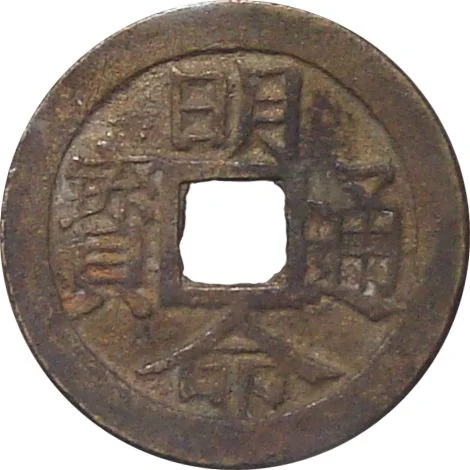
Obverse
Description:
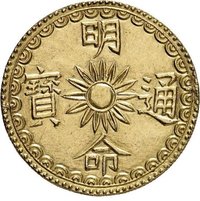
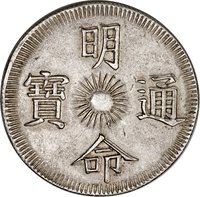
Four Chinese characters read vertically, right to left.
Inscription:
明
寶 通
命
寶 通
命
Translation:
Obey the Mandate of Heaven.
Circulate the Currency.
Circulate the Currency.
Scripts: Chinese (traditional, regular script)
Language: Classical Chinese
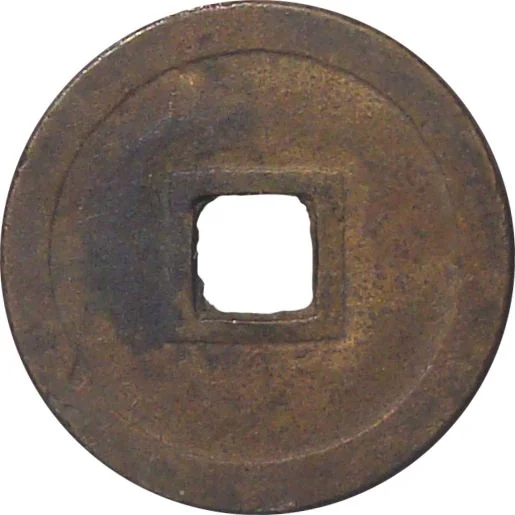
Reverse
Description:
Blank (uniface).
Edge
Plain
Mintings
| Year | Mint Mark | Mintage | Quality | Collection |
|---|---|---|---|---|
| — | — | — |
Historical background
In 1822, the currency situation within the Empire of Vietnam, ruled by Emperor Minh Mạng, was characterized by a deliberate and centralized shift away from foreign coinage. Following the unification of the country under his father, Gia Long, the early Nguyễn Dynasty had tolerated the widespread circulation of various coins, primarily Chinese copper cash and silver Spanish/Mexican dollars (known as piastres or yuan). These foreign coins filled a void but represented a lack of domestic monetary sovereignty. Minh Mạng, a ruler keen on asserting imperial authority and cultural independence, saw this reliance as a weakness and initiated a policy to replace them with a unified, state-issued currency system.
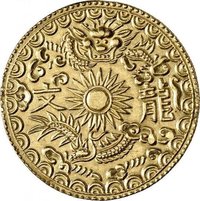
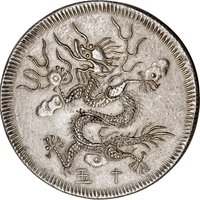
The cornerstone of this reform was the introduction of a new imperial coinage. In 1820, Minh Mạng had already begun minting his own copper cash coins bearing his reign title, and by 1822, this production was well underway. More significantly, he pioneered the minting of standardized silver and gold coins, known as tiền (for silver) and lượng or nén (for gold bullion). These were not mere imitations but distinct Vietnamese coins, often hexagonal or square with a round hole, stamped with the emperor's name and legitimizing phrases. The state aimed to control the value and purity of these metals, establishing official exchange rates between copper, silver, and gold to create a coherent, tri-metallic system.
However, the situation in practice was complex. The government's ability to produce enough high-quality coinage to fully displace the deeply entrenched foreign dollars was limited. Counterfeiting of the new coins was a persistent problem, and the older mixed coinage remained in use, especially in regional and international trade. Thus, 1822 represents a pivotal year within a longer transition: the imperial court was actively imposing a centralized monetary standard to bolster economic control and national prestige, yet the reality in markets across the empire was likely one of coexistence, with old and new coins circulating side-by-side as the reforms gradually took hold.
The cornerstone of this reform was the introduction of a new imperial coinage. In 1820, Minh Mạng had already begun minting his own copper cash coins bearing his reign title, and by 1822, this production was well underway. More significantly, he pioneered the minting of standardized silver and gold coins, known as tiền (for silver) and lượng or nén (for gold bullion). These were not mere imitations but distinct Vietnamese coins, often hexagonal or square with a round hole, stamped with the emperor's name and legitimizing phrases. The state aimed to control the value and purity of these metals, establishing official exchange rates between copper, silver, and gold to create a coherent, tri-metallic system.
However, the situation in practice was complex. The government's ability to produce enough high-quality coinage to fully displace the deeply entrenched foreign dollars was limited. Counterfeiting of the new coins was a persistent problem, and the older mixed coinage remained in use, especially in regional and international trade. Thus, 1822 represents a pivotal year within a longer transition: the imperial court was actively imposing a centralized monetary standard to bolster economic control and national prestige, yet the reality in markets across the empire was likely one of coexistence, with old and new coins circulating side-by-side as the reforms gradually took hold.
🌟 Uncommon