


2 Dollars (ANZAC) – New Zealand
Non-circulating coins
Commemoration: 100 year ANZAC anniversary
New Zealand
Context

Material
Weight: 15.57 g
Silver weight: 15.55 g
Thickness: 2 mm
Shape: Irregular rectangular
Composition: 99.9% Silver
Standard: Silver half ounce
Magnetic: No
Alignment: Medal alignment
flip

References
KM: #Click to copy to clipboard385
Numista: #173915
Value
Exchange value: 2 NZD = $1.20
Bullion value: $44.52
Inflation-adjusted value: 2.41 NZD
Obverse
Description:
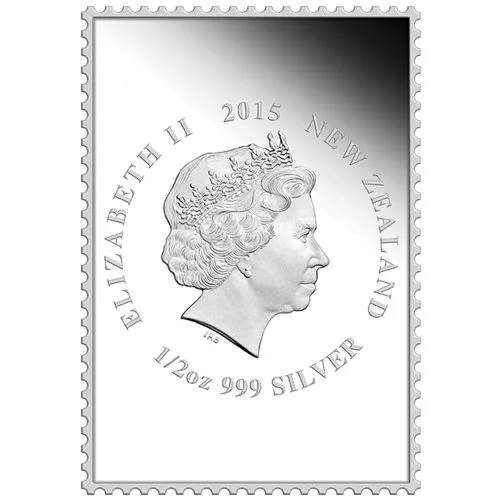
Queen Elizabeth II facing right in tiara, legend around, date below.
Inscription:
ELIZABETH II 2015 NEW ZEALAND
IRB
1/2oz 999 SILVER
IRB
1/2oz 999 SILVER
Script: Latin
Designer: Ian Rank-Broadley
Reverse
Description:
Coloured silhouettes of an Australian and New Zealand soldier at Anzac Cove, with silver fern fronds. Legend and denomination below.
Inscription:
ANZAC
NEW ZEALAND $2
NEW ZEALAND $2
Script: Latin
Edge
Coarse reeding to simulate stamp perforations
Mintings
| Year | Mint Mark | Mintage | Quality | Collection |
|---|---|---|---|---|
| 2015 | — | 2,500 | Proof |
Historical background
In 2015, New Zealand's currency situation was characterised by a significant and sustained depreciation of the New Zealand Dollar (NZD) against its major trading partners, particularly the US Dollar. The NZD/USD exchange rate fell from above 0.78 in July 2014 to a low near 0.62 in September 2015, a decline of over 20%. This sharp drop was driven by a confluence of global and domestic factors, most notably a collapse in dairy prices—New Zealand's key export—which undermined the country's terms of trade and economic outlook. Concurrently, the US Federal Reserve was moving towards tightening monetary policy, strengthening the USD, while the Reserve Bank of New Zealand (RBNZ) had begun a cycle of interest rate cuts in June, reducing the NZD's yield appeal.
The RBNZ played an active role in this environment, implementing four Official Cash Rate (OCR) cuts during the year (from 3.5% to 2.5%) to combat persistently low inflation and to cushion the economic impact of falling export revenues. Governor Graeme Wheeler also explicitly voiced the view that the NZD's decline was necessary and justified, and the bank intervened in foreign exchange markets on several occasions to dampen volatility and discourage speculative positioning. However, the currency's weakness was not uniform; the NZD remained historically high on a Trade-Weighted Index (TWI) basis against the currencies of other trading partners like Australia and Japan, which continued to pressure export competitiveness.
Overall, the 2015 currency backdrop reflected a economy in adjustment. The decline alleviated some pressure on exporters and helped rebalance growth towards the non-dairy sector and tourism, which benefited from a more favourable exchange rate. However, it also raised the cost of imports and contributed to a period of lacklustre headline inflation, complicating the RBNZ's policy decisions. The year concluded with the NZD finding a lower trading range, setting the stage for the economic rebalancing that would continue in the following years.
The RBNZ played an active role in this environment, implementing four Official Cash Rate (OCR) cuts during the year (from 3.5% to 2.5%) to combat persistently low inflation and to cushion the economic impact of falling export revenues. Governor Graeme Wheeler also explicitly voiced the view that the NZD's decline was necessary and justified, and the bank intervened in foreign exchange markets on several occasions to dampen volatility and discourage speculative positioning. However, the currency's weakness was not uniform; the NZD remained historically high on a Trade-Weighted Index (TWI) basis against the currencies of other trading partners like Australia and Japan, which continued to pressure export competitiveness.
Overall, the 2015 currency backdrop reflected a economy in adjustment. The decline alleviated some pressure on exporters and helped rebalance growth towards the non-dairy sector and tourism, which benefited from a more favourable exchange rate. However, it also raised the cost of imports and contributed to a period of lacklustre headline inflation, complicating the RBNZ's policy decisions. The year concluded with the NZD finding a lower trading range, setting the stage for the economic rebalancing that would continue in the following years.


✨ Legendary