

5 Golde – Sierra Leone
Non-circulating coins
Commemoration: World Wide Fund
Sierra Leone
Context
Year: 1987
Issuer: Sierra Leone 
Ruler: Joseph Saidu Momoh
Currency:
(1964—2023)
Demonetization: 1 January 2024
Total mintage: 5,000
Material
References
KM: #Click to copy to clipboard42
Numista: #173278
Value
Exchange value: 5 SLL
Bullion value: $2440.43
Obverse
Description:
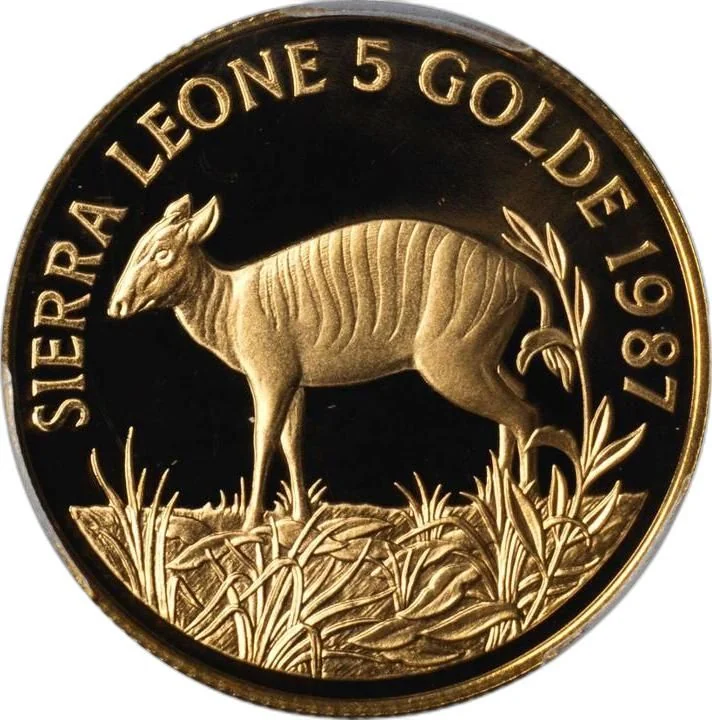
Duiker (Cephalophinae) | SIERRA LEONE | 5 GOLDE | 1987
Inscription:
SIERRA LEONE 5 GOLDE 1987
Script: Latin
Reverse
Description:
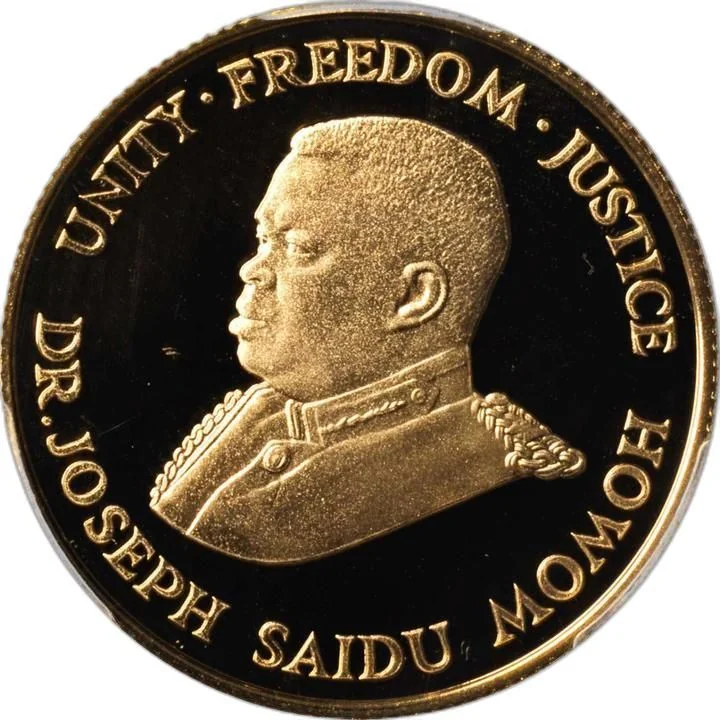
Back: President Joseph Saidu Momoh (1985–1992). Motto: UNITY FREEDOM JUSTICE. Ruler: DR. JOSEPH SAIDU MOMOH.
Inscription:
UNITY · FREEDOM · JUSTICE
DR. JOSEPH SAIDU MOMOH
DR. JOSEPH SAIDU MOMOH
Script: Latin
Edge
Reeded
Categories
| Animal> Deer |
| Person> Politician |
| Organization> WWF |
Mints
| Name | Mark |
|---|---|
| Royal Mint | — |
Mintings
| Year | Mint Mark | Mintage | Quality | Collection |
|---|---|---|---|---|
| 1987 | — | 5,000 | Proof |
Historical background
In 1987, Sierra Leone's currency situation was characterized by severe economic strain under the presidency of Joseph Saidu Momoh. The country was grappling with the long-term consequences of economic mismanagement, a heavy reliance on a declining diamond and mineral export sector, and widespread corruption. The national currency, the Leone, was subject to a complex and unsustainable multi-tier exchange rate system set by the Bank of Sierra Leone. An overvalued official rate existed alongside a vastly different and booming black market rate, creating major distortions, discouraging legitimate exports, and fostering a culture of arbitrage and rent-seeking.
This dysfunctional foreign exchange regime was a symptom of deeper fiscal woes. The government ran persistent large budget deficits, which it financed primarily through borrowing from the central bank—a process that fueled rampant money supply growth and inflation. While precise figures are elusive, inflation was estimated to be high, eroding purchasing power and living standards. The overvalued official currency also made imports artificially cheap, draining scarce foreign reserves, while simultaneously making Sierra Leone's exports uncompetitive on the global market, further exacerbating the foreign exchange shortage.
The situation in 1987 represented the culmination of years of economic decline and set the stage for even more severe crises. Attempts at reform, including discussions with the International Monetary Fund (IMF), were hesitant and inconsistent, as the government resisted the austerity measures typically required for stabilization. Consequently, the structural imbalances remained unaddressed, leaving the Leone vulnerable and the economy fragile. This precarious financial environment contributed to the social and political instability that would eventually lead to the devastating civil war just a few years later.
This dysfunctional foreign exchange regime was a symptom of deeper fiscal woes. The government ran persistent large budget deficits, which it financed primarily through borrowing from the central bank—a process that fueled rampant money supply growth and inflation. While precise figures are elusive, inflation was estimated to be high, eroding purchasing power and living standards. The overvalued official currency also made imports artificially cheap, draining scarce foreign reserves, while simultaneously making Sierra Leone's exports uncompetitive on the global market, further exacerbating the foreign exchange shortage.
The situation in 1987 represented the culmination of years of economic decline and set the stage for even more severe crises. Attempts at reform, including discussions with the International Monetary Fund (IMF), were hesitant and inconsistent, as the government resisted the austerity measures typically required for stabilization. Consequently, the structural imbalances remained unaddressed, leaving the Leone vulnerable and the economy fragile. This precarious financial environment contributed to the social and political instability that would eventually lead to the devastating civil war just a few years later.
✨ Legendary