


5 Pounds (Prince Philip) – United Kingdom
Non-circulating coins
Commemoration: 90th anniversary of the birth of Prince Philip
United Kingdom
Context

Material
Diameter: 38.61 mm
Weight: 28.28 g
Thickness: 2.89 mm
Shape: Round
Composition: Copper-nickel
Technique: Milled
Alignment: Medal alignment
flip

References
KM: #Click to copy to clipboard1201
Numista: #17304
Value
Exchange value: 5 GBP = $6.77
Inflation-adjusted value: 8.19 GBP
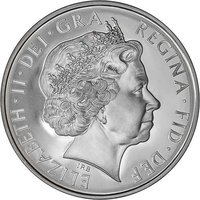
Obverse
Description:
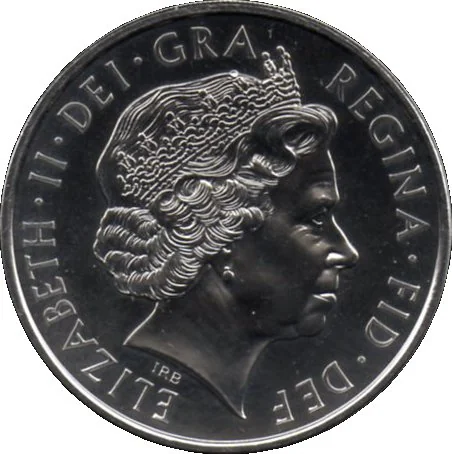
Queen Elizabeth IV facing right, wearing the Girls of Great Britain and Ireland tiara.
Inscription:
ELIZABETH·II·DEI·GRA REGINA·FID·DEF·
IRB
IRB
Translation:
Elizabeth II by the Grace of God Queen Defender of the Faith
Script: Latin
Language: Latin
Engraver: Ian Rank-Broadley
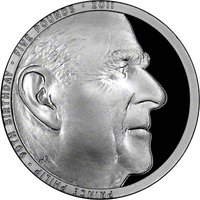
Reverse
Description:
Prince Philip portrait, right-facing, encircled by legend.
Inscription:
PRINCE PHILIP · 90TH BIRTHDAY · FIVE POUNDS · 2011
MR
MR
Script: Latin
Engraver: Mark Richards
Edge
Reeded
Categories
| Event> Birth anniversary |
Mints
| Name | Mark |
|---|---|
| Royal Mint | — |
Mintings
| Year | Mint Mark | Mintage | Quality | Collection |
|---|---|---|---|---|
| 2011 | — | 18,730 | BU | |
| 2011 | — | 28,974 | Proof |
Historical background
In 2011, the United Kingdom’s currency situation was dominated by the enduring fallout from the 2008-09 global financial crisis and the specific challenges of the Eurozone sovereign debt crisis. The pound sterling (GBP), while having recovered from its sharp depreciation in 2008-09, remained under pressure due to a weak domestic economic outlook. The Conservative-Liberal Democrat coalition government had embarked on a major programme of fiscal austerity to reduce the budget deficit, which subdued growth and kept the Bank of England’s main interest rate at a historic low of 0.5%. This environment of low yields and economic uncertainty limited sterling’s strength, keeping it range-bound against a basket of major currencies.
A key dynamic was sterling’s performance against the euro (EUR). For much of the year, the pound benefited from its status as a non-euro currency as investors grew increasingly concerned about the solvency of several Eurozone nations, notably Greece, Ireland, and Portugal. This "safe-haven" effect saw GBP/EUR rise towards the €1.15 level in the summer. However, this strength was not sustained uniformly, as UK economic data frequently disappointed and domestic inflation, driven by higher VAT and commodity prices, remained stubbornly high—eroding real incomes and further clouding the growth picture.
Ultimately, 2011 was a year of defensive stability for sterling rather than robust strength. The Bank of England maintained its ultra-loose monetary policy, even expanding its quantitative easing programme in October to £275 billion in response to deteriorating global conditions. While the currency avoided the dramatic swings of 2008-09, it reflected an economy caught between high inflation, stagnant growth, and external threats from the Eurozone. This left the UK navigating a precarious balance, with a cheap pound supporting exports but also exacerbating imported inflationary pressures, defining a complex and challenging monetary landscape.
A key dynamic was sterling’s performance against the euro (EUR). For much of the year, the pound benefited from its status as a non-euro currency as investors grew increasingly concerned about the solvency of several Eurozone nations, notably Greece, Ireland, and Portugal. This "safe-haven" effect saw GBP/EUR rise towards the €1.15 level in the summer. However, this strength was not sustained uniformly, as UK economic data frequently disappointed and domestic inflation, driven by higher VAT and commodity prices, remained stubbornly high—eroding real incomes and further clouding the growth picture.
Ultimately, 2011 was a year of defensive stability for sterling rather than robust strength. The Bank of England maintained its ultra-loose monetary policy, even expanding its quantitative easing programme in October to £275 billion in response to deteriorating global conditions. While the currency avoided the dramatic swings of 2008-09, it reflected an economy caught between high inflation, stagnant growth, and external threats from the Eurozone. This left the UK navigating a precarious balance, with a cheap pound supporting exports but also exacerbating imported inflationary pressures, defining a complex and challenging monetary landscape.
🌟 Limited