

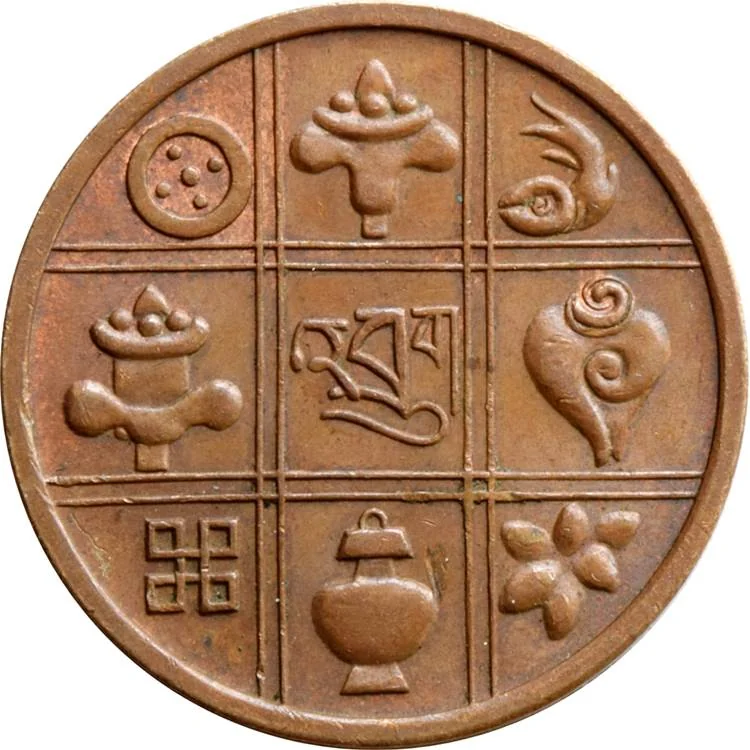
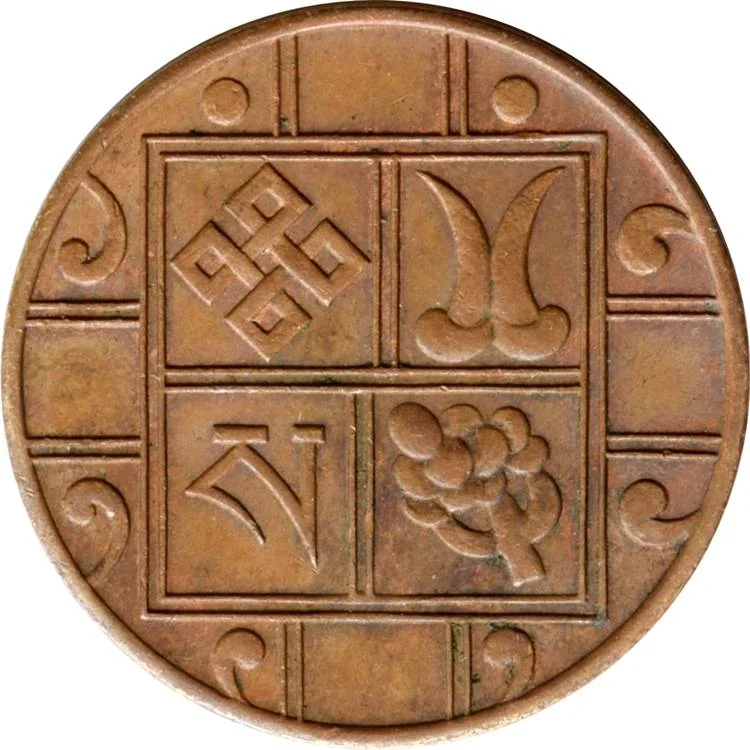
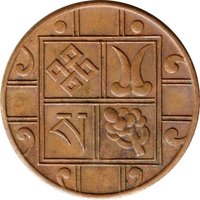
Obverse
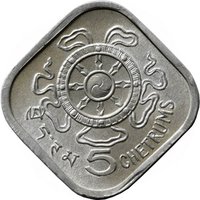
Reverse
Description:
Central square with Buddha, symbols, and the earth letter "sa."
Edge
Plain
Mints
| Name | Mark |
|---|---|
| Kolkata / Calcutta / Murshidabad | — |
Mintings
| Year | Mint Mark | Mintage | Quality | Collection |
|---|---|---|---|---|
| 1951 | — | — | ||
| 1954 | — | 1,260,000 |
Historical background
In 1951, Bhutan's currency situation reflected its historical isolation and economic structure. The country operated without a formal, unified national currency. The primary mediums of exchange were the Indian rupee, which circulated widely due to Bhutan's close economic ties with British India (and later independent India), and in-kind payments through barter, especially in rural areas. Additionally, the government issued its own silver coins, known as chetrum and tikchung, but these were limited in quantity and not sufficient to serve as a comprehensive monetary system for the entire kingdom.
This monetary landscape was a direct consequence of Bhutan's deliberate policy of isolation and its traditional agrarian economy. External trade was minimal and tightly controlled, mostly conducted through a few border towns with India. Internally, many taxes and obligations were settled through payments in kind, such as agricultural produce, butter, or textiles. The use of Indian rupees was most prevalent in government transactions and among the small merchant class, creating a de facto dual-currency environment that was informal and regionally inconsistent.
The year 1951 is significant as it marked the beginning of a transformative period under the Third King, Jigme Dorji Wangchuck, who initiated a series of modernization reforms. While a central bank (the Bank of Bhutan) and a decimalized national currency (the Ngultrum, pegged 1:1 to the Indian rupee) would not be established until 1968, the economic planning that began in the early 1950s laid the essential groundwork. Therefore, the currency situation in 1951 represents the final chapter of a traditional system, poised on the brink of integration into the modern monetary world.
This monetary landscape was a direct consequence of Bhutan's deliberate policy of isolation and its traditional agrarian economy. External trade was minimal and tightly controlled, mostly conducted through a few border towns with India. Internally, many taxes and obligations were settled through payments in kind, such as agricultural produce, butter, or textiles. The use of Indian rupees was most prevalent in government transactions and among the small merchant class, creating a de facto dual-currency environment that was informal and regionally inconsistent.
The year 1951 is significant as it marked the beginning of a transformative period under the Third King, Jigme Dorji Wangchuck, who initiated a series of modernization reforms. While a central bank (the Bank of Bhutan) and a decimalized national currency (the Ngultrum, pegged 1:1 to the Indian rupee) would not be established until 1968, the economic planning that began in the early 1950s laid the essential groundwork. Therefore, the currency situation in 1951 represents the final chapter of a traditional system, poised on the brink of integration into the modern monetary world.
🌱 Common