

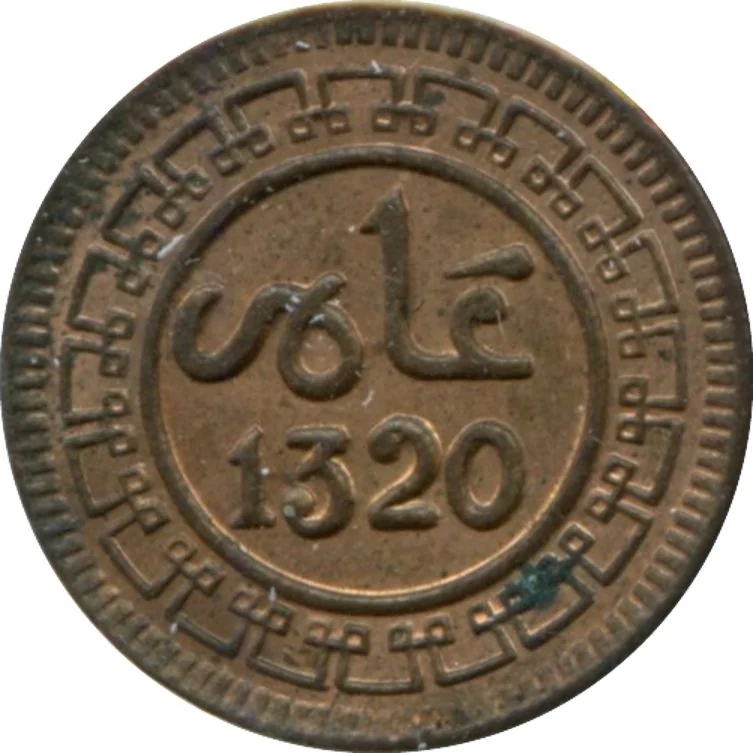
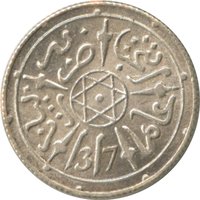
Obverse
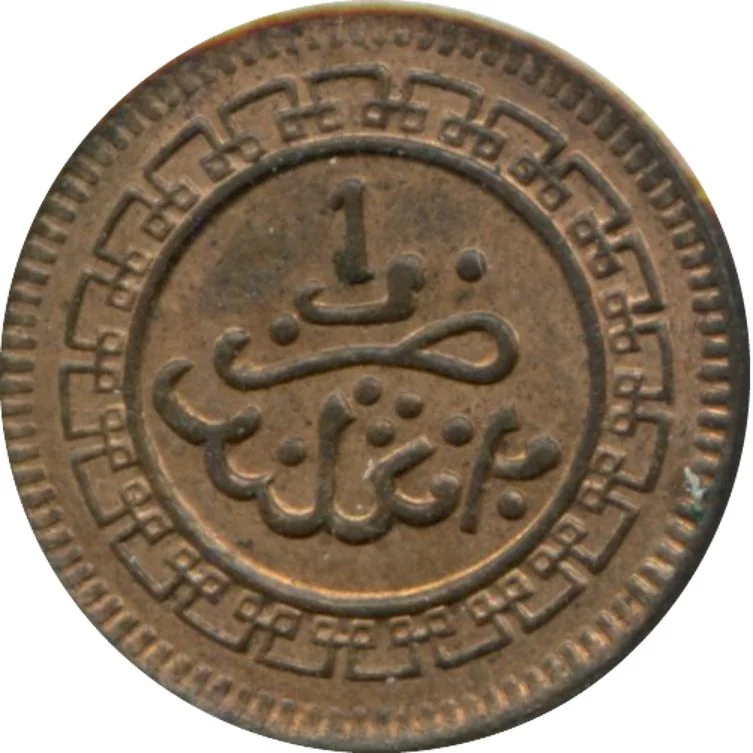
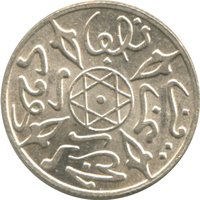
Reverse
Edge
Plain
Mints
| Name | Mark |
|---|---|
| Heaton and Sons / The Mint Birmingham | — |
Mintings
| Year | Mint Mark | Mintage | Quality | Collection |
|---|---|---|---|---|
| 1902 | — | 3,000,000 | ||
| 1903 | — | 900,000 |
Historical background
In 1902, Morocco's currency situation was a complex reflection of its political and economic fragility. The country, still an independent sultanate but under intense European pressure, lacked a unified modern monetary system. Circulation was dominated by a chaotic mix of coins: the silver dirham and rial (worth approximately 5 Spanish pesetas) issued by the Sultan's government, alongside a flood of foreign silver coins, particularly Spanish pesetas, French francs, and British sterling. This multiplicity created confusion in trade and facilitated exploitation, as exchange rates fluctuated wildly between regions and merchants.
The core of the monetary crisis was a severe and chronic shortage of small change, which crippled everyday transactions and local markets. The government's minting was irregular and insufficient, leading to the widespread practice of cutting whole silver coins into halves and quarters to create smaller denominations. These fragmented pieces, known as "black money" due to their tarnished appearance, were often accepted by weight rather than face value, further undermining trust in the currency. This scarcity stifled internal commerce and caused significant hardship for the common population.
This unstable financial environment was both a symptom and a cause of Morocco's declining sovereignty. European powers, especially France and Spain, viewed monetary reform as a key step toward greater control, arguing that a stable currency was necessary for the loans the Sultan desperately needed. By 1902, plans backed by French capital to establish a state bank and introduce a new, standardized currency were being formulated, setting the stage for the major financial reforms that would soon be imposed as part of the prelude to the establishment of the French and Spanish protectorates in 1912.
The core of the monetary crisis was a severe and chronic shortage of small change, which crippled everyday transactions and local markets. The government's minting was irregular and insufficient, leading to the widespread practice of cutting whole silver coins into halves and quarters to create smaller denominations. These fragmented pieces, known as "black money" due to their tarnished appearance, were often accepted by weight rather than face value, further undermining trust in the currency. This scarcity stifled internal commerce and caused significant hardship for the common population.
This unstable financial environment was both a symptom and a cause of Morocco's declining sovereignty. European powers, especially France and Spain, viewed monetary reform as a key step toward greater control, arguing that a stable currency was necessary for the loans the Sultan desperately needed. By 1902, plans backed by French capital to establish a state bank and introduce a new, standardized currency were being formulated, setting the stage for the major financial reforms that would soon be imposed as part of the prelude to the establishment of the French and Spanish protectorates in 1912.
🌟 Uncommon