

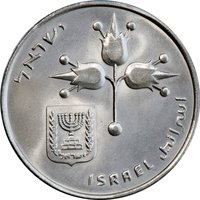
Obverse
Description:
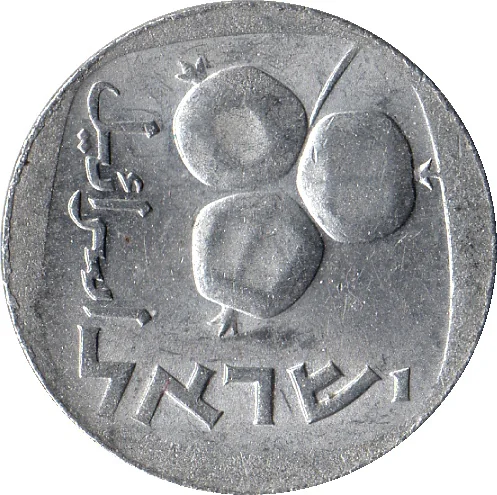
Three ripe pomegranates.
Inscription:
ישראל اسرائيل
Translation:
Israel Israel
Engravers: Gerd Rothschild, Zeev Lipman
Reverse
Description:
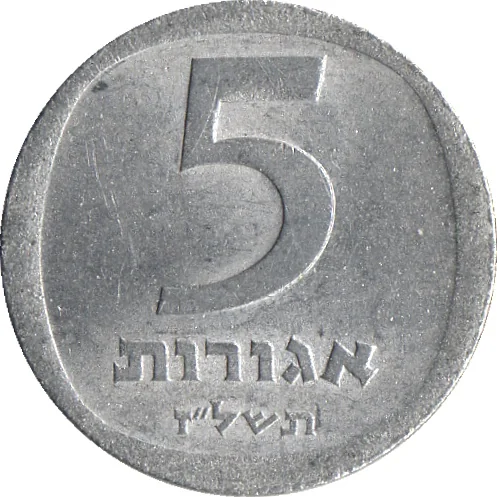
Value by year.
Inscription:
5
אגורות
תשל"ז
אגורות
תשל"ז
Translation:
5
Agorot
5737
Agorot
5737
Script: Hebrew
Language: Hebrew
Engravers: Gabriel Shamir, Maxim Shamir
Edge
Plain
Mints
| Name | Mark |
|---|---|
| Jerusalem | — |
| Royal Canadian Mint of Winnipeg | — |
Mintings
| Year | Mint Mark | Mintage | Quality | Collection |
|---|---|---|---|---|
| 1975 | — | — | ||
| 1976 | — | 13,156,000 | ||
| 1977 | — | 15,000,010 | Proof | |
| 1977 | — | 16,800,000 | Matte | |
| 1977 | — | 15,000,010 | Prooflike | |
| 1978 | — | 38,716,000 | Proof | |
| 1978 | — | 38,716,000 | Prooflike | |
| 1978 | — | 21,480,000 | Matte | |
| 1979 | — | 58,433 |
Historical background
By 1975, Israel's currency situation was one of severe crisis and hyperinflation, marking a pivotal moment in the nation's economic history. The roots of the crisis lay in the aftermath of the 1973 Yom Kippur War, which triggered massive defense spending, a sharp drop in productivity, and a growing government budget deficit financed by printing money. This, combined with a system of indexation that linked wages, prices, and savings to the cost-of-living index, created a self-perpetuating inflationary spiral. The Israeli lira (later the shekel) was in a state of rapid devaluation, losing public confidence and eroding savings, while the government maintained an overvalued official exchange rate that fueled a booming black market for foreign currency.
The economic policies of the time, often described as "muddling through," were ineffective at stemming the tide. The government, led by Prime Minister Yitzhak Rabin and Finance Minister Yehoshua Rabinowitz, was politically constrained from making the necessary deep cuts to public spending or breaking the indexation mechanism for fear of social unrest. Attempts at stabilization, including a devaluation and a temporary freeze on certain prices in November 1974, provided only brief respite. By 1975, inflation was accelerating toward an annual rate that would exceed 40%, and the economy was plagued by large trade deficits, dwindling foreign reserves, and a heavy reliance on U.S. aid to avoid a balance of payments collapse.
This turbulent currency situation set the stage for the dramatic economic reforms that would follow later in the decade. The crisis of 1975 made it clear that the existing model of a highly centralized, socialist-oriented economy was unsustainable. It built the political and intellectual momentum for the 1977 "Mahapach" (upheaval) election and, ultimately, the comprehensive 1985 Economic Stabilization Plan. That plan, implemented under a national unity government, would finally slash hyperinflation through sharp budget cuts, a wage and price freeze, and a decisive shift toward market-oriented policies, fundamentally restructuring Israel's relationship with its currency and its economy.
The economic policies of the time, often described as "muddling through," were ineffective at stemming the tide. The government, led by Prime Minister Yitzhak Rabin and Finance Minister Yehoshua Rabinowitz, was politically constrained from making the necessary deep cuts to public spending or breaking the indexation mechanism for fear of social unrest. Attempts at stabilization, including a devaluation and a temporary freeze on certain prices in November 1974, provided only brief respite. By 1975, inflation was accelerating toward an annual rate that would exceed 40%, and the economy was plagued by large trade deficits, dwindling foreign reserves, and a heavy reliance on U.S. aid to avoid a balance of payments collapse.
This turbulent currency situation set the stage for the dramatic economic reforms that would follow later in the decade. The crisis of 1975 made it clear that the existing model of a highly centralized, socialist-oriented economy was unsustainable. It built the political and intellectual momentum for the 1977 "Mahapach" (upheaval) election and, ultimately, the comprehensive 1985 Economic Stabilization Plan. That plan, implemented under a national unity government, would finally slash hyperinflation through sharp budget cuts, a wage and price freeze, and a decisive shift toward market-oriented policies, fundamentally restructuring Israel's relationship with its currency and its economy.
🌱 Very Common