

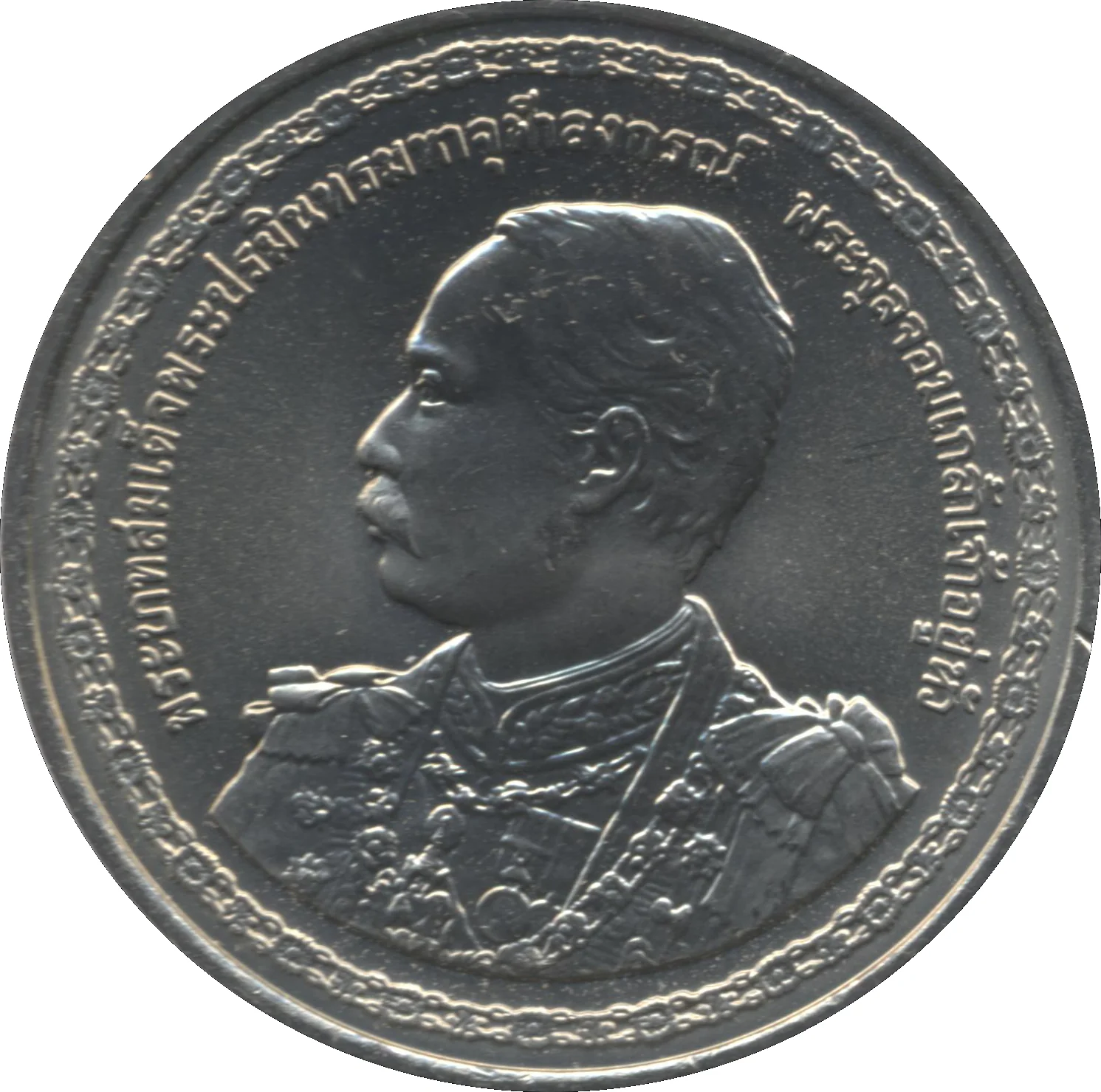
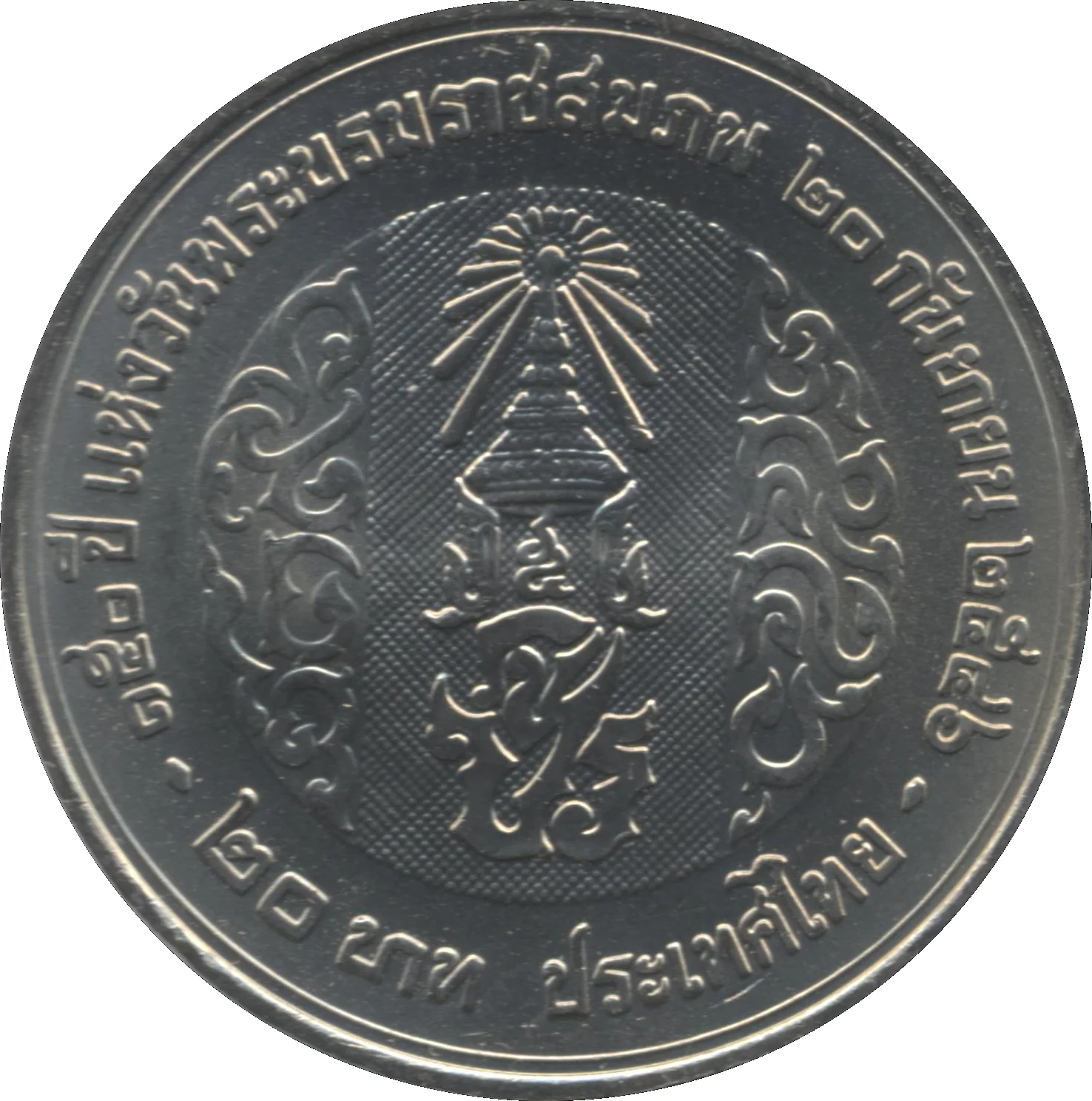
20 Bahts (Rama V) – Thailand
Non-circulating coins
Commemoration: 150th Birthday of Rama V
Thailand
Context
Year: 2003
Thai Year: 2546
Issuer: Thailand 
Ruler: Bhumibol Adulyadej
Currency:
(since 1897)
Total mintage: 3,026,000
Material
Diameter: 32 mm
Weight: 15 g
Shape: Round
Composition: Copper-nickel (75% Copper)
Technique: Milled
Alignment: Medal alignment
flip
References
Y: #Click to copy to clipboard420
Numista: #17210
Value
Exchange value: 20 THB = $0.64
Obverse
Reverse
Description:
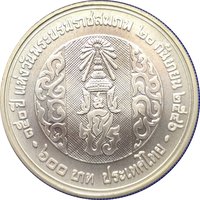
King Chulalongkorn's cypher under the Great Crown of Victory, with a Thai "5" between them. Flanking the cypher are the artist-designed Thai numerals "2396" (left) and "2546" (right).
Inscription:
๑๕๐ ปี แห่งวันพระบรมราชสมภพ ๒๐ กันยายน ๒๕๔๖
๒๐ บาท ประเทศไทย
๒๐ บาท ประเทศไทย
Translation:
150th Anniversary of the Royal Birth Day 20 September 2003
20 Baht Thailand
20 Baht Thailand
Script: Thai
Language: Thai
Edge
Reeded.
Mintings
| Year | Mint Mark | Mintage | Quality | Collection |
|---|---|---|---|---|
| 2003 | — | 3,000,000 | ||
| 2003 | — | 26,000 | Proof |
Historical background
In 2003, Thailand's currency situation was characterized by a period of managed stability for the Thai baht (THB) under a "managed float" regime, a system maintained by the Bank of Thailand (BOT) since the aftermath of the 1997 Asian Financial Crisis. The baht was no longer pegged, but the central bank actively intervened in the foreign exchange market to prevent excessive volatility and sharp appreciations that could hurt the country's crucial export sector. This period followed a significant devaluation and economic restructuring, and by 2003, the baht had stabilized, trading in a relatively predictable range, which helped foster renewed investor confidence and economic recovery.
The primary external pressure on the baht in 2003 was substantial capital inflow, driven by global investor interest in emerging markets and Thailand's strengthening economic fundamentals. These inflows, combined with a large current account surplus, created persistent appreciation pressure on the currency. The BOT's interventions, which involved buying US dollars to curb the baht's rise, led to a significant accumulation of foreign reserves, which grew to over $40 billion by year's end. This policy aimed to maintain export competitiveness, as Thailand's economy was heavily reliant on exports of electronics, automobiles, and agricultural products.
However, this strategy was not without its challenges and criticisms. The sterilization efforts required to manage the money supply from these interventions placed a fiscal cost on the BOT. Furthermore, the accumulation of US dollars exposed the country to potential valuation losses. The situation in 3 set the stage for future tensions, as the persistent inflows and managed exchange rate would later contribute to the imposition of controversial capital controls in 2006. Overall, 2003 represented a year of cautious stability management, where authorities balanced post-crisis recovery with the new challenges of reintegration into global capital flows.
The primary external pressure on the baht in 2003 was substantial capital inflow, driven by global investor interest in emerging markets and Thailand's strengthening economic fundamentals. These inflows, combined with a large current account surplus, created persistent appreciation pressure on the currency. The BOT's interventions, which involved buying US dollars to curb the baht's rise, led to a significant accumulation of foreign reserves, which grew to over $40 billion by year's end. This policy aimed to maintain export competitiveness, as Thailand's economy was heavily reliant on exports of electronics, automobiles, and agricultural products.
However, this strategy was not without its challenges and criticisms. The sterilization efforts required to manage the money supply from these interventions placed a fiscal cost on the BOT. Furthermore, the accumulation of US dollars exposed the country to potential valuation losses. The situation in 3 set the stage for future tensions, as the persistent inflows and managed exchange rate would later contribute to the imposition of controversial capital controls in 2006. Overall, 2003 represented a year of cautious stability management, where authorities balanced post-crisis recovery with the new challenges of reintegration into global capital flows.
🌟 Limited