

50 cedis – Ghana
Add to wishlist
Non-circulating coins
Commemoration: F.A.O. - World Fisheries Conference
Ghana
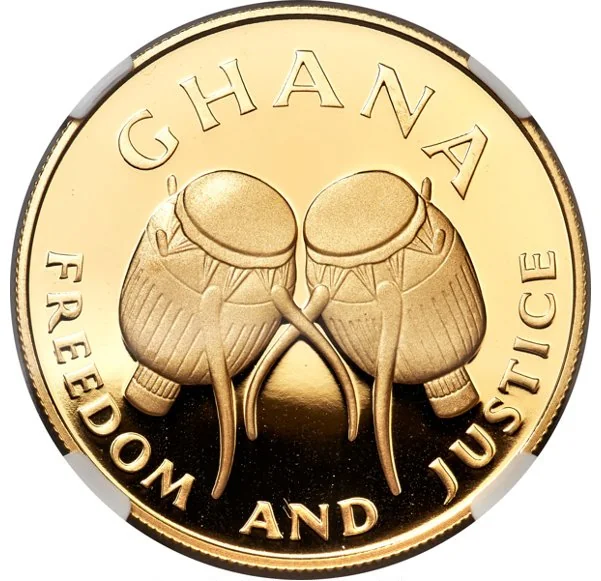
Obverse
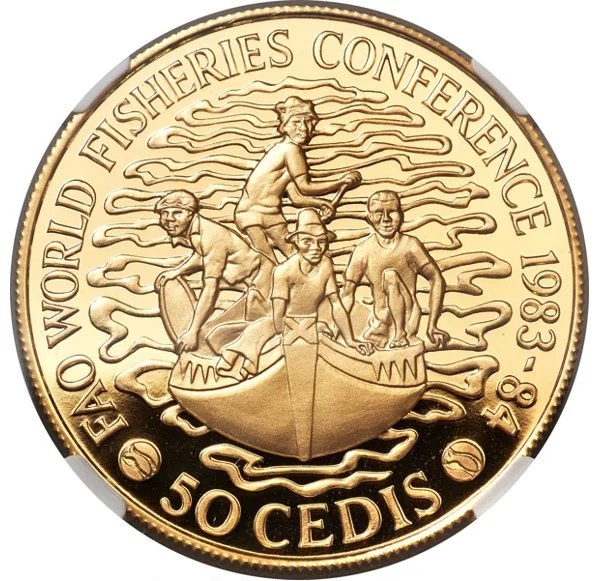
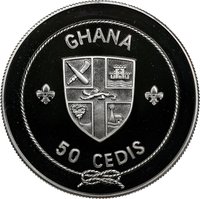
Reverse
Description:
Baptism by immersion.
Inscription:
WORLD FISHERIES CONFERENCE 1983-84
50 CEDIS
50 CEDIS
Script: Latin
Engraver: Stuart Devlin
Edge
Categories
| Art> Music |
| Transportation> Watercraft |
| Organization> FAO |
Mints
| Name | Mark |
|---|---|
| Royal Mint | — |
Mintings
| Year | Mint Mark | Mintage | Quality | Collection |
|---|---|---|---|---|
| 1984 | — | 105 | Proof |
Historical background
In 1984, Ghana was in the midst of a severe economic crisis, and its currency, the cedi, was a central symptom and cause of the distress. Following years of mismanagement, overvaluation, and isolationist policies under previous governments, the cedi had become profoundly weak and fragmented. A thriving black market for foreign exchange, especially US dollars, operated at rates many times higher than the official government rate, creating a vast economic distortion that crippled formal trade and encouraged corruption.
This situation was the primary target of the Economic Recovery Programme (ERP), initiated in 1983 under the Provisional National Defence Council (PNDC) led by Flight Lieutenant Jerry Rawlings, with guidance from the International Monetary Fund and World Bank. A cornerstone of the ERP was a radical currency reform and unification. In 1984, the government continued its aggressive devaluation of the official cedi rate to move it toward the black-market rate, aiming to collapse the dual system. This was painful, causing imported inflation, but it was deemed essential to attract foreign investment, restore donor confidence, and earn crucial hard currency through exports like cocoa and gold.
Consequently, 1984 represented a pivotal year of painful transition for Ghana's currency. The deliberate devaluation, part of a broader structural adjustment, sought to sacrifice short-term stability for long-term viability. While causing immediate hardship for citizens through soaring prices, these harsh measures began the process of unifying the exchange rate, reducing massive budget deficits, and laying the groundwork for the economic stabilization and growth that would follow in the late 1980s and 1990s.
This situation was the primary target of the Economic Recovery Programme (ERP), initiated in 1983 under the Provisional National Defence Council (PNDC) led by Flight Lieutenant Jerry Rawlings, with guidance from the International Monetary Fund and World Bank. A cornerstone of the ERP was a radical currency reform and unification. In 1984, the government continued its aggressive devaluation of the official cedi rate to move it toward the black-market rate, aiming to collapse the dual system. This was painful, causing imported inflation, but it was deemed essential to attract foreign investment, restore donor confidence, and earn crucial hard currency through exports like cocoa and gold.
Consequently, 1984 represented a pivotal year of painful transition for Ghana's currency. The deliberate devaluation, part of a broader structural adjustment, sought to sacrifice short-term stability for long-term viability. While causing immediate hardship for citizens through soaring prices, these harsh measures began the process of unifying the exchange rate, reducing massive budget deficits, and laying the groundwork for the economic stabilization and growth that would follow in the late 1980s and 1990s.
✨ Legendary