

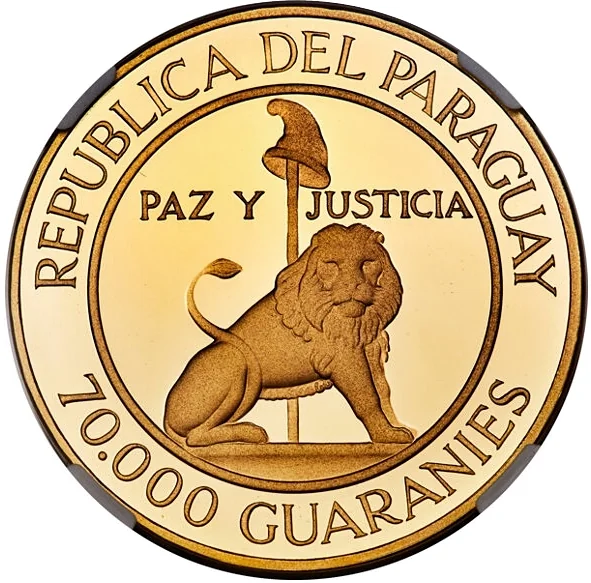
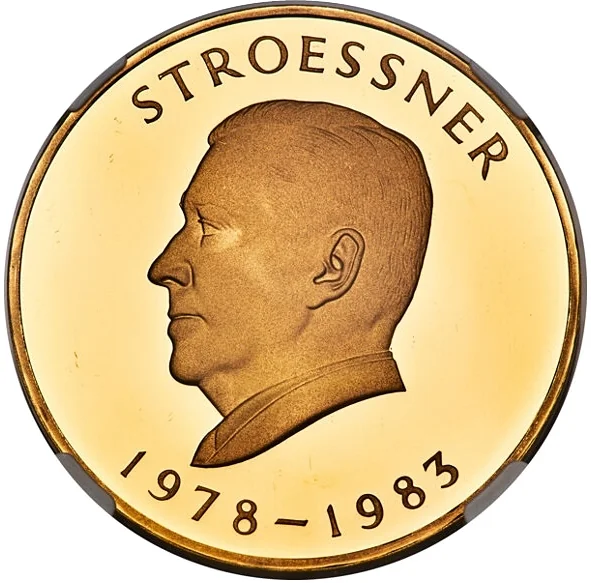
70000 Guaraníes – Paraguay
Non-circulating coins
Commemoration: 6th Term of President Stroessner
Paraguay
Context
Year: 1978
Issuer: Paraguay 
Issuing organization: Central Bank of Paraguay
Period:
(since 1811)
Currency:
(since 1944)
Total mintage: 300
Material
References
KM: #Click to copy to clipboard168
Numista: #171224
Value
Exchange value: 70000 PYG
Bullion value: $6892.26
Obverse
Reverse
Edge
Lettered
Categories
| Animal> Feline |
| Person> Military leader |
| Person> Politician |
| Symbols> Coat of Arms |
| Symbol> Phrygian cap |
Mints
| Name | Mark |
|---|---|
| Royal Mint | — |
Mintings
| Year | Mint Mark | Mintage | Quality | Collection |
|---|---|---|---|---|
| 1978 | — | 300 | Proof |
Historical background
In 1978, Paraguay operated under the authoritarian regime of General Alfredo Stroessner, who had been in power since 1954. The country's currency, the guaraní, was subject to a strict system of multiple exchange rates controlled by the central bank. This system was a hallmark of the import-substitution industrialization model and served to protect specific sectors, subsidize essential imports (like fuel and wheat), and generate revenue for the state and its clientelist network. The official rate was artificially overvalued, creating a significant disparity with the black-market rate, which reflected the currency's true, weaker value due to underlying economic pressures.
The economy was heavily dependent on agricultural exports, particularly soybeans and cotton, but faced external headwinds including volatile commodity prices and the aftermath of the 1973 oil shock. While the late 1970s saw a period of relative macroeconomic stability compared to regional neighbors—with moderate inflation and GDP growth fueled by major infrastructure projects like the Itaipú Dam—the exchange rate regime created chronic distortions. It encouraged capital flight, fostered corruption through the discretionary allocation of favorable rates, and created a complex bureaucracy that stifled genuine competition and foreign investment.
Ultimately, the currency controls of 1978 were less a tool of sound monetary policy and more an instrument of political control and patronage. The system allowed the Stroessner regime to reward loyal business elites with cheap dollars for imports while insulating the general population from some inflationary costs in the short term. However, it masked deeper structural weaknesses, including a narrow export base and a heavily regulated economy, setting the stage for the economic difficulties and necessary liberalization reforms that would follow in the next decade.
The economy was heavily dependent on agricultural exports, particularly soybeans and cotton, but faced external headwinds including volatile commodity prices and the aftermath of the 1973 oil shock. While the late 1970s saw a period of relative macroeconomic stability compared to regional neighbors—with moderate inflation and GDP growth fueled by major infrastructure projects like the Itaipú Dam—the exchange rate regime created chronic distortions. It encouraged capital flight, fostered corruption through the discretionary allocation of favorable rates, and created a complex bureaucracy that stifled genuine competition and foreign investment.
Ultimately, the currency controls of 1978 were less a tool of sound monetary policy and more an instrument of political control and patronage. The system allowed the Stroessner regime to reward loyal business elites with cheap dollars for imports while insulating the general population from some inflationary costs in the short term. However, it masked deeper structural weaknesses, including a narrow export base and a heavily regulated economy, setting the stage for the economic difficulties and necessary liberalization reforms that would follow in the next decade.

✨ Legendary