

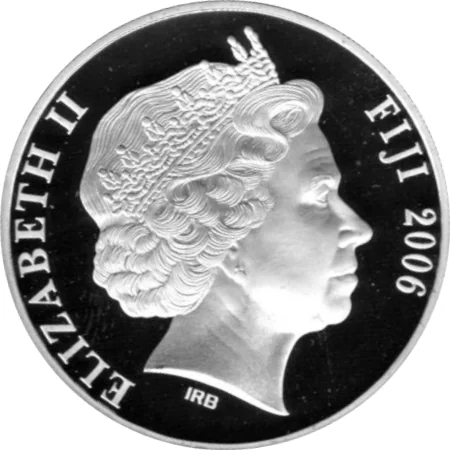
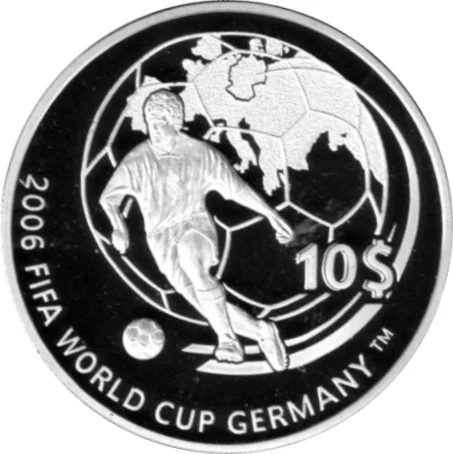
10 dollars – Fiji
Add to wishlist
Non-circulating coins
Commemoration: FIFA World Cup Germany 2006
Fiji
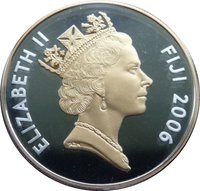
Obverse
Description:
Bust of Elizabeth II facing right.
Inscription:
ELIZABETH II
FIJI 2006
FIJI 2006
Translation:
ELIZABETH II
FIJI 2006
FIJI 2006
Script: Latin
Language: English
Engraver: Ian Rank-Broadley
Reverse
Edge
Reeded
Categories
| Sport> Football> FIFA World Cup |
| Map |
Mintings
| Year | Mint Mark | Mintage | Quality | Collection |
|---|---|---|---|---|
| 2006 | — | — | Proof |
Historical background
In 2006, Fiji's currency, the Fijian dollar (FJD), operated under a managed float regime, with its value primarily influenced by the Reserve Bank of Fiji (RBF) through foreign exchange interventions. The economy was heavily dependent on tourism, remittances, and sugar exports, making the currency vulnerable to external shocks and seasonal fluctuations. A key concern for the RBF was maintaining adequate foreign reserves, which were crucial for stabilizing the FJD, funding essential imports, and servicing external debt. Throughout the year, the central bank aimed to keep reserves above a benchmark of three months of import cover, a target that was often under pressure.
The political landscape of 2006 cast a significant shadow over the currency's stability. Growing tensions and uncertainty leading up to the military coup d'état on December 5th created investor unease and contributed to capital flight. In the months preceding the coup, the RBF had to actively defend the FJD, selling foreign currency to counteract depreciation pressures. The coup itself triggered an immediate economic downturn, with sanctions threatened by international bodies like the Commonwealth and the Pacific Islands Forum, further jeopardizing the inflows of tourism and investment that the currency relied upon.
Despite the political turmoil, the formal exchange rate remained relatively stable in 2006 due to the RBF's stringent controls and interventions. However, this stability came at a cost, depleting foreign reserves and masking underlying economic stresses. The post-coup environment set the stage for significant challenges in 2007, including a sharp decline in reserves and increased difficulty in maintaining the currency peg. Thus, while the FJD's value did not collapse in 2006, the year ended with the currency's fundamental supports severely weakened by the political crisis, foreshadowing greater economic difficulties ahead.
The political landscape of 2006 cast a significant shadow over the currency's stability. Growing tensions and uncertainty leading up to the military coup d'état on December 5th created investor unease and contributed to capital flight. In the months preceding the coup, the RBF had to actively defend the FJD, selling foreign currency to counteract depreciation pressures. The coup itself triggered an immediate economic downturn, with sanctions threatened by international bodies like the Commonwealth and the Pacific Islands Forum, further jeopardizing the inflows of tourism and investment that the currency relied upon.
Despite the political turmoil, the formal exchange rate remained relatively stable in 2006 due to the RBF's stringent controls and interventions. However, this stability came at a cost, depleting foreign reserves and masking underlying economic stresses. The post-coup environment set the stage for significant challenges in 2007, including a sharp decline in reserves and increased difficulty in maintaining the currency peg. Thus, while the FJD's value did not collapse in 2006, the year ended with the currency's fundamental supports severely weakened by the political crisis, foreshadowing greater economic difficulties ahead.

💎 Extremely Rare