

25 Paisa – Nepal
Nepal
Context

Material
Diameter: 19 mm
Weight: 3 g
Thickness: 1.3 mm
Shape: Round
Composition: Copper-nickel
Technique: Milled
Alignment: Medal alignment
flip
References
KM: #Click to copy to clipboard771
Numista: #17084
Value
Exchange value: 0.25 NPR
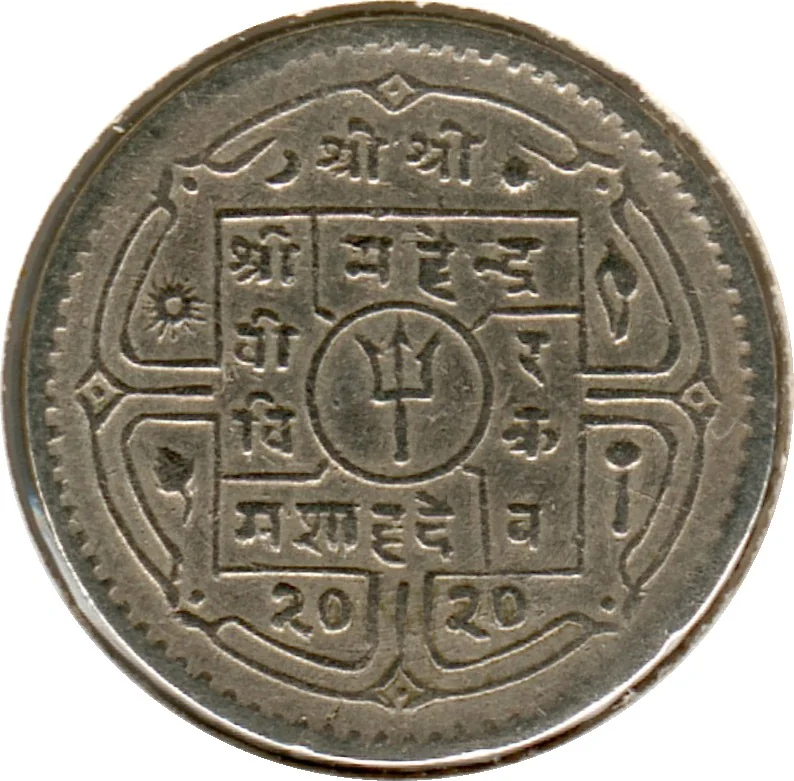
Obverse
Description:
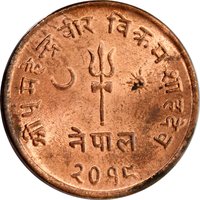
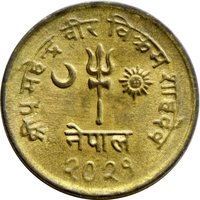
Central circle: Trident. Square interior: King Mahendra's name. Exterior: Hindu icons (clockwise from top left): Chakra, Shank, Gadha, Padma. Top: Crescent, Sri symbol, Sun. Bottom: Year.
Inscription:
श्री श्री
श्री ५महेन्द्र
वी र
वि क्र
म शाहदे व
२०२०
श्री ५महेन्द्र
वी र
वि क्र
म शाहदे व
२०२०
Translation:
Shri Shri
Shri 5 Mahendra
Veera
Vikrama
Shahadeva
2020
Shri 5 Mahendra
Veera
Vikrama
Shahadeva
2020
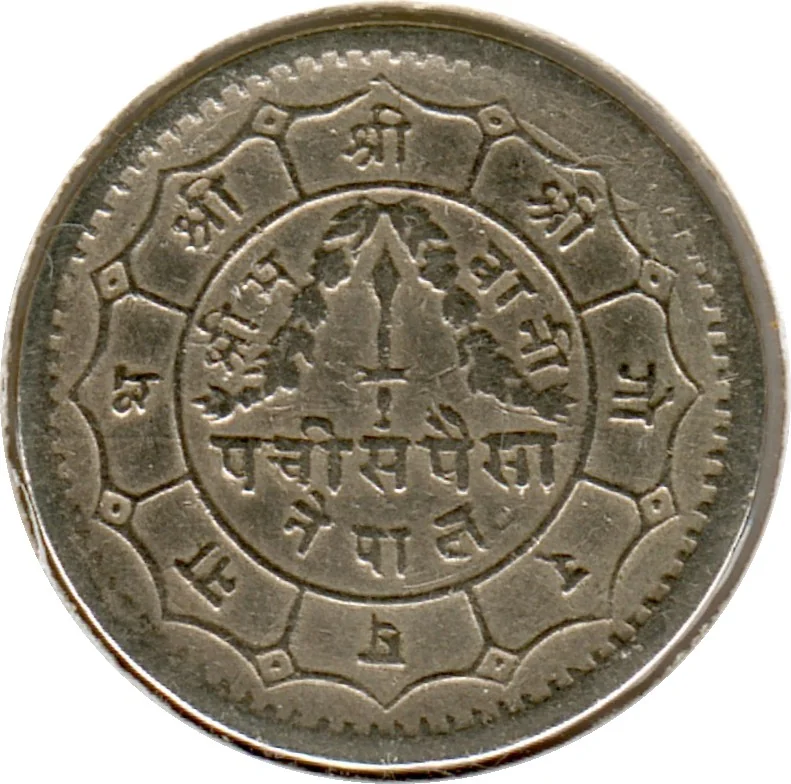
Reverse
Edge
Reeded
Mintings
| Year | Mint Mark | Mintage | Quality | Collection |
|---|---|---|---|---|
| 1958 | — | — | ||
| 1961 | — | — | ||
| 1963 | — | — | ||
| 1964 | — | — | ||
| 1965 | — | — |
Historical background
In 1958, Nepal's currency situation was characterized by a period of transition and foundational economic reform following the end of the Rana regime in 1951. The nation was operating under the Nepalese Mohar system, but the primary and more stable currency in practical use, especially for larger transactions and foreign trade, was still the Indian Rupee. This dual-currency reality underscored Nepal's deep economic dependency on India, as the Nepalese Rupee (NPR), introduced in 1932, was pegged at a fixed rate of 1:1 with the Indian Rupee (INR) and its circulation was limited.
The year 1958 was significant as it fell within the preparatory phase of a major monetary overhaul. The government, under King Mahendra and with advice from Indian experts, was laying the groundwork for the Nepal Rastra Bank Act of 1955 to take full effect. The central bank, Nepal Rastra Bank, had been established in 1956 but was still in the process of consolidating its role as the sole issuer and regulator of the nation's currency. A key objective was to expand the circulation and legitimacy of the Nepalese Rupee within its own borders to assert monetary sovereignty.
Therefore, the currency situation in 1958 was one of managed stability on the surface, with the fixed peg to the Indian Rupee facilitating trade but also reflecting a lack of independent monetary policy. Beneath this stability, the institutions and frameworks were being actively built to replace the old mohar system and reduce the dominant informal circulation of Indian currency. This set the stage for the more assertive national monetary policies that would follow in the 1960s, aiming to unify the economy under a single, nationally controlled currency.
The year 1958 was significant as it fell within the preparatory phase of a major monetary overhaul. The government, under King Mahendra and with advice from Indian experts, was laying the groundwork for the Nepal Rastra Bank Act of 1955 to take full effect. The central bank, Nepal Rastra Bank, had been established in 1956 but was still in the process of consolidating its role as the sole issuer and regulator of the nation's currency. A key objective was to expand the circulation and legitimacy of the Nepalese Rupee within its own borders to assert monetary sovereignty.
Therefore, the currency situation in 1958 was one of managed stability on the surface, with the fixed peg to the Indian Rupee facilitating trade but also reflecting a lack of independent monetary policy. Beneath this stability, the institutions and frameworks were being actively built to replace the old mohar system and reduce the dominant informal circulation of Indian currency. This set the stage for the more assertive national monetary policies that would follow in the 1960s, aiming to unify the economy under a single, nationally controlled currency.
🌱 Fairly Common