

5 Israeli Pounds (Israel's Independence) – Israel
Non-circulating coins
Commemoration: Israel's 15th Anniversary of Independence 5723-1963 - Seafaring
Israel
Context
Year: 1963
Hebrew Year: 5723
Issuer: Israel 
Issuing organization: Israel Government Coins and medals Corp.
Period:
(since 1948)
Currency:
(1949—1960)
Demonetized: Yes
Total mintage: 10,455
Material
References
KM: #Click to copy to clipboard39
Numista: #17083
Value
Exchange value: 5 ILP
Bullion value: $64.19
Inflation-adjusted value: 594863.84 ILP
Obverse
Description:
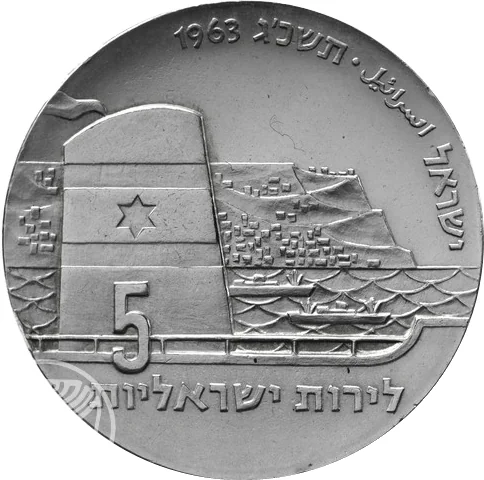
A steamship's smokestack and superstructure with Haifa Bay and Mount Carmel behind. On the smokestack base: "5 Israeli Lirot" in Hebrew. Around the top border: "Israel" in Hebrew and Arabic and the mint year "5723-1963" in Hebrew and English.
Inscription:
1963 ישראל اسرائيل • תשנ'ג
5
לירות ישראליות
5
לירות ישראליות
Translation:
One Hundred Sixty-Three Israel • 5723
5
Israeli Liras
5
Israeli Liras
Engraver: Zvi Narkiss
Reverse
Description:
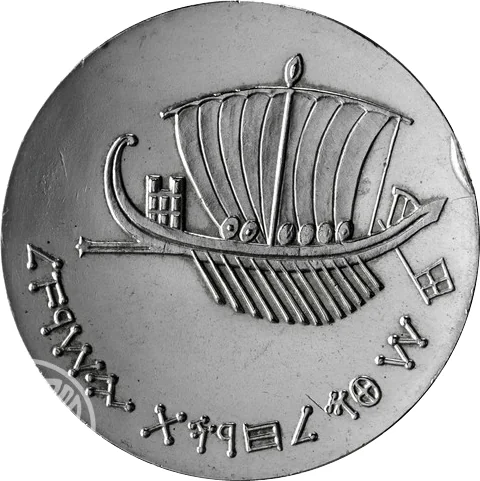
A reproduction of an ancient galley. It has thirteen oars, six protective parapets, a forecastle with a tower, and a battering ram. A rig with many sails hangs from the mast. The aft rudder is inscribed in ancient Hebrew: "Fifteenth year of Israel's Freedom".
Script: Hebrew
Engraver: Yitzhak Behar
Edge
Inscripted
Categories
| Event> Independence |
| Transportation> Watercraft |
| Symbol> Hexagram |
Mints
| Name | Mark |
|---|---|
| Rome | — |
Mintings
| Year | Mint Mark | Mintage | Quality | Collection |
|---|---|---|---|---|
| 1963 | — | 4,495 | Proof | |
| 1963 | — | 5,960 |
Historical background
In 1963, Israel's currency, the lira (often called the Israeli pound or IL), was in a period of relative but fragile stability under a fixed exchange rate regime. The currency was pegged to a basket of foreign currencies, heavily weighted toward the British pound sterling, at a rate of IL 3 per US dollar. This stability, however, was largely artificial and maintained through stringent government controls. The Bank of Israel enforced a complex system of foreign currency regulations, limiting the amount of money citizens and businesses could exchange or transfer abroad, a necessity to protect the nation's modest foreign currency reserves and manage a persistent trade deficit.
This controlled environment masked underlying economic strains. The young state was still heavily reliant on capital imports, including foreign aid, loans, and reparations from Germany, to finance its rapid development and absorb large waves of immigration. The economy was characterized by a substantial public sector, high inflation by Western standards, and a balance of payments that was chronically in deficit. The fixed exchange rate, therefore, was not a reflection of natural market strength but a managed tool to provide predictability for planning and to curb inflationary pressures from imported goods.
The situation in 1963 represented a calm before a period of significant monetary adjustment. The pressures building beneath the surface of control would become increasingly difficult to contain. Within a few years, the strain would lead to a major devaluation in 1967 (to IL 3.5 per dollar) and the eventual abandonment of the sterling peg, marking the beginning of a long era of currency depreciation and high inflation that would only be decisively addressed with the economic stabilization plan of 1985 and the introduction of the new shekel.
This controlled environment masked underlying economic strains. The young state was still heavily reliant on capital imports, including foreign aid, loans, and reparations from Germany, to finance its rapid development and absorb large waves of immigration. The economy was characterized by a substantial public sector, high inflation by Western standards, and a balance of payments that was chronically in deficit. The fixed exchange rate, therefore, was not a reflection of natural market strength but a managed tool to provide predictability for planning and to curb inflationary pressures from imported goods.
The situation in 1963 represented a calm before a period of significant monetary adjustment. The pressures building beneath the surface of control would become increasingly difficult to contain. Within a few years, the strain would lead to a major devaluation in 1967 (to IL 3.5 per dollar) and the eventual abandonment of the sterling peg, marking the beginning of a long era of currency depreciation and high inflation that would only be decisively addressed with the economic stabilization plan of 1985 and the introduction of the new shekel.

⭐ Rare