

½ Peso (Restoration of the Republic) – Dominican Republic
Circulating commemorative coins
Commemoration: 100th Anniversary of the Restoration of the Republic
Dominican Republic
Context
Year: 1963
Issuer: Dominican Republic 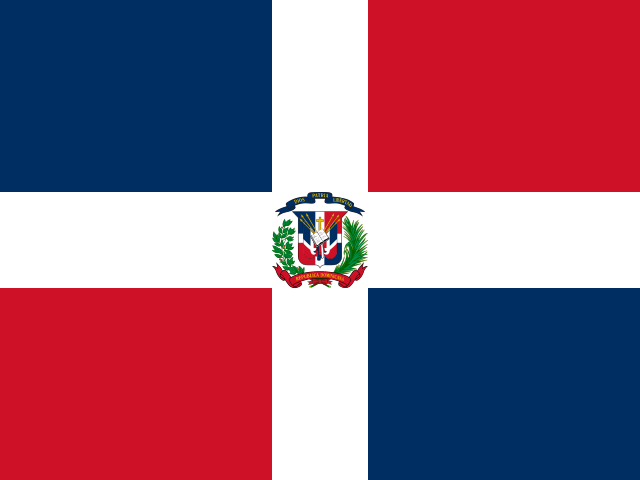
Period:
(1922—1965)
Currency:
(since 1937)
Total mintage: 300,000
Material
References
KM: #Click to copy to clipboard29
Numista: #17078
Value
Exchange value: ½ DOP
Bullion value: $23.10
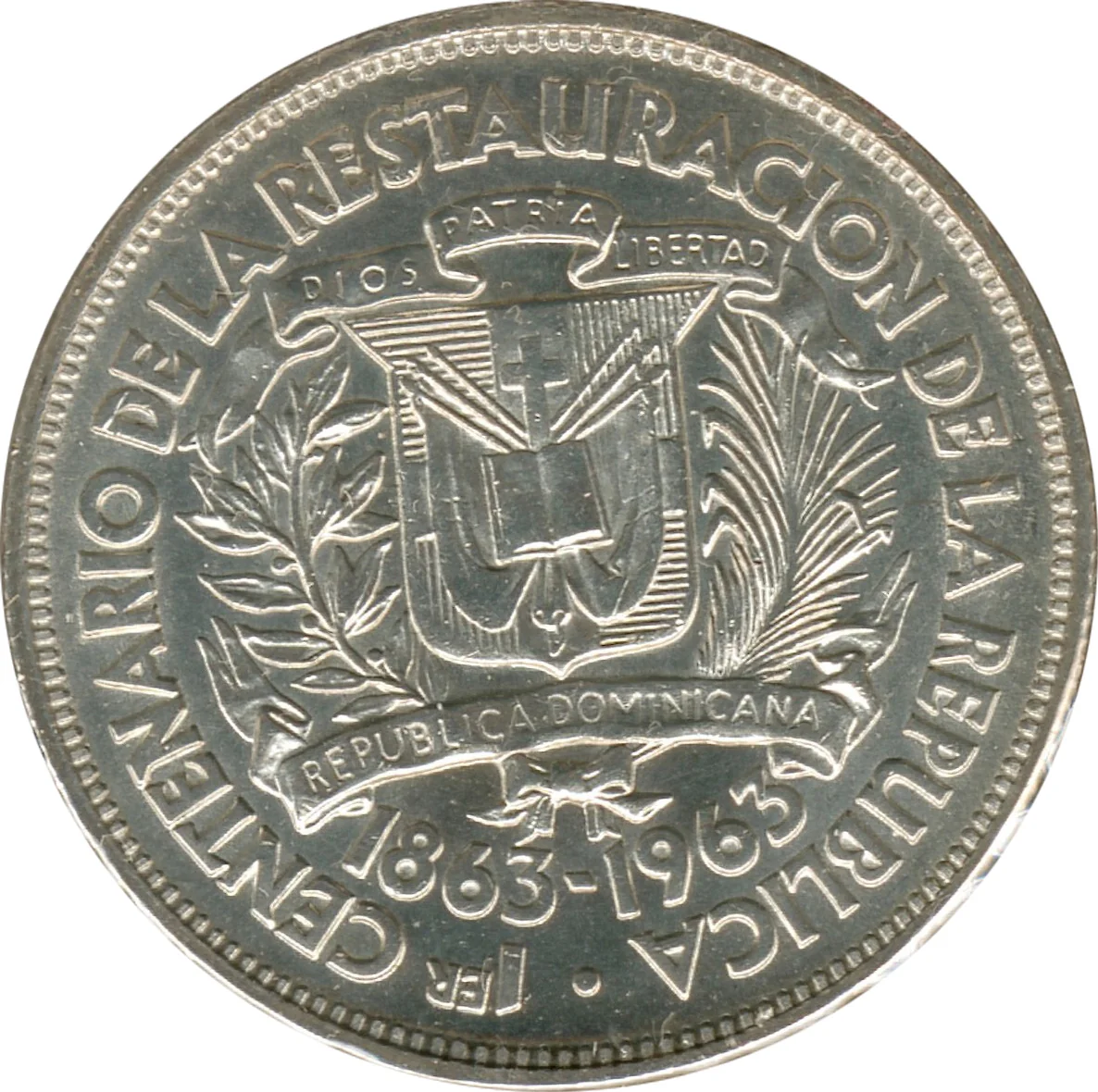
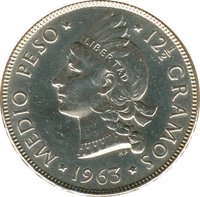
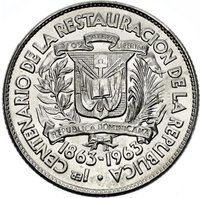
Obverse
Description:
Heraldic emblem
Inscription:
CENTENARIO DE LA RESTAURACION DE LA REPUBLICA
DIOS PATRIA LIBERTAD
REPUBLICA DOMINICANA
1863-1963
DIOS PATRIA LIBERTAD
REPUBLICA DOMINICANA
1863-1963
Translation:
Centenary of the Restoration of the Republic
God Homeland Liberty
Dominican Republic
1863-1963
God Homeland Liberty
Dominican Republic
1863-1963
Script: Latin
Language: Spanish
Engravers: Thomas Humphrey Paget, Derek C Gorringe
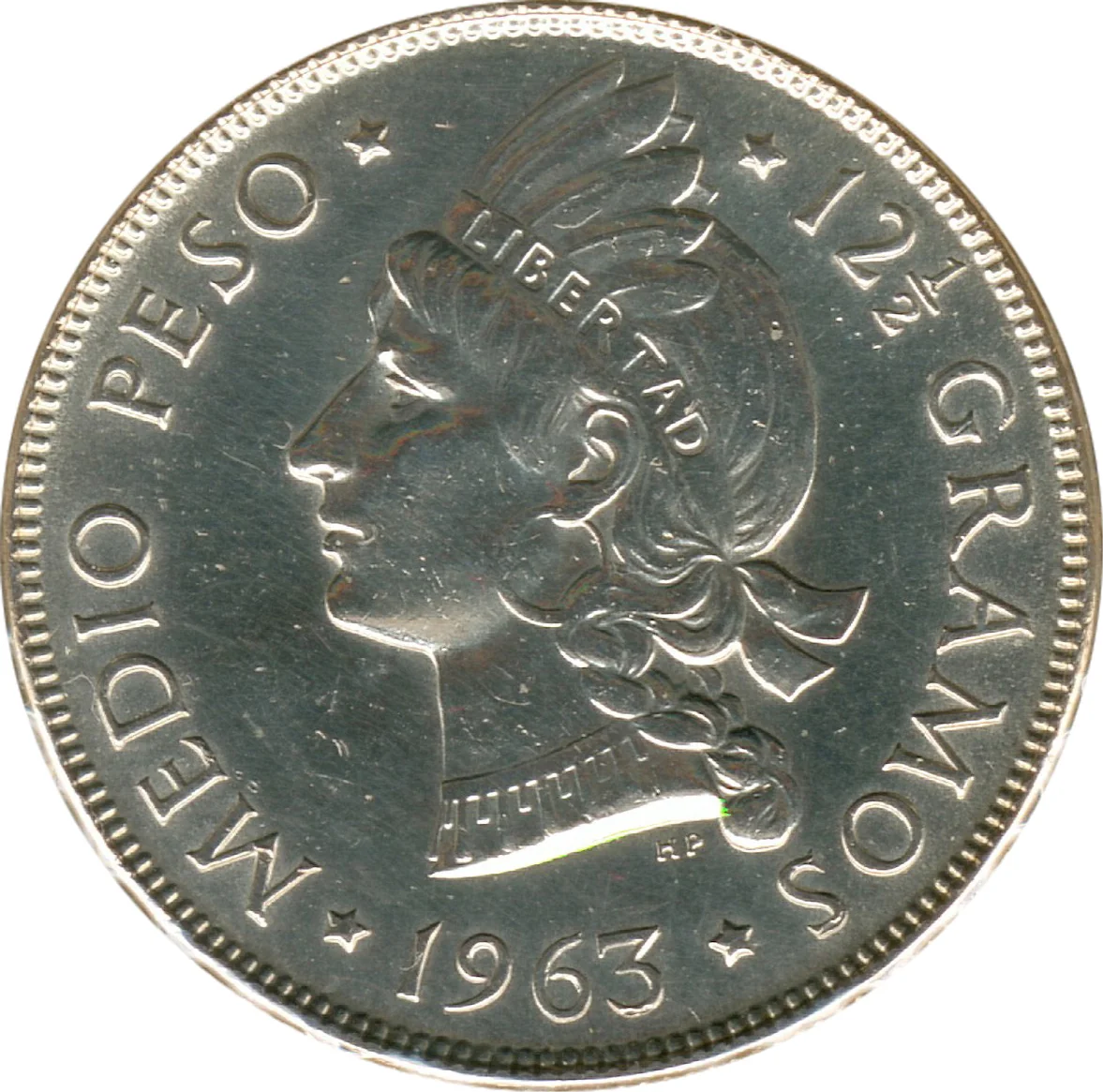
Reverse
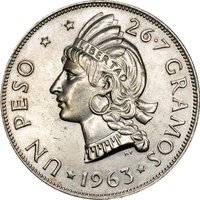
Description:
Indian woman's head facing left ("Liberty").
Inscription:
* MEDIO PESO *
* 12½ GRAMOS *
LIBERTAD
1963
* 12½ GRAMOS *
LIBERTAD
1963
Translation:
Half Peso;
12½ Grams;
Liberty
1963
12½ Grams;
Liberty
1963
Script: Latin
Language: Spanish
Engravers: Thomas Humphrey Paget, Derek C Gorringe
Edge
Reeded
Mints
| Name | Mark |
|---|---|
| Royal Mint (Tower Hill) | — |
Mintings
| Year | Mint Mark | Mintage | Quality | Collection |
|---|---|---|---|---|
| 1963 | — | 300,000 |
Historical background
In 1963, the Dominican Republic's currency situation was intrinsically tied to the nation's profound political instability. The year began under the brief, reformist presidency of Juan Bosch, who had taken office in February after the 1961 assassination of longtime dictator Rafael Trujillo. While Bosch's government did not enact major currency reforms, his administration inherited an economy and a monetary system still heavily distorted by the Trujillo regime's practices, including the extensive personal control of key industries and a history of fiscal mismanagement. The political uncertainty itself became a primary economic driver, discouraging foreign investment and creating cautious fiscal policy, all of which placed underlying pressure on the Dominican peso (DOP), which was pegged to the US dollar.
The pivotal event occurred on September 25, 1963, when President Bosch was overthrown by a military coup. This regime change abruptly ended his constitutional project and ushered in a reactionary civilian triumvirate. The immediate economic consequence was a collapse in confidence, both domestically and internationally. While no formal devaluation was declared in the remaining months of the year, the coup triggered capital flight and heightened inflationary pressures, as the new, unelected government lacked legitimacy and a clear economic plan. The peso's stability became increasingly reliant on the country's foreign exchange reserves and its continued adherence to the dollar peg, a policy that would be severely tested in the coming years.
Thus, the currency background of 1963 is best understood as a period of latent crisis. The direct monetary indicators from that specific year are less significant than the profound political shock that defined it. The collapse of democracy and the return of authoritarian rule set the stage for the economic turmoil and eventual debt crisis that would culminate in 1965 with a civil war and a US military intervention. Therefore, the currency situation was one of precarious stability, artificially maintained by a fixed exchange rate but fundamentally weakened by the political rupture that would dictate the nation's troubled economic path for the next two decades.
The pivotal event occurred on September 25, 1963, when President Bosch was overthrown by a military coup. This regime change abruptly ended his constitutional project and ushered in a reactionary civilian triumvirate. The immediate economic consequence was a collapse in confidence, both domestically and internationally. While no formal devaluation was declared in the remaining months of the year, the coup triggered capital flight and heightened inflationary pressures, as the new, unelected government lacked legitimacy and a clear economic plan. The peso's stability became increasingly reliant on the country's foreign exchange reserves and its continued adherence to the dollar peg, a policy that would be severely tested in the coming years.
Thus, the currency background of 1963 is best understood as a period of latent crisis. The direct monetary indicators from that specific year are less significant than the profound political shock that defined it. The collapse of democracy and the return of authoritarian rule set the stage for the economic turmoil and eventual debt crisis that would culminate in 1965 with a civil war and a US military intervention. Therefore, the currency situation was one of precarious stability, artificially maintained by a fixed exchange rate but fundamentally weakened by the political rupture that would dictate the nation's troubled economic path for the next two decades.
🌟 Limited