

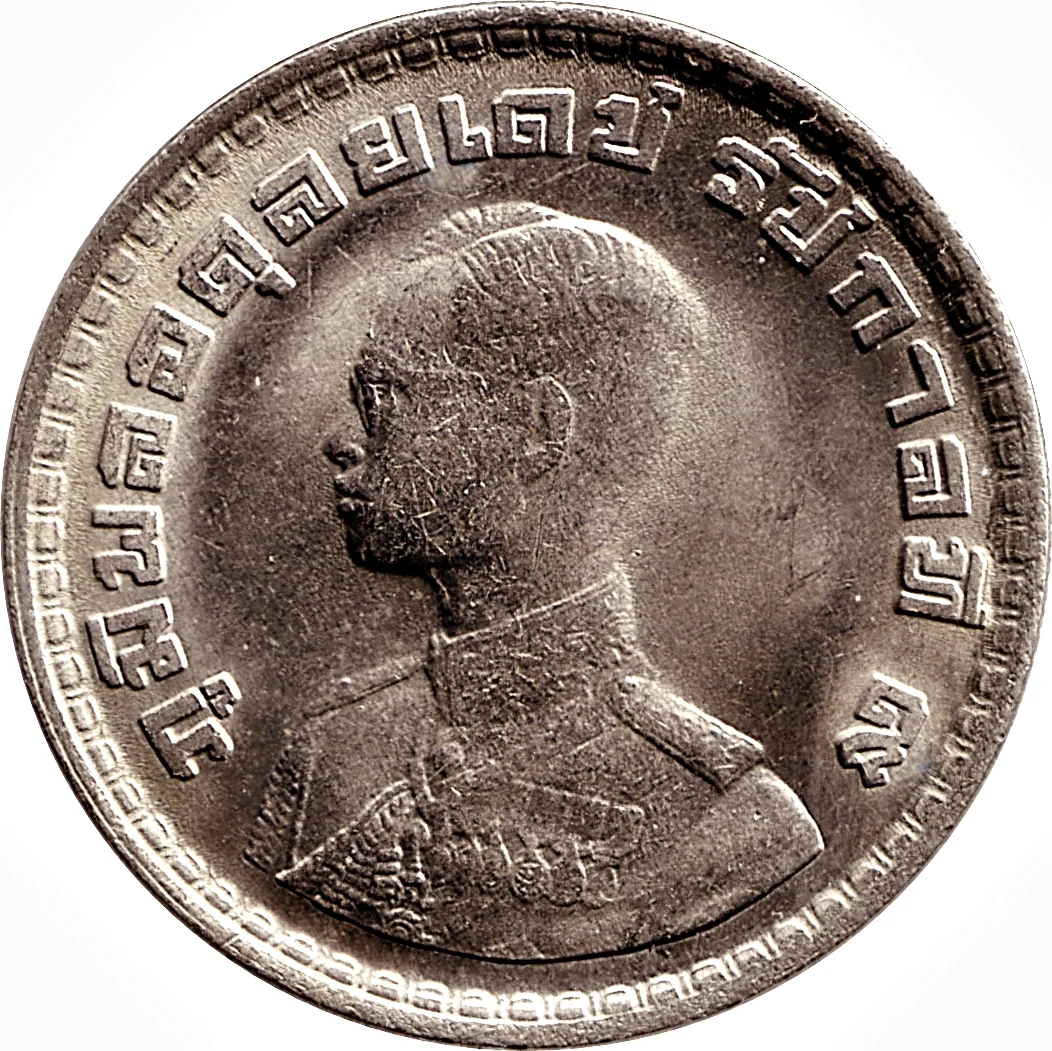
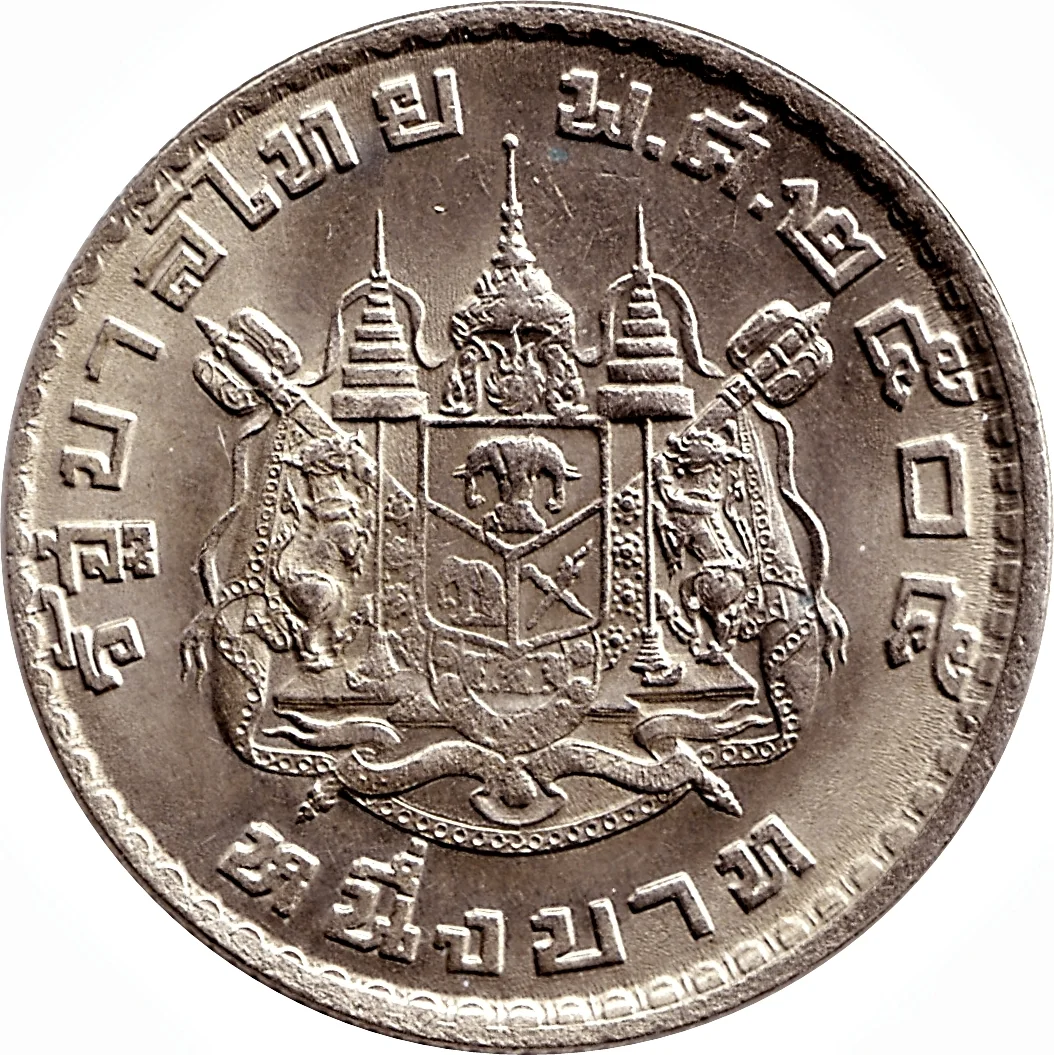
1 Baht – Thailand
Thailand
Context
Year: 1962
Thai Year: 2505
Issuer: Thailand 
Ruler: Bhumibol Adulyadej
Currency:
(since 1897)
Demonetized: Yes
Total mintage: 883,086,000
Material
Diameter: 26.9 mm
Weight: 7.5 g
Thickness: 1.73 mm
Shape: Round
Composition: Copper-nickel
Technique: Milled
Alignment: Coin alignment
flip
References
Y: #Click to copy to clipboard84
Numista: #1701
Value
Exchange value: 1 THB = $0.03
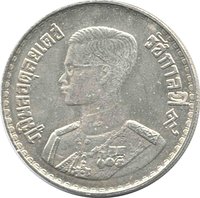
Obverse
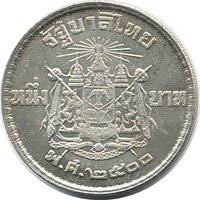
Reverse
Edge
Milled
Categories
| Symbols> Coat of Arms |
Mints
| Name | Mark |
|---|---|
| Bangkok | — |
Mintings
| Year | Mint Mark | Mintage | Quality | Collection |
|---|---|---|---|---|
| 1962 | — | 883,086,000 |
Historical background
In 1962, Thailand's currency system was defined by the Baht (THB), which operated under a fixed exchange rate regime pegged to the U.S. Dollar. This peg was a cornerstone of the nation's economic policy, established to provide stability, control inflation, and foster confidence for both domestic and international trade. The rate was set at approximately 20.8 Baht to 1 USD, a valuation maintained by the Bank of Thailand through strict capital controls and management of the country's foreign exchange reserves.
This monetary stability occurred under the authoritarian, developmentalist government of Field Marshal Sarit Thanarat, who prioritized economic modernization and close alignment with Western allies, particularly the United States. The fixed exchange rate facilitated predictable conditions for the key sectors driving growth: agriculture (especially rice, rubber, and tin exports) and the beginnings of import-substitution industrialization. The system was bolstered by rising U.S. military spending in the region due to the Vietnam War, which provided an important inflow of dollars.
However, the rigidity of the peg also presented underlying challenges. It required the Bank of Thailand to maintain sufficient foreign reserves to defend the currency, limiting independent monetary policy. Furthermore, the focus on stability sometimes came at the expense of adjusting to real shifts in economic competitiveness. While the system would remain largely intact throughout the 1960s, these inherent tensions would later contribute to significant monetary crises, culminating in a devaluation and a shift to a managed float in the 1980s.
This monetary stability occurred under the authoritarian, developmentalist government of Field Marshal Sarit Thanarat, who prioritized economic modernization and close alignment with Western allies, particularly the United States. The fixed exchange rate facilitated predictable conditions for the key sectors driving growth: agriculture (especially rice, rubber, and tin exports) and the beginnings of import-substitution industrialization. The system was bolstered by rising U.S. military spending in the region due to the Vietnam War, which provided an important inflow of dollars.
However, the rigidity of the peg also presented underlying challenges. It required the Bank of Thailand to maintain sufficient foreign reserves to defend the currency, limiting independent monetary policy. Furthermore, the focus on stability sometimes came at the expense of adjusting to real shifts in economic competitiveness. While the system would remain largely intact throughout the 1960s, these inherent tensions would later contribute to significant monetary crises, culminating in a devaluation and a shift to a managed float in the 1980s.
🌱 Very Common