

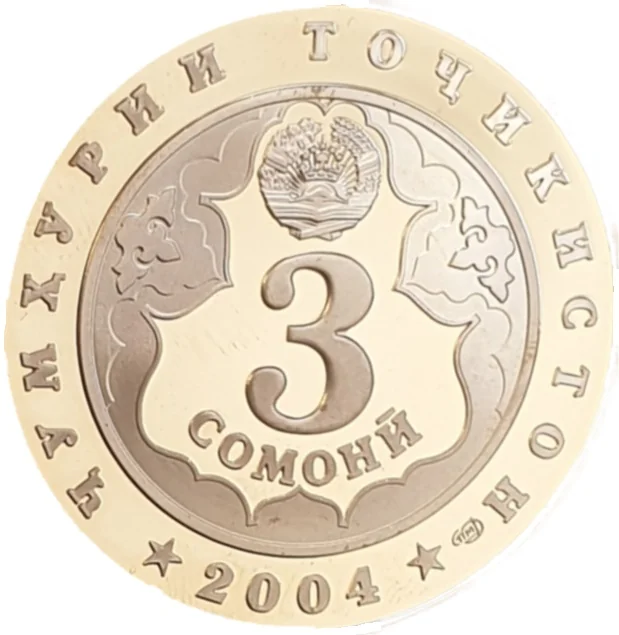
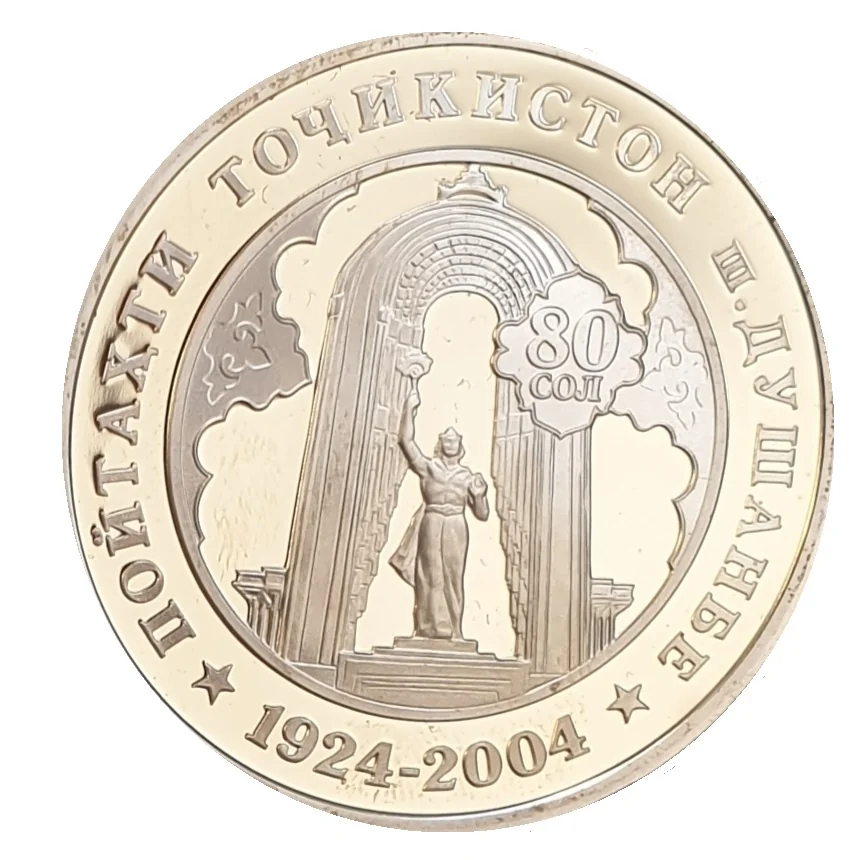
3 somoni (Dushanbe) – Tajikistan
Add to wishlist
Non-circulating coins
Commemoration: 80th Anniversary of Dushanbe City
Tajikistan
Context
Material
References
KM: #
Numista: #106571
Value
Exchange value: 3 TJS
Bullion value: $15.68
Obverse
Reverse
Edge
Smooth with inscription
Legend:
* СЕ СОМОНӢ * СЕ СОМОНӢ
Translation:
THIS IS THE COIN * THIS IS THE COIN
Language: Old Church Slavonic
Mints
| Name | Mark |
|---|---|
| Saint Petersburg | — |
Mintings
| Year | Mint Mark | Mintage | Quality | Collection |
|---|---|---|---|---|
| 2004 | СПМД | 1,000 | Proof |
Historical background
In 2004, Tajikistan's currency, the somoni (introduced in 2000 to replace the Tajik ruble), was in a period of relative stabilization following a turbulent post-Soviet decade marked by civil war and hyperinflation. The National Bank of Tajikistan (NBT) maintained a managed float regime, carefully controlling the exchange rate against the US dollar to curb volatility. This policy resulted in a slow, government-managed depreciation aimed at supporting exports, primarily aluminum and cotton, while preventing a sudden loss of purchasing power for a population heavily dependent on remittances.
The economy remained dollarized to a significant degree, with foreign currency, especially US dollars and Russian rubles, widely used for large transactions and savings. This was driven by lingering public distrust in the national currency and the immense importance of remittances from migrant workers in Russia, which by 2004 were becoming a critical pillar of the economy. These inflows provided essential foreign exchange reserves for the NBT and helped stabilize the somoni, but also highlighted the economy's external vulnerabilities.
Despite surface-level stability, underlying pressures persisted. The banking sector was weak and poorly integrated into the broader economy, with limited credit available to the private sector. Fiscal deficits and reliance on a narrow export base created long-term vulnerabilities. Consequently, while 2004 did not see a currency crisis, the somoni's stability was fragile, artificially maintained by administrative controls and contingent on continuous remittance flows rather than robust domestic productivity.
The economy remained dollarized to a significant degree, with foreign currency, especially US dollars and Russian rubles, widely used for large transactions and savings. This was driven by lingering public distrust in the national currency and the immense importance of remittances from migrant workers in Russia, which by 2004 were becoming a critical pillar of the economy. These inflows provided essential foreign exchange reserves for the NBT and helped stabilize the somoni, but also highlighted the economy's external vulnerabilities.
Despite surface-level stability, underlying pressures persisted. The banking sector was weak and poorly integrated into the broader economy, with limited credit available to the private sector. Fiscal deficits and reliance on a narrow export base created long-term vulnerabilities. Consequently, while 2004 did not see a currency crisis, the somoni's stability was fragile, artificially maintained by administrative controls and contingent on continuous remittance flows rather than robust domestic productivity.

💎 Extremely Rare