

20 rials (Sacred Defense) – Iran
Add to wishlist
Circulating commemorative coins
Commemoration: 8th Anniversary of Sacred Defense
Iran
Context
Year: 1989
Iranian - Persian Year:: 1368
Issuer: Iran
Period:
(since 1979)
Currency:
(since 1932)
Demonetized: Yes
Material
Diameter: 24 mm
Weight: 4.7 g
Thickness: 1.4 mm
Shape: Round
Composition: Copper-nickel
Technique: Milled
Alignment: Coin alignment
flip
References
KM: #
Numista: #1688
Value
Exchange value: 20 IRR
Obverse
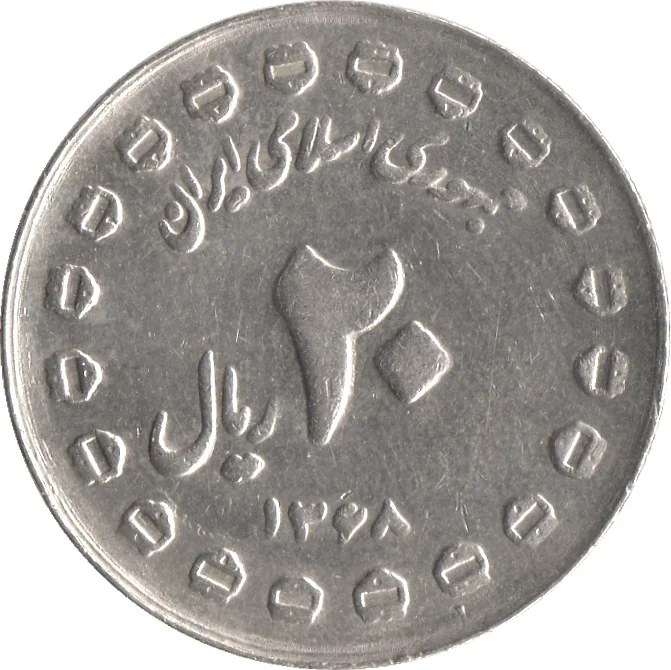
Description:
Date circled by 22 small ornaments.
Inscription:
جمهوری اسلامی ايران
٢٠ ریال
١٣۶٨
٢٠ ریال
١٣۶٨
Translation:
Islamic Republic of Iran
20 Rials
1368
20 Rials
1368
Language: Persian
Reverse
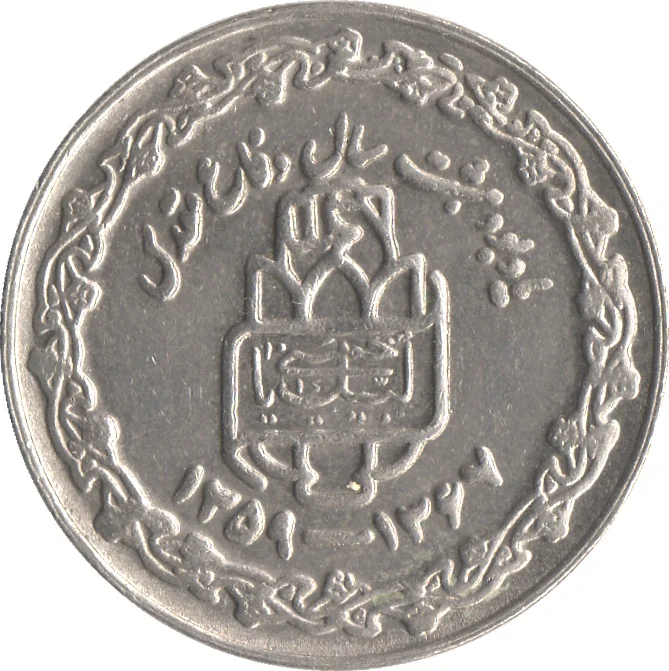
Description:
Shield with dates and inscription in wreath.
Inscription:
١٣٦٧ - ١٣٥٩
Translation:
1367 - 1359
Language: Arabic
Edge
17 plain segments, 17 reeded segments, each having 5 dents above edge level
Mintings
| Year | Mint Mark | Mintage | Quality | Collection |
|---|---|---|---|---|
| 1989 | — | — |
Historical background
In 1989, Iran's currency situation was defined by the severe economic strain of the nearly-concluded Iran-Iraq War (1980-1988). The conflict had devastated infrastructure, drained foreign reserves, and led to massive wartime spending, largely financed through monetary expansion. This resulted in persistent and high inflation, which eroded the value of the Iranian rial on the official market. However, the government maintained a complex multi-tiered exchange rate system, with a highly overvalued official rate used for imports of essential goods like food and medicine, subsidized by the state. This created a significant gap with the unofficial black-market rate, where the rial traded for a fraction of its official value, fostering corruption and a thriving currency smuggling trade.
The economic landscape was in transition with the war's end in 1988 and the death of Ayatollah Khomeini in June 1989, which brought new leadership under President Akbar Hashemi Rafsanjani. His administration began advocating for a policy of economic reconstruction and liberalization, which included tentative discussions about reforming the dysfunctional currency regime. There was a recognized need to unify the exchange rates to reduce market distortions, curb capital flight, and attract foreign investment for rebuilding the country. However, these plans faced immense political and social hurdles, as unifying rates would mean ending costly subsidies, risking a sudden surge in inflation for basic goods and potential public unrest.
Consequently, while 1989 was a pivotal year that set the stage for future economic debates, immediate and radical currency reform was postponed. The government continued to defend the overvalued official rial through strict capital controls and the allocation of scarce hard currency, primarily from limited oil revenues, to priority sectors. The year ended with the dual-exchange system firmly intact, but under increasing pressure. The fundamental challenges of high inflation, a large budget deficit, and a growing disconnect between the official economy and the reality of the black market defined the rial's precarious position as Iran entered a new post-war political era.
The economic landscape was in transition with the war's end in 1988 and the death of Ayatollah Khomeini in June 1989, which brought new leadership under President Akbar Hashemi Rafsanjani. His administration began advocating for a policy of economic reconstruction and liberalization, which included tentative discussions about reforming the dysfunctional currency regime. There was a recognized need to unify the exchange rates to reduce market distortions, curb capital flight, and attract foreign investment for rebuilding the country. However, these plans faced immense political and social hurdles, as unifying rates would mean ending costly subsidies, risking a sudden surge in inflation for basic goods and potential public unrest.
Consequently, while 1989 was a pivotal year that set the stage for future economic debates, immediate and radical currency reform was postponed. The government continued to defend the overvalued official rial through strict capital controls and the allocation of scarce hard currency, primarily from limited oil revenues, to priority sectors. The year ended with the dual-exchange system firmly intact, but under increasing pressure. The fundamental challenges of high inflation, a large budget deficit, and a growing disconnect between the official economy and the reality of the black market defined the rial's precarious position as Iran entered a new post-war political era.
🌱 Very Common