

1 Paisa – Nepal
Nepal
Context
Year: 1888
Vikram Samvat Year: 1945
Issuer: Nepal 
Ruler: Prithvi Bir Bikram Shah
Currency:
(1546—1932)
Demonetized: Yes
References
KM: #Click to copy to clipboard624
Numista: #167270
Obverse
Description:
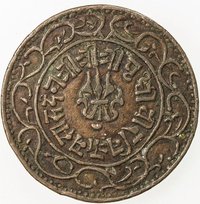
Crossed khukuris within a floral border, encircled by text.
Reverse
Edge
Mintings
| Year | Mint Mark | Mintage | Quality | Collection |
|---|---|---|---|---|
| 1888 | — | — |
Historical background
In 1888, Nepal operated under a complex and fragmented currency system, a legacy of its feudal past and its economic relationship with British India. The dominant currency in circulation was the Mohar, a silver coin minted by the state. However, the system was not unified; various principalities and regions historically issued their own coins, leading to a lack of standardization in weight and purity. Furthermore, the highly valued Mohar existed alongside a plethora of smaller, often debased copper coins called Damas, used for everyday transactions, creating a cumbersome multi-metallic system.
Critically, this period saw the increasing dominance of the Indian Rupee in Nepal's economy, particularly in the southern Terai plains bordering India. The Rupee, a stable and widely accepted currency, flowed into Nepal through trade, remittances from Nepalese serving in the British Indian Army, and general cross-border commerce. This created a de facto dual-currency environment where the Indian Rupee often held more trust for larger transactions, while local coins remained in use for local markets. The Nepalese state, under the Rana regime, struggled to control this monetary influx and maintain the value of its own coinage.
The situation in 1888 was one of transition and underlying strain. The Rana rulers, recognizing the economic and administrative problems posed by a weak currency, were on the cusp of major reform. Just two years later, in 1890, Prime Minister Bir Shumsher Jang Bahadur Rana would introduce a landmark currency reform, decimalizing the system and introducing the silver Nepalese Rupee (NPR) to directly compete with and replace the Indian Rupee's influence. Therefore, 1888 represents the final years of an archaic monetary order, with pressures from a more modern regional economy necessitating the comprehensive changes that would soon follow.
Critically, this period saw the increasing dominance of the Indian Rupee in Nepal's economy, particularly in the southern Terai plains bordering India. The Rupee, a stable and widely accepted currency, flowed into Nepal through trade, remittances from Nepalese serving in the British Indian Army, and general cross-border commerce. This created a de facto dual-currency environment where the Indian Rupee often held more trust for larger transactions, while local coins remained in use for local markets. The Nepalese state, under the Rana regime, struggled to control this monetary influx and maintain the value of its own coinage.
The situation in 1888 was one of transition and underlying strain. The Rana rulers, recognizing the economic and administrative problems posed by a weak currency, were on the cusp of major reform. Just two years later, in 1890, Prime Minister Bir Shumsher Jang Bahadur Rana would introduce a landmark currency reform, decimalizing the system and introducing the silver Nepalese Rupee (NPR) to directly compete with and replace the Indian Rupee's influence. Therefore, 1888 represents the final years of an archaic monetary order, with pressures from a more modern regional economy necessitating the comprehensive changes that would soon follow.
✨ Legendary