


5 euro – Latvia
Add to wishlist
Non-circulating coins
Commemoration: Cat's Mill
Latvia
Context
Material

References
KM: #
Numista: #166313
Value
Exchange value: 5 EUR
Bullion value: $50.79
Inflation-adjusted value: 6.93 EUR
Obverse
Description:
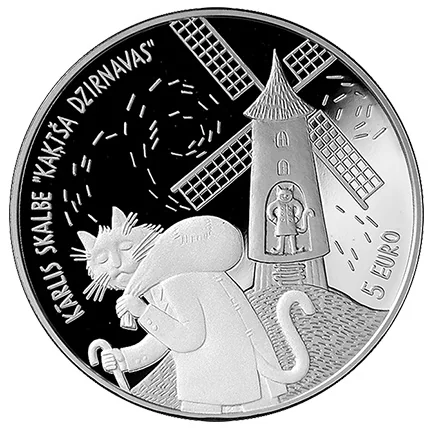
A cat with a patched sack and walking stick stands before a mill, where another black cat appears in the doorway. Inscriptions read "KĀRLIS SKALBE. 'KAĶĪŠA DZIRNAVAS'" and "5 EURO."
Inscription:
KĀRLIS SKALBE "KAĶĪŠA DZIRNAVAS"
5 EURO
5 EURO
Translation:
Karlis Skalbe "The Kitten's Mill"
5 Euro
5 Euro
Script: Latin
Language: Latvian
Engraver: Ligita Franckeviča
Designer: Elīna Brasliņa
Reverse
Description:
Centered is a cat on the King's lap, with the inscription "ĶĒNIŅ, ES NEPIEMINU ĻAUNU" and the year 2019 in a semi-circle to the right.
Inscription:
ĶĒNIŅ, ES NEPIEMINU ĻAUNU
2019
2019
Translation:
KING, I DO NOT REMEMBER EVIL
Script: Latin
Language: Latvian
Engraver: Ligita Franckeviča
Designer: Elīna Brasliņa
Edge
The edge bears the inscriptions LATVIJAS BANKA and LATVIJAS REPUBLIKA, separated by rhombic dots.
Legend:
LATVIJAS BANKA ◊ LATVIJAS REPUBLIKA ◊
Translation:
LATVIJAS BANKA ◊ LATVIJAS REPUBLIKA ◊
Language: Latvian
Mints
| Name | Mark |
|---|---|
| Lithuanian Mint | — |
Mintings
| Year | Mint Mark | Mintage | Quality | Collection |
|---|---|---|---|---|
| 2019 | — | 2,500 | Proof |
Historical background
In 2019, Latvia was in its sixth year as a member of the Eurozone, having adopted the euro on January 1, 2014. This move replaced the national currency, the lats (LVL), and firmly anchored Latvia within the core of the European Union's economic and monetary structures. The primary focus in 2019 was not on currency instability or exchange rates, but on the ongoing benefits and integration challenges of using the shared currency. The euro provided macroeconomic stability, eliminated exchange costs for trade (crucial for an open economy like Latvia's), and helped maintain low borrowing interest rates, supporting both public finance and private investment.
However, the euro membership also meant that Latvia had relinquished independent monetary policy tools to the European Central Bank (ECB). In 2019, a key domestic concern was the persistent inflation rate, which, at around 2.7%, was slightly above the Eurozone average. This was largely driven by rising wages in a tight labour market and strong domestic demand, rather than monetary policy. The ECB's accommodative stance, including historically low interest rates, was generally supportive of growth but also contributed to concerns about housing affordability and economic overheating in Riga and other major cities.
Overall, the currency situation in 2019 was one of stable institutional integration. Public support for the euro remained relatively high, though not overwhelming, with many citizens associating it with higher prices since the transition. The debate had shifted from whether to keep the euro to how best to leverage its stability for convergence with Western European living standards. The economic policy focus was therefore on structural reforms, improving productivity, and prudent fiscal policy—the tools still available to national authorities—to ensure competitiveness within the single currency area.
However, the euro membership also meant that Latvia had relinquished independent monetary policy tools to the European Central Bank (ECB). In 2019, a key domestic concern was the persistent inflation rate, which, at around 2.7%, was slightly above the Eurozone average. This was largely driven by rising wages in a tight labour market and strong domestic demand, rather than monetary policy. The ECB's accommodative stance, including historically low interest rates, was generally supportive of growth but also contributed to concerns about housing affordability and economic overheating in Riga and other major cities.
Overall, the currency situation in 2019 was one of stable institutional integration. Public support for the euro remained relatively high, though not overwhelming, with many citizens associating it with higher prices since the transition. The debate had shifted from whether to keep the euro to how best to leverage its stability for convergence with Western European living standards. The economic policy focus was therefore on structural reforms, improving productivity, and prudent fiscal policy—the tools still available to national authorities—to ensure competitiveness within the single currency area.


💎 Extremely Rare