

1 Cent – Nova Scotia
Canada
Context
Years: 1861–1864
Country: Canada 
Issuer: Nova Scotia
Ruler: Victoria
Currency:
(1860—1871)
Demonetized: Yes
Total mintage: 2,600,000
Material
References
KM: #Click to copy to clipboard8
Numista: #1064
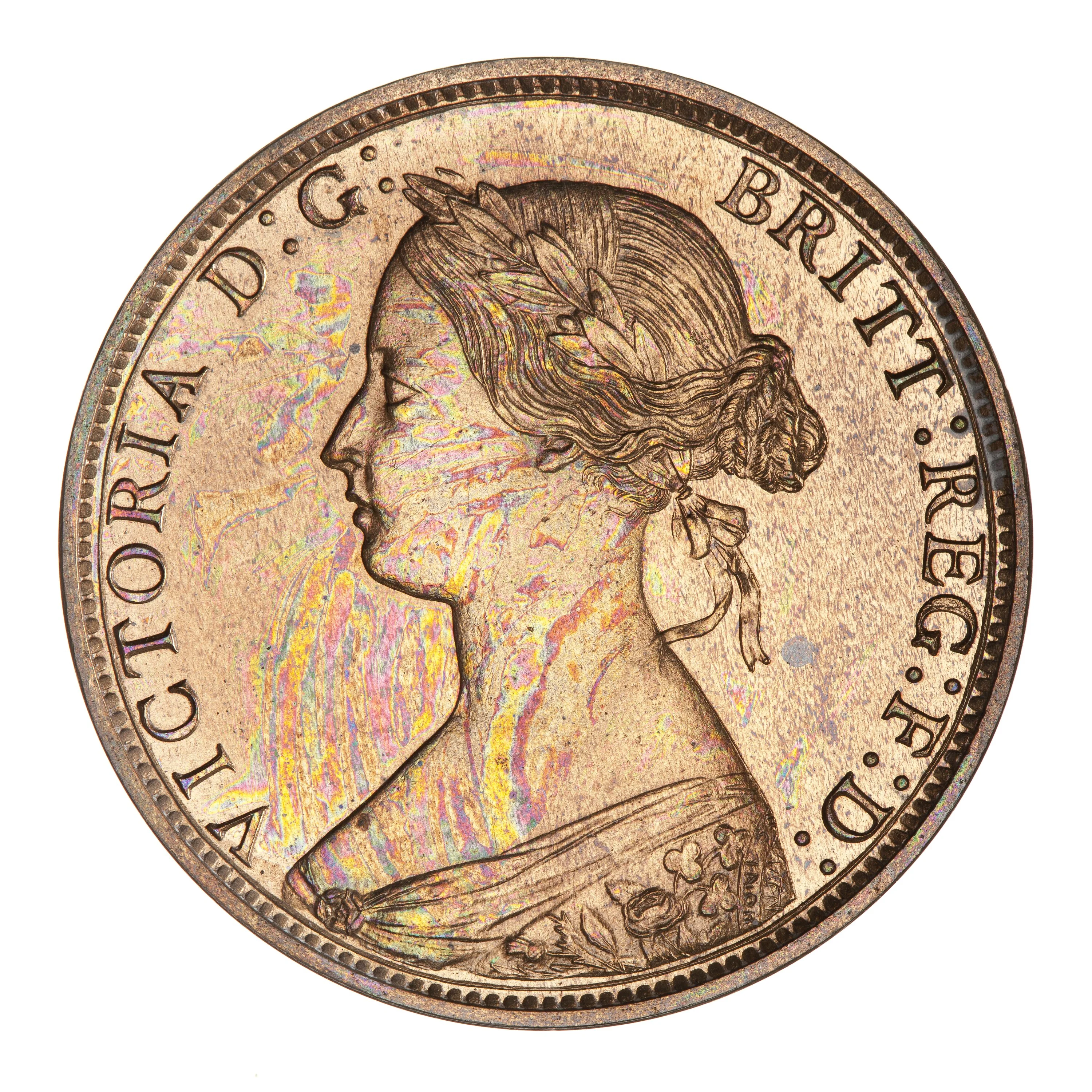
Obverse
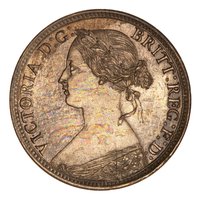
Description:
Portrait of Queen Victoria facing left.
Inscription:
VICTORIA D:G: BRITT:REG:F:D:
Translation:
Victoria by the Grace of God, Queen of Britain, Defender of the Faith.
Script: Latin
Language: Latin
Engraver: Leonard Charles Wyon
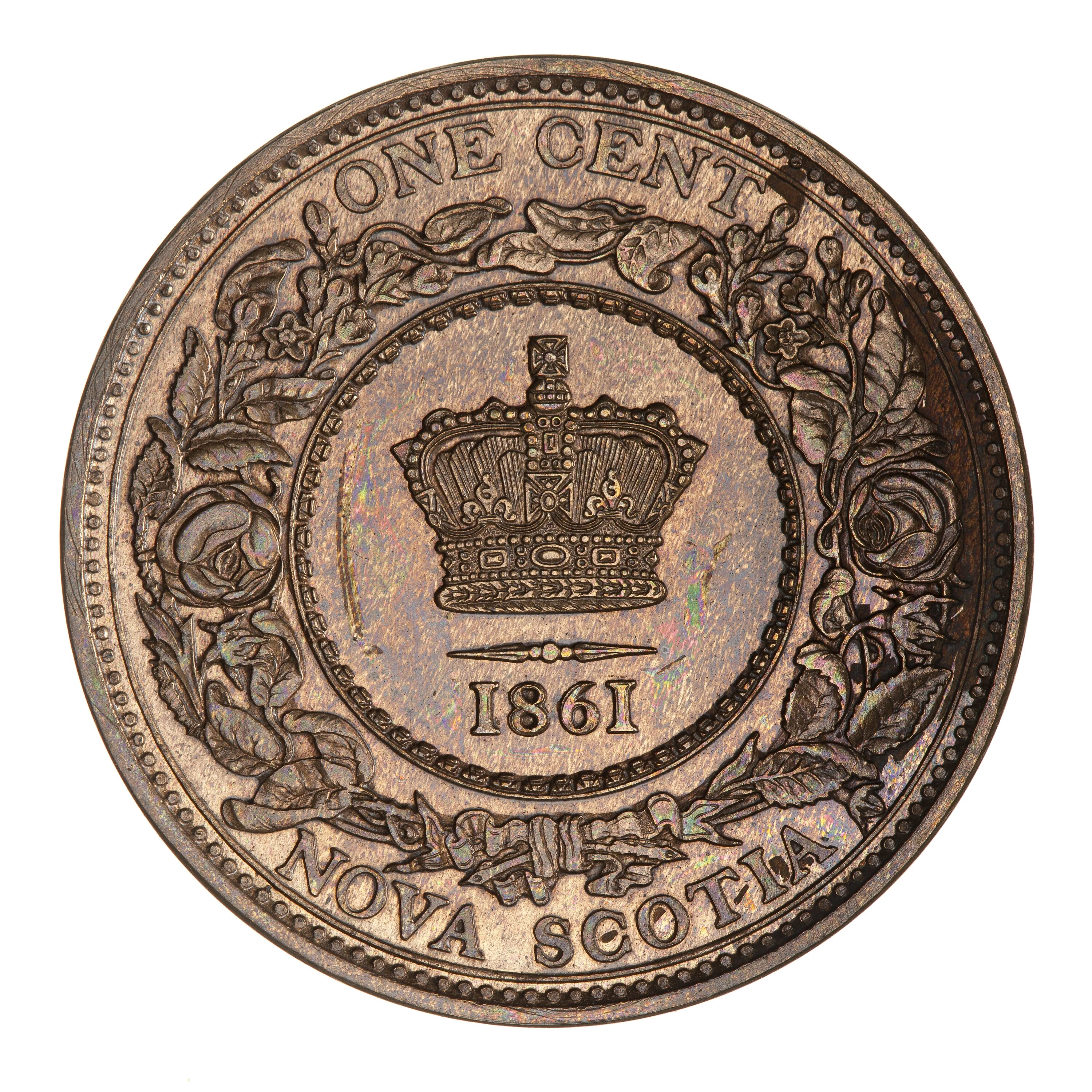
Reverse
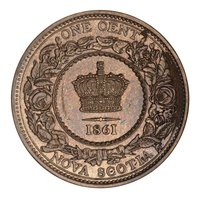
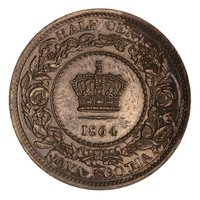
Description:
Imperial crown with mayflowers. Check comments for variations. Note bud size to right of SCOTIA.
Inscription:
ONE CENT
1861
NOVA SCOTIA
1861
NOVA SCOTIA
Script: Latin
Engraver: Horace Morehen
Edge
Plain
Mints
| Name | Mark |
|---|---|
| Royal Mint (Tower Hill) | — |
Mintings
| Year | Mint Mark | Mintage | Quality | Collection |
|---|---|---|---|---|
| 1861 | — | 1,800,000 | BU | |
| 1862 | — | — | BU | |
| 1864 | — | 800,000 | BU |
Historical background
In 1861, Nova Scotia, like the other British North American colonies, operated without a standardized national currency. The monetary system was a complex and often chaotic mix of foreign and domestic coins, bank notes, and government tokens. British gold sovereigns and silver coins circulated alongside Spanish and Mexican silver dollars, while the most common medium of everyday exchange was paper money issued by a handful of private, chartered banks like the Bank of Nova Scotia and the Halifax Banking Company. The value and acceptance of these banknotes were entirely dependent on public confidence in the issuing institution, leading to frequent discounts and instability, especially for notes from distant or less-trusted banks.
This fragmented system posed significant problems for trade and economic development. The provincial government had attempted to bring order by issuing its own copper coinage in the early 1860s and by passing the Provincial Note Act in 1861, which authorized the creation of government notes. However, these provincial notes were not yet a dominant force in the economy. Furthermore, the looming American Civil War to the south created economic uncertainty and heightened awareness of the need for a more resilient and unified financial system, a concern shared across the colonies.
Thus, the currency situation in 1861 was characterized by transition and growing pressure for reform. The inadequacies of the existing patchwork system were becoming increasingly apparent to merchants and politicians alike. This context of monetary disorder became a powerful practical argument in favour of a broader political union, directly contributing to the discussions that would culminate in the Charlottetown and Québec Conferences and, ultimately, the assignment of exclusive currency-issuing power to the federal government under the British North America Act of 1867.
This fragmented system posed significant problems for trade and economic development. The provincial government had attempted to bring order by issuing its own copper coinage in the early 1860s and by passing the Provincial Note Act in 1861, which authorized the creation of government notes. However, these provincial notes were not yet a dominant force in the economy. Furthermore, the looming American Civil War to the south created economic uncertainty and heightened awareness of the need for a more resilient and unified financial system, a concern shared across the colonies.
Thus, the currency situation in 1861 was characterized by transition and growing pressure for reform. The inadequacies of the existing patchwork system were becoming increasingly apparent to merchants and politicians alike. This context of monetary disorder became a powerful practical argument in favour of a broader political union, directly contributing to the discussions that would culminate in the Charlottetown and Québec Conferences and, ultimately, the assignment of exclusive currency-issuing power to the federal government under the British North America Act of 1867.
🌱 Very Common