

50 Shillings (1969 Revolution) – Somalia
Non-circulating coins
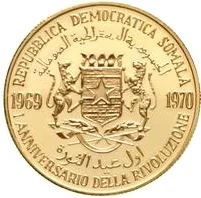
Commemoration: 1st Anniversary of 1969 Revolution
Somalia
Context

Material
References
KM: #Click to copy to clipboard18
Numista: #165156
Value
Exchange value: 50 SOS
Bullion value: $1048.82
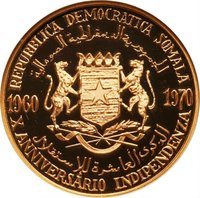
Obverse
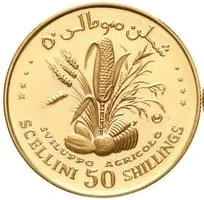
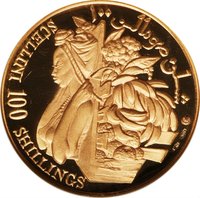
Reverse
Edge
Categories
| Agriculture |
| Symbols> Coat of Arms |
Mintings
| Year | Mint Mark | Mintage | Quality | Collection |
|---|---|---|---|---|
| 1970 | — | — | Proof |
Historical background
In 1970, Somalia’s currency situation was characterized by the exclusive use of the Somali shilling (SOS), which had been introduced in 1962 to replace the East African shilling. This move was a key part of post-independence nation-building, creating a sovereign monetary symbol for the young republic. The currency was managed by the Central Bank of Somalia, established in 1960, and enjoyed a period of relative stability, being pegged to major international currencies like the US dollar and the British pound sterling. This peg facilitated trade and provided a measure of predictability in the early years of the civilian government.
Politically, 1970 was a pivotal year, as the military coup led by Siad Barre in October 1969 had just solidified its power, declaring the country a socialist state. The new regime initially maintained the existing monetary system but signaled a shift toward centralized economic planning. The shilling remained the legal tender, but its management began to align with the government's new ideological direction, focusing on state control of key financial institutions and a move away from the previous market-oriented policies.
Looking ahead, the stability of 1970 was fragile and presaged future difficulties. While not yet in crisis, the foundations for later hyperinflation and currency collapse were being laid. The government's increasing fiscal deficits, driven by ambitious public spending and military expansion, would eventually lead to excessive money printing. Combined with the devastating civil war that would erupt in the late 1980s, these factors ultimately led to the Central Bank's loss of monetary control and the shilling's severe devaluation in the decades following 1970.
Politically, 1970 was a pivotal year, as the military coup led by Siad Barre in October 1969 had just solidified its power, declaring the country a socialist state. The new regime initially maintained the existing monetary system but signaled a shift toward centralized economic planning. The shilling remained the legal tender, but its management began to align with the government's new ideological direction, focusing on state control of key financial institutions and a move away from the previous market-oriented policies.
Looking ahead, the stability of 1970 was fragile and presaged future difficulties. While not yet in crisis, the foundations for later hyperinflation and currency collapse were being laid. The government's increasing fiscal deficits, driven by ambitious public spending and military expansion, would eventually lead to excessive money printing. Combined with the devastating civil war that would erupt in the late 1980s, these factors ultimately led to the Central Bank's loss of monetary control and the shilling's severe devaluation in the decades following 1970.
✨ Legendary