

20 Lira (National Sovereignty) – Turkey
Non-circulating coins
Commemoration: Anniversary of National Sovereignty
Turkey
Context

Material
Diameter: 38.61 mm
Weight: 31.47 g
Silver weight: 29.11 g
Shape: Round
Composition: 92.5% Silver
Standard: Silver ounce
Magnetic: No
Technique: Milled
Alignment: Medal alignment

flip
References
KM: #Click to copy to clipboard1189
Numista: #164800
Value
Exchange value: 20 TRY = $0.46
Bullion value: $84.57
Inflation-adjusted value: 475.94 TRY
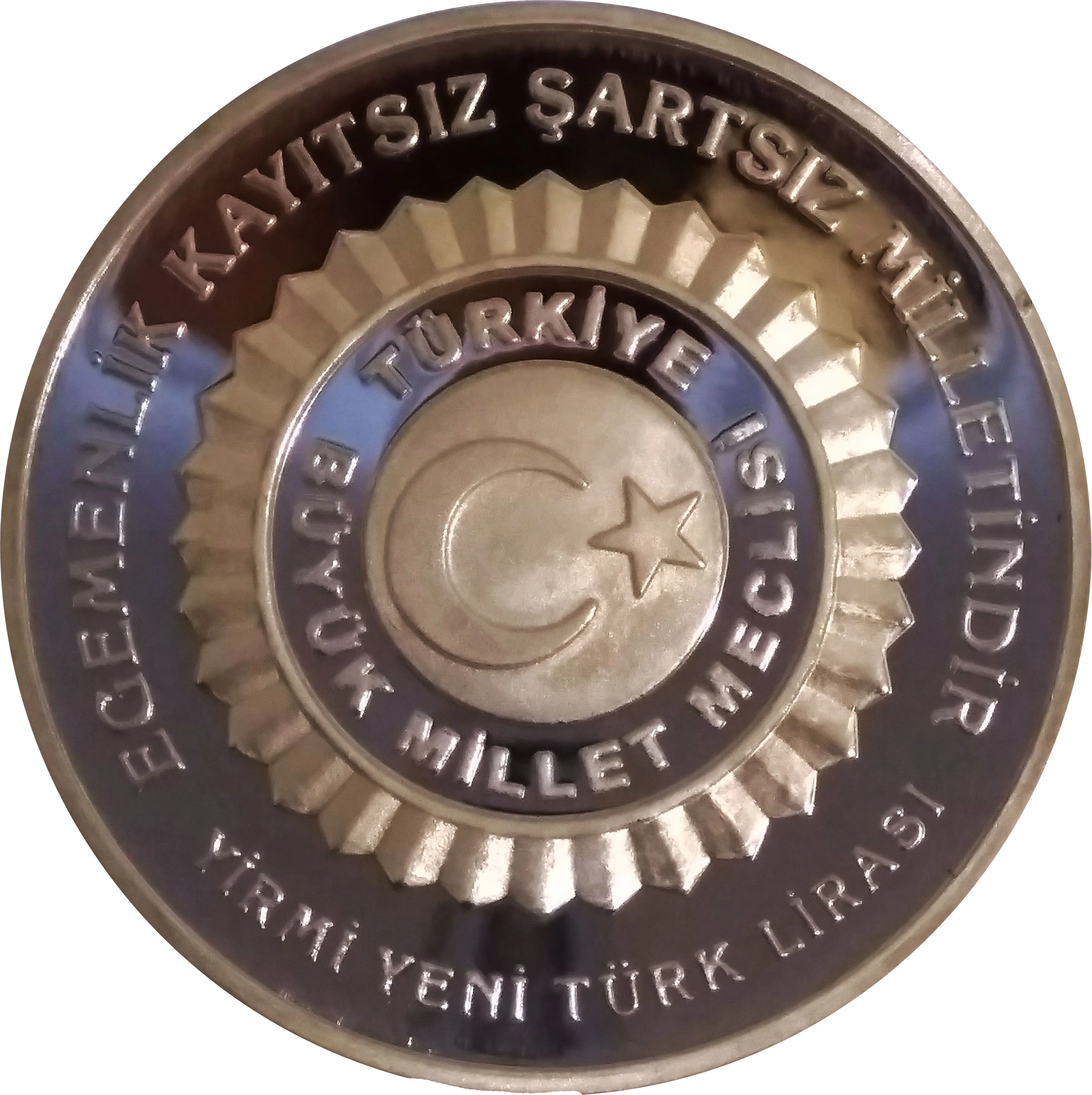
Obverse
Inscription:
Egemenlik Kayıtsız Şartsız Milletindir.
Türkiye Büyük Millet Meclisi
Yirmi Yeni Türk Lirası
Türkiye Büyük Millet Meclisi
Yirmi Yeni Türk Lirası
Translation:
Sovereignty belongs unconditionally to the Nation.
The Grand National Assembly of Turkey
Twenty New Turkish Liras
The Grand National Assembly of Turkey
Twenty New Turkish Liras
Script: Latin
Language: Turkish
Engraver: Suat Özyönüm
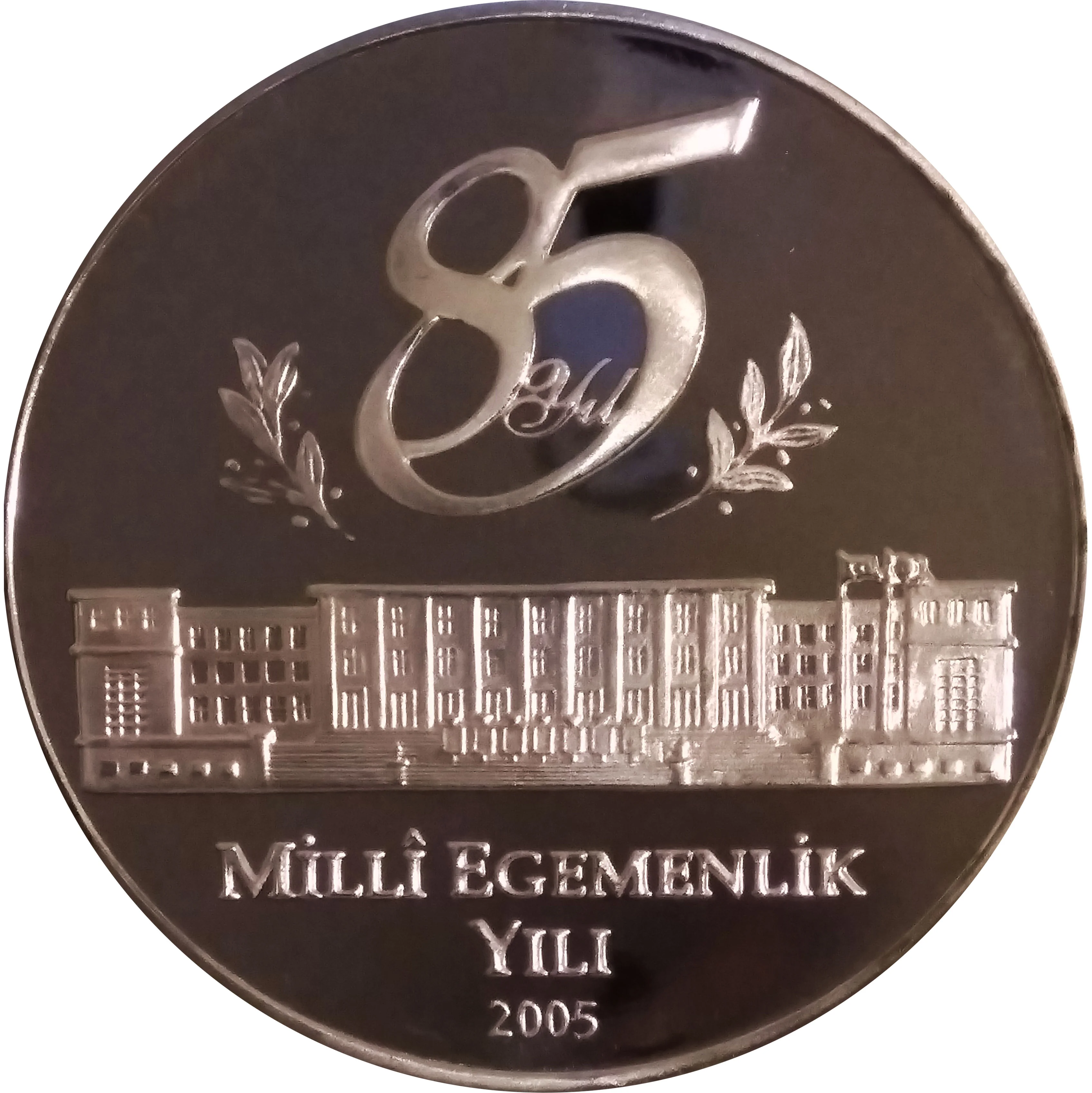
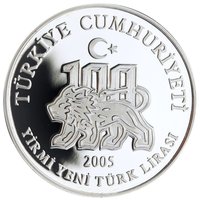
Reverse
Inscription:
85. Yıl - Milli Egemenlik Yılı
Translation:
85th Year - Year of National Sovereignty
Script: Latin
Language: Turkish
Engraver: Suat Özyönüm
Edge
Reeded
Mints
| Name | Mark |
|---|---|
| Turkish State Mint | — |
Mintings
| Year | Mint Mark | Mintage | Quality | Collection |
|---|---|---|---|---|
| 2005 | — | 1,216 | Proof |
Historical background
In 2005, Turkey's currency situation was defined by a landmark achievement: the introduction of the New Turkish Lira (YTL). This was the culmination of a radical redenomination, removing six zeros from the old, severely inflated currency to restore functionality and public confidence. The reform, enacted on January 1, was a symbolic cornerstone of the government's broader economic stabilization program, heavily backed by the International Monetary Fund. It aimed to draw a clear line under a history of chronic high inflation and currency weakness that had plagued the country for decades.
This monetary reform was underpinned by a period of relative macroeconomic stability under Prime Minister Recep Tayyip Erdoğan and his economic minister, Ali Babacan. Following a severe financial crisis in 2001, Turkey had adopted a tight fiscal policy, independent central bank targeting, and a floating exchange rate regime. By 2005, these policies had successfully reduced inflation from peak hyperinflationary levels to around 8%, fostering a sense of optimism. The strong political commitment to EU accession negotiations, which formally began in October 2005, also bolstered investor sentiment and supported the Lira.
However, the situation was not without underlying vulnerabilities. The current account deficit was widening significantly, fueled by a strong consumer demand for imports and high energy prices. Economic growth was heavily reliant on short-term foreign capital inflows ("hot money") to finance this deficit, making the economy sensitive to shifts in global risk appetite. While the new currency was a success in practical terms, these persistent structural imbalances hinted at future challenges, setting the stage for the pressures that would re-emerge in the years following this period of calm.
This monetary reform was underpinned by a period of relative macroeconomic stability under Prime Minister Recep Tayyip Erdoğan and his economic minister, Ali Babacan. Following a severe financial crisis in 2001, Turkey had adopted a tight fiscal policy, independent central bank targeting, and a floating exchange rate regime. By 2005, these policies had successfully reduced inflation from peak hyperinflationary levels to around 8%, fostering a sense of optimism. The strong political commitment to EU accession negotiations, which formally began in October 2005, also bolstered investor sentiment and supported the Lira.
However, the situation was not without underlying vulnerabilities. The current account deficit was widening significantly, fueled by a strong consumer demand for imports and high energy prices. Economic growth was heavily reliant on short-term foreign capital inflows ("hot money") to finance this deficit, making the economy sensitive to shifts in global risk appetite. While the new currency was a success in practical terms, these persistent structural imbalances hinted at future challenges, setting the stage for the pressures that would re-emerge in the years following this period of calm.


✨ Legendary