

50 Pyas – Myanmar
Circulating commemorative coins
Commemoration: F.A.O.
Myanmar

Obverse
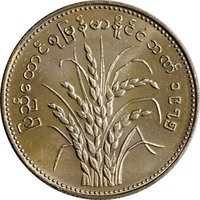
Description:
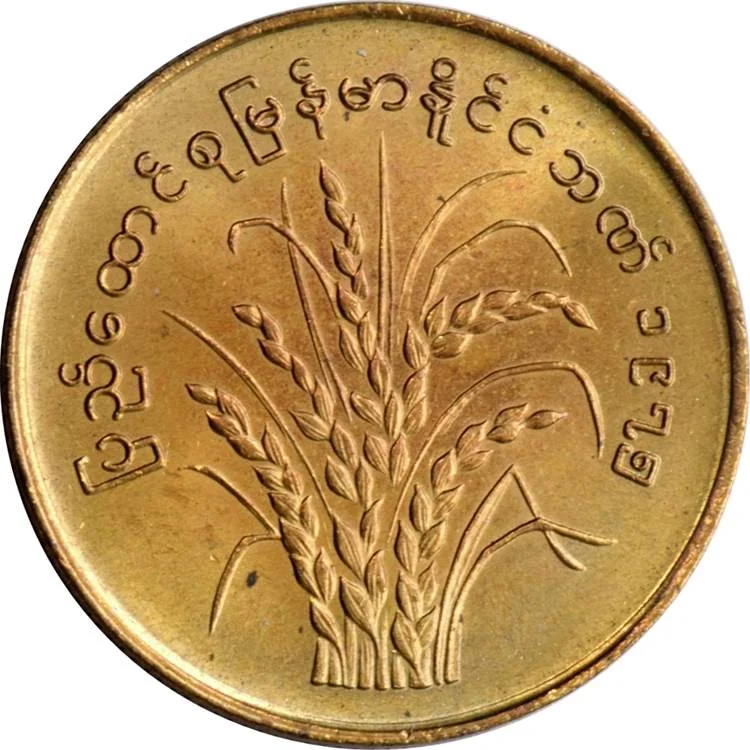
Rice plant, dated.
Inscription:
ပြည်ထောင်စု မြန်မာ နိုင်ငံ ဘဏ် ၁၉၇၅
Translation:
Union of Myanmar Bank 1975
Language: Burmese
Reverse
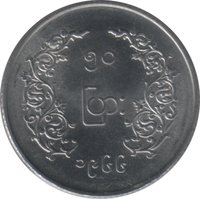
Description:
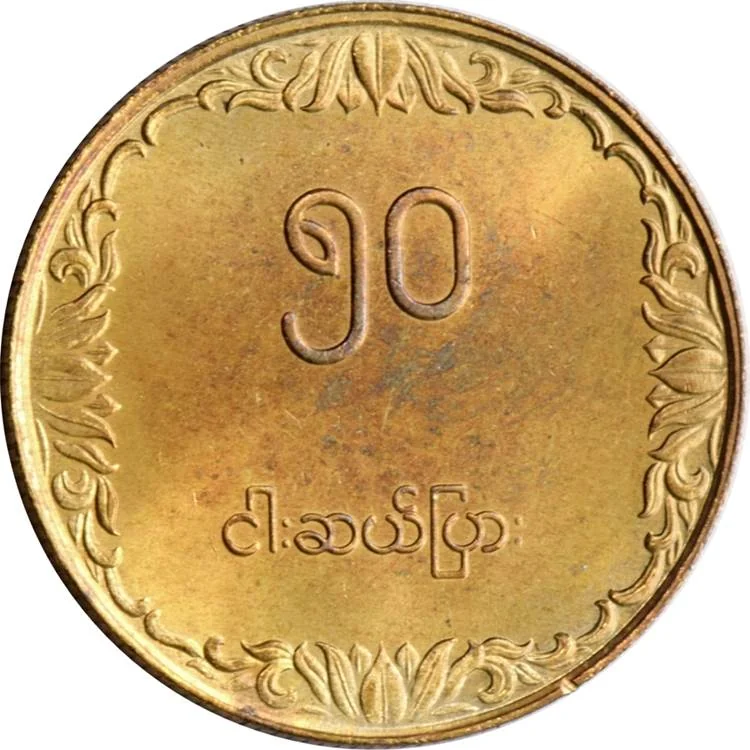
Central square's border defines its denomination.
Inscription:
၅၀
ငါးဆယ်ပြား
ငါးဆယ်ပြား
Translation:
Fifty Pyas
Language: Burmese
Edge
Reeded
Categories
| Organization> FAO |
Mintings
| Year | Mint Mark | Mintage | Quality | Collection |
|---|---|---|---|---|
| 1975 | — | — | ||
| 1976 | — | — |
Historical background
In 1975, Myanmar’s currency situation was defined by the rigid, state-controlled economic system of General Ne Win’s socialist government, which had been in place since the 1962 coup. The national currency, the kyat, operated under a complex and unsustainable fixed exchange rate regime set by the government. The official rate was pegged at approximately 4.8 to 5 kyat to the U.S. dollar, a gross overvaluation that bore no relation to economic reality. This policy was a cornerstone of the "Burmese Way to Socialism," which aimed for economic isolation and self-sufficiency, but it severely distorted trade and crippled the formal economy.
The disparity between the official rate and the black-market rate was stark and growing. By the mid-1970s, the black-market value of the kyat had plummeted to between 20 to 30 kyat per dollar, reflecting a severe lack of confidence in the currency and the wider economy. This vast gap encouraged rampant smuggling and corruption, as legitimate export earnings through official channels became unprofitable. The state's demonetization of high-value banknotes (25, 50, and 100 kyat) in 1964 had already eroded public trust, and by 1975, a thriving underground economy operated largely on foreign currency, gold, and barter, undermining the official monetary system.
Consequently, the currency situation in 1975 was a critical symptom of Myanmar’s deepening economic stagnation. The overvalued kyat discouraged foreign investment and legal exports, while essential imports became prohibitively expensive for the state, leading to widespread shortages of goods. The government maintained strict currency controls, but these measures only exacerbated inefficiencies and fueled inflation. This unsustainable financial environment, characterized by a dysfunctional dual-exchange rate system, entrenched poverty and set the stage for the severe economic crises that would unfold in the decades to follow.
The disparity between the official rate and the black-market rate was stark and growing. By the mid-1970s, the black-market value of the kyat had plummeted to between 20 to 30 kyat per dollar, reflecting a severe lack of confidence in the currency and the wider economy. This vast gap encouraged rampant smuggling and corruption, as legitimate export earnings through official channels became unprofitable. The state's demonetization of high-value banknotes (25, 50, and 100 kyat) in 1964 had already eroded public trust, and by 1975, a thriving underground economy operated largely on foreign currency, gold, and barter, undermining the official monetary system.
Consequently, the currency situation in 1975 was a critical symptom of Myanmar’s deepening economic stagnation. The overvalued kyat discouraged foreign investment and legal exports, while essential imports became prohibitively expensive for the state, leading to widespread shortages of goods. The government maintained strict currency controls, but these measures only exacerbated inefficiencies and fueled inflation. This unsustainable financial environment, characterized by a dysfunctional dual-exchange rate system, entrenched poverty and set the stage for the severe economic crises that would unfold in the decades to follow.
🌱 Very Common