

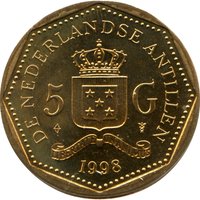
5 Gulden – Netherlands Antilles
Netherlands
Context
Years: 1998–2013
Country: Netherlands 
Issuer: Netherlands Antilles
Ruler: Beatrix
Currency:
(since 1828)
Demonetization: 31 March 2025
Total mintage: 2,411,600
Material
References
KM: #Click to copy to clipboard43
Numista: #10630
Value
Exchange value: 5 ANG
Inflation-adjusted value: 9.18 ANG
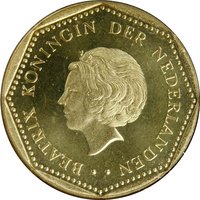
Obverse
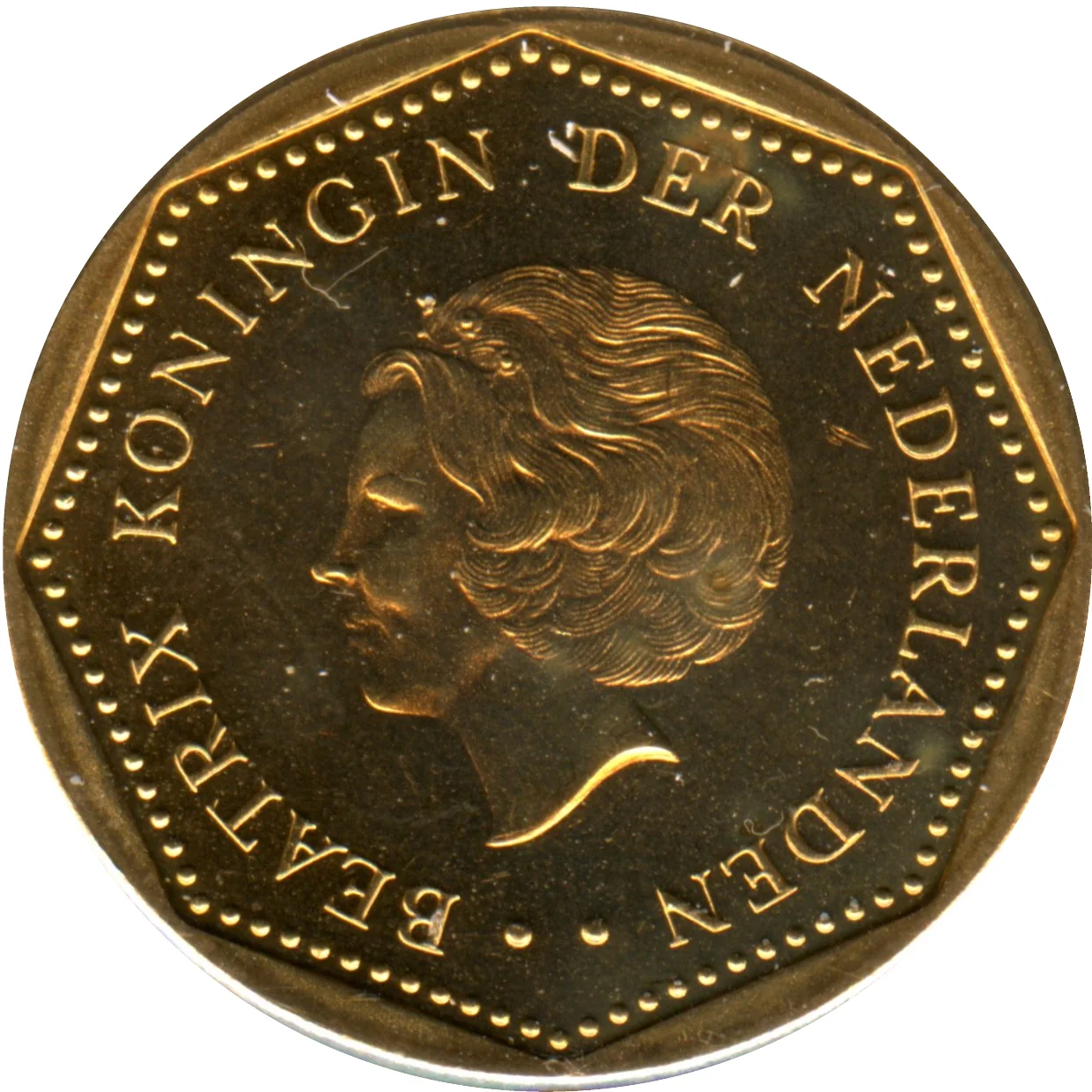
Description:
Queen Beatrix facing left
Inscription:
• BEATRIX KONINGIN DER NEDERLANDEN •
Translation:
Beatrix Queen of the Netherlands
Script: Latin
Language: Dutch
Engraver: Johan Christaan Hekman
Reverse
Edge
Categories
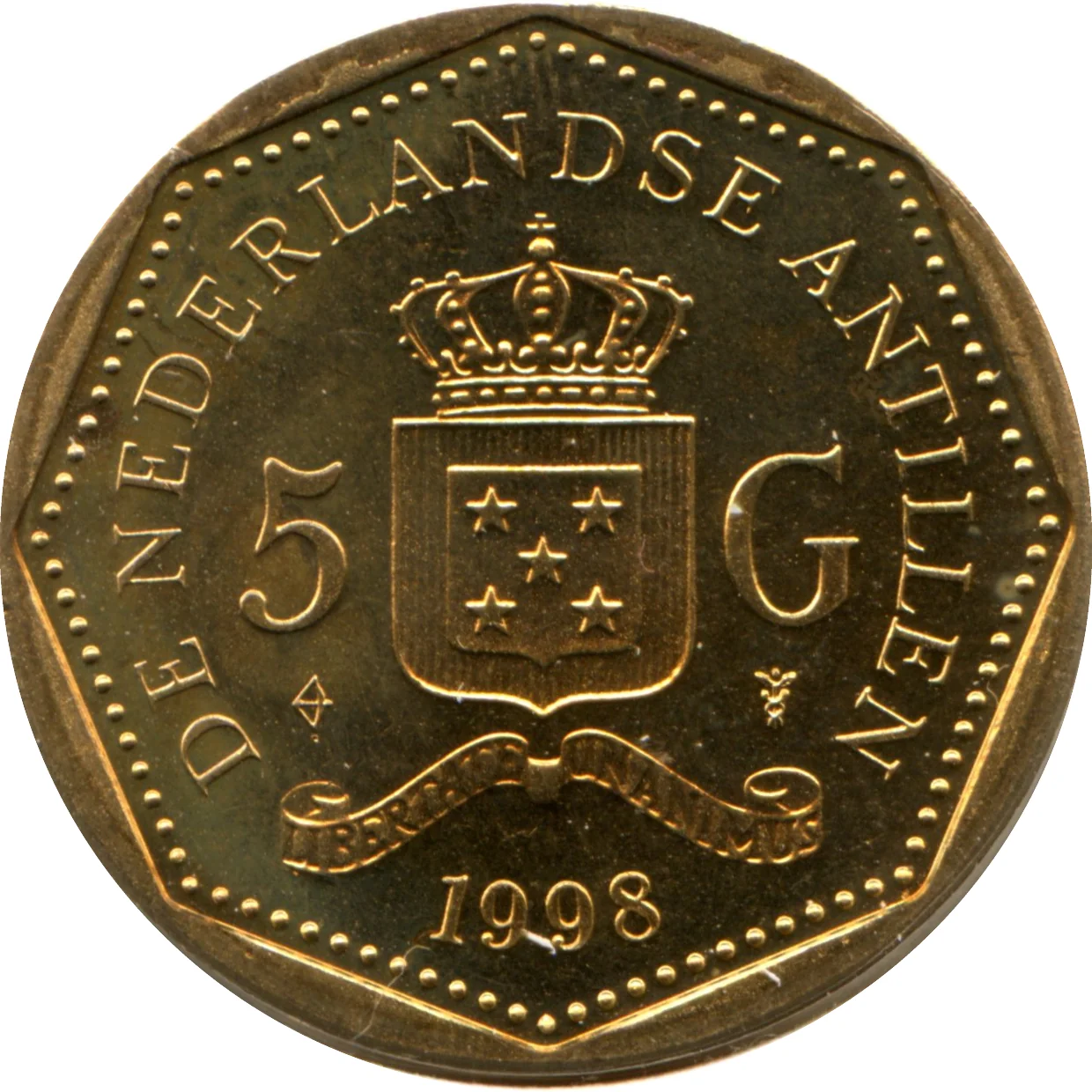
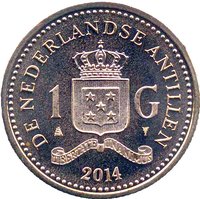
| Symbols> Coat of Arms |
| Symbol> Crown |
Mints
| Name | Mark |
|---|---|
| Royal Dutch Mint | — |
Mintings
| Year | Mint Mark | Mintage | Quality | Collection |
|---|---|---|---|---|
| 1998 | — | 607,000 | ||
| 1999 | — | 999,000 | ||
| 2000 | — | 9,000 | ||
| 2001 | — | 9,500 | ||
| 2002 | — | 6,000 | BU | |
| 2003 | — | 7,000 | ||
| 2004 | — | 102,100 | ||
| 2005 | — | 11,000 | ||
| 2006 | — | 2,000 | BU | |
| 2007 | — | 5,000 | ||
| 2008 | — | 119,000 | ||
| 2009 | — | 227,000 | ||
| 2010 | — | 302,000 | ||
| 2011 | — | 2,000 | BU | |
| 2012 | — | 2,000 | BU | |
| 2013 | — | 2,000 | BU |
Historical background
In 1998, the currency situation in the Netherlands Antilles was defined by its long-standing and unique monetary arrangement. The official currency was the Netherlands Antillean guilder (ANG), which had been pegged to the United States dollar at a fixed rate of 1.79 ANG = 1 USD since 1971. This peg was managed by the central bank of the Netherlands Antilles, the Bank van de Nederlandse Antillen (BNA), and was a cornerstone of monetary policy aimed at ensuring stability and predictability for the islands' open, tourism-dependent economies and their vital offshore financial sectors.
However, this stability existed against a backdrop of underlying economic and political challenges. The late 1990s saw the Netherlands Antilles grappling with persistent public debt issues, structural budget deficits, and occasional pressures on the currency peg. While the peg itself was not in immediate danger in 1998, maintaining it required disciplined fiscal policy and occasional support, which sometimes led to tensions between the autonomous island governments and the central bank. The financial sector, particularly in Curaçao, was also under increasing international scrutiny regarding regulation and transparency.
Furthermore, the political landscape was evolving, with ongoing discussions about the future constitutional status of the islands within the Kingdom of the Netherlands. This created an atmosphere of uncertainty about long-term monetary arrangements. While 1998 was not a year of crisis, it was a period where the sustainability of the existing currency model was being quietly questioned, setting the stage for future changes that would eventually lead to the dissolution of the Netherlands Antilles in 2010 and the subsequent adoption of the US dollar by Curaçao and Sint Maarten.
However, this stability existed against a backdrop of underlying economic and political challenges. The late 1990s saw the Netherlands Antilles grappling with persistent public debt issues, structural budget deficits, and occasional pressures on the currency peg. While the peg itself was not in immediate danger in 1998, maintaining it required disciplined fiscal policy and occasional support, which sometimes led to tensions between the autonomous island governments and the central bank. The financial sector, particularly in Curaçao, was also under increasing international scrutiny regarding regulation and transparency.
Furthermore, the political landscape was evolving, with ongoing discussions about the future constitutional status of the islands within the Kingdom of the Netherlands. This created an atmosphere of uncertainty about long-term monetary arrangements. While 1998 was not a year of crisis, it was a period where the sustainability of the existing currency model was being quietly questioned, setting the stage for future changes that would eventually lead to the dissolution of the Netherlands Antilles in 2010 and the subsequent adoption of the US dollar by Curaçao and Sint Maarten.
🌱 Common