

50 centimes – Madagascar
Add to wishlist
Madagascar
Context
Year: 1943
Issuer: Madagascar
Period:
(1940—1945)
Currency:
(1925—1945)
Demonetization: 1 September 1956
Total mintage: 4,000,000
Material
References
KM: #
Numista: #10627
Value
Exchange value: 0.50 MGG
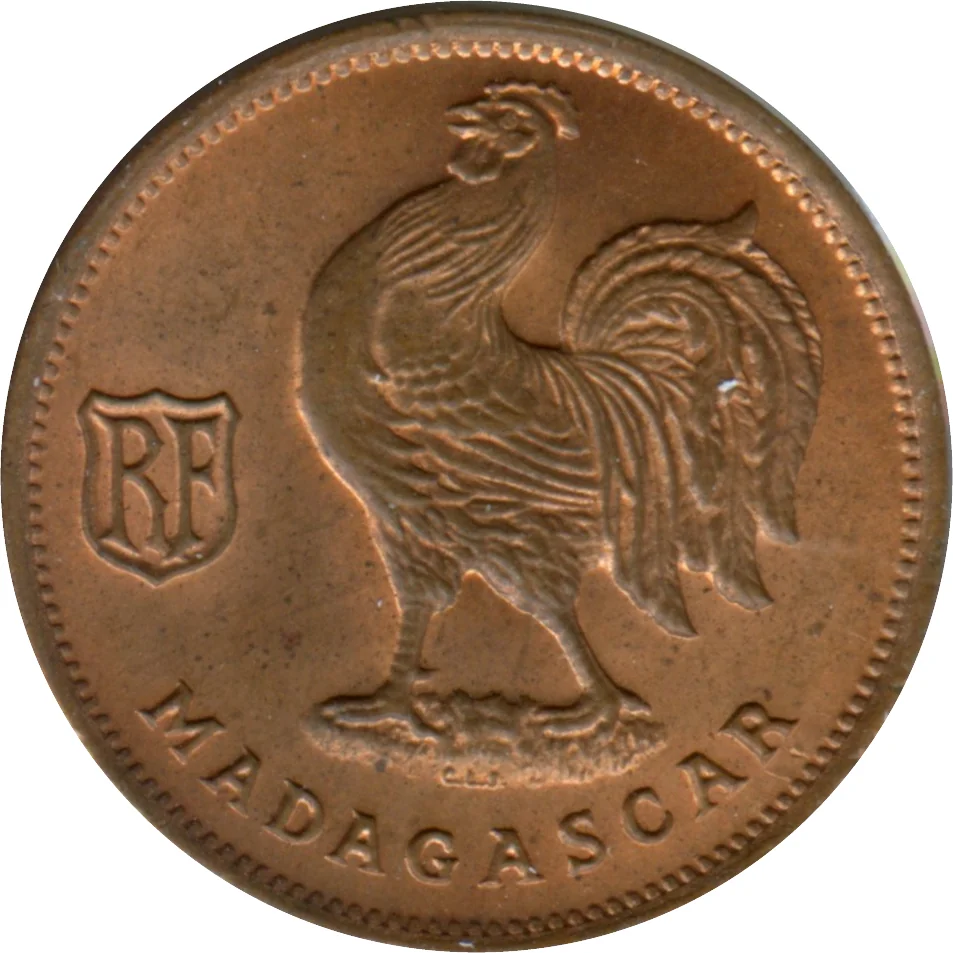
Obverse
Description:
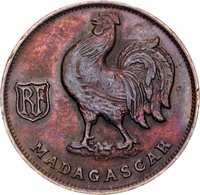
Rooster and "RF" initials on a coat of arms.
Inscription:
RF
MADAGASCAR
MADAGASCAR
Script: Latin
Engraver: Coert Laurens Steynberg
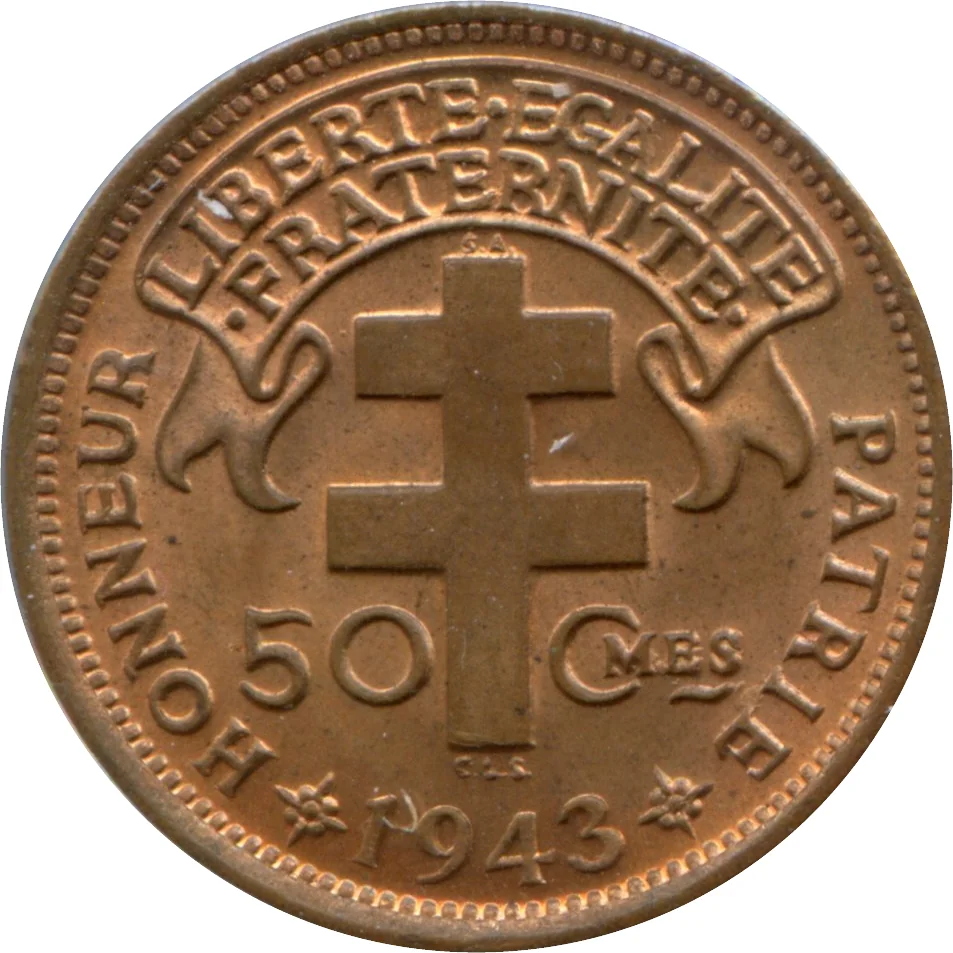
Reverse
Description:
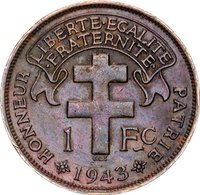
Cross of Lorraine splits value, date beneath.
Inscription:
HONNEUR LIBERTE·EGALITE PATRIE
·FRATERNITE·
50 Cmes
C.L.S
1943
·FRATERNITE·
50 Cmes
C.L.S
1943
Script: Latin
Engraver: Coert Laurens Steynberg
Edge
Plain
Mints
| Name | Mark |
|---|---|
| Pretoria | — |
Mintings
| Year | Mint Mark | Mintage | Quality | Collection |
|---|---|---|---|---|
| 1943 | SA | 4,000,000 |
Historical background
In 1943, Madagascar's currency situation was a direct consequence of the island's strategic importance in World War II and the fall of France in 1940. Following the French surrender, the colonial administration on Madagascar remained loyal to the Vichy regime, creating a complex monetary environment. The official currency remained the French franc, specifically issues from the Banque de Madagascar, but its legitimacy and convertibility were severely compromised. The island was economically isolated from the Free French and Allied forces, leading to shortages and inflationary pressures as trade routes were disrupted.
This instability culminated with the British-led Allied invasion (Operation Ironclad) in May 1942 to prevent Japanese use of the island. By 1943, full military control had been transferred to the Free French under General de Gaulle. One of the new administration's immediate tasks was to reform the currency to stabilize the economy and assert political authority. The Free French government demonetized the existing Vichy-affiliated banknotes and introduced a new currency issue for Madagascar, the "Free French franc" or "Madagascar franc," which was pegged to the British pound sterling for the duration of the war.
Thus, the currency situation in 1943 was one of transition and imposed stability. The new currency served to reintegrate Madagascar's economy into the Allied sphere, facilitating the island's role as a key supply and military base. However, this stability was artificial and externally enforced, masking underlying economic strain from the war effort and setting the stage for post-war monetary debates within the French colonial empire. The reforms primarily served military and political objectives, with long-term economic consequences for the Malagasy population yet to be fully felt.
This instability culminated with the British-led Allied invasion (Operation Ironclad) in May 1942 to prevent Japanese use of the island. By 1943, full military control had been transferred to the Free French under General de Gaulle. One of the new administration's immediate tasks was to reform the currency to stabilize the economy and assert political authority. The Free French government demonetized the existing Vichy-affiliated banknotes and introduced a new currency issue for Madagascar, the "Free French franc" or "Madagascar franc," which was pegged to the British pound sterling for the duration of the war.
Thus, the currency situation in 1943 was one of transition and imposed stability. The new currency served to reintegrate Madagascar's economy into the Allied sphere, facilitating the island's role as a key supply and military base. However, this stability was artificial and externally enforced, masking underlying economic strain from the war effort and setting the stage for post-war monetary debates within the French colonial empire. The reforms primarily served military and political objectives, with long-term economic consequences for the Malagasy population yet to be fully felt.
🌱 Common