

100 Dollars – United States
Non-circulating coins
Commemoration: Judicial Branch
United States
Context
Material
Diameter: 32.7 mm
Weight: 31.11 g
Platinum weight: 31.09 g
Thickness: 2.39 mm
Shape: Round
Composition: 99.95% Platinum
Standard: Silver ounce
Technique: Milled
Alignment: Coin alignment
flip
References
KM: #Click to copy to clipboard437
Numista: #101541
Value
Exchange value: 100 USD = $100.00
Bullion value: $0.00
Inflation-adjusted value: 154.83 USD
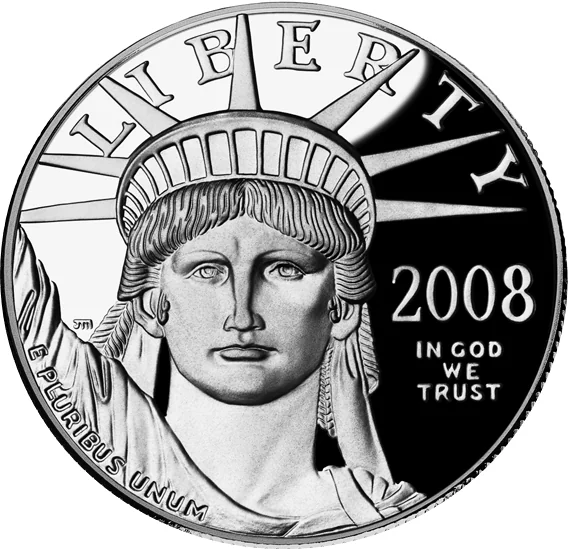
Obverse
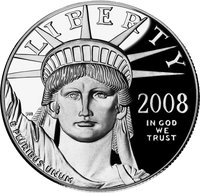
Description:
Liberty Enlightening the World
Inscription:
LIBERTY
2008
JM
IN GOD
WE
TRUST
E PLURIBUS UNUM
2008
JM
IN GOD
WE
TRUST
E PLURIBUS UNUM
Script: Latin
Engraver: John M. Mercanti
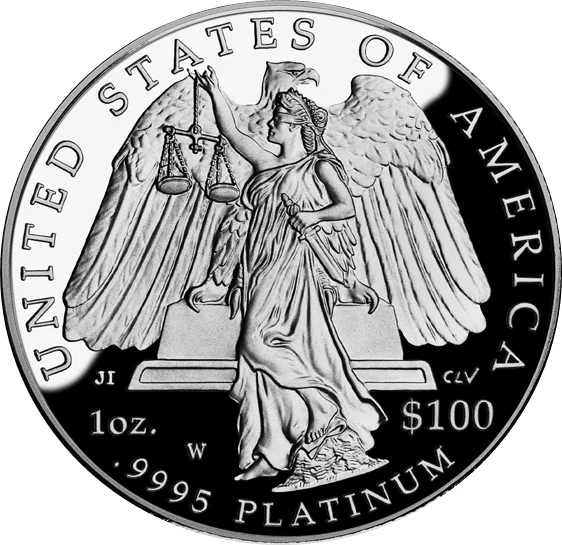
Reverse
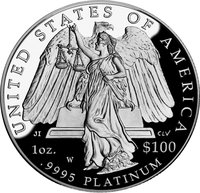
Description:
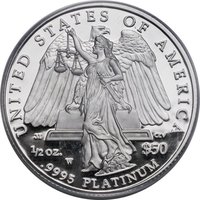
Lady Justice, a classic symbol, holds scales for the balance of law and a sword for the power of judgment.
Inscription:
UNITED STATES OF AMERICA
JI CLV
1oz. $100
W
.9995 PLATINUM
JI CLV
1oz. $100
W
.9995 PLATINUM
Script: Latin
Engravers: Joel Iskowitz, Charles Lessie Vickers
Edge
Reeded
Mints
| Name | Mark |
|---|---|
| United States Mint of West Point | W |
Historical background
The United States entered 2008 in a precarious economic position, with a housing market collapse that had begun in 2007 triggering a severe financial crisis. This created intense pressure on the U.S. dollar and the broader monetary system. As major financial institutions like Bear Stearns and Lehman Brothers faced insolvency due to exposure to toxic mortgage-backed securities, credit markets froze. The Federal Reserve, led by Chairman Ben Bernanke, was forced to take unprecedented and expansive actions to provide liquidity and prevent a total systemic meltdown, dramatically altering the currency and monetary landscape.
In response to the crisis, the Federal Reserve embarked on a radical policy path known as "quantitative easing" (QE). It slashed the federal funds rate effectively to zero by December 2008 and began creating new money to purchase vast quantities of Treasury bonds and mortgage-backed securities. The goal was to lower long-term interest rates, stimulate borrowing, and restore confidence. This massive expansion of the Fed's balance sheet, which ballooned from under $900 billion to over $2 trillion in months, raised significant concerns about potential long-term dollar devaluation and future inflation, though these effects were largely muted in the immediate term by the powerful deflationary forces of the crisis.
Throughout this period, the U.S. dollar experienced significant volatility. Initially, it surged during the peak panic in late 2008 as investors worldwide sought the safety and liquidity of U.S. Treasury securities, a phenomenon known as a "flight to quality." However, as the Fed's aggressive money-printing measures took hold and global risk appetite tentatively returned, the dollar began a sustained decline against other major currencies through 2009. The 2008 currency situation thus set the stage for a new era of unconventional monetary policy, with the Fed actively managing the money supply in ways not seen since World War II, fundamentally reshaping the dollar's role in the global economy for years to come.
In response to the crisis, the Federal Reserve embarked on a radical policy path known as "quantitative easing" (QE). It slashed the federal funds rate effectively to zero by December 2008 and began creating new money to purchase vast quantities of Treasury bonds and mortgage-backed securities. The goal was to lower long-term interest rates, stimulate borrowing, and restore confidence. This massive expansion of the Fed's balance sheet, which ballooned from under $900 billion to over $2 trillion in months, raised significant concerns about potential long-term dollar devaluation and future inflation, though these effects were largely muted in the immediate term by the powerful deflationary forces of the crisis.
Throughout this period, the U.S. dollar experienced significant volatility. Initially, it surged during the peak panic in late 2008 as investors worldwide sought the safety and liquidity of U.S. Treasury securities, a phenomenon known as a "flight to quality." However, as the Fed's aggressive money-printing measures took hold and global risk appetite tentatively returned, the dollar began a sustained decline against other major currencies through 2009. The 2008 currency situation thus set the stage for a new era of unconventional monetary policy, with the Fed actively managing the money supply in ways not seen since World War II, fundamentally reshaping the dollar's role in the global economy for years to come.
✨ Legendary