

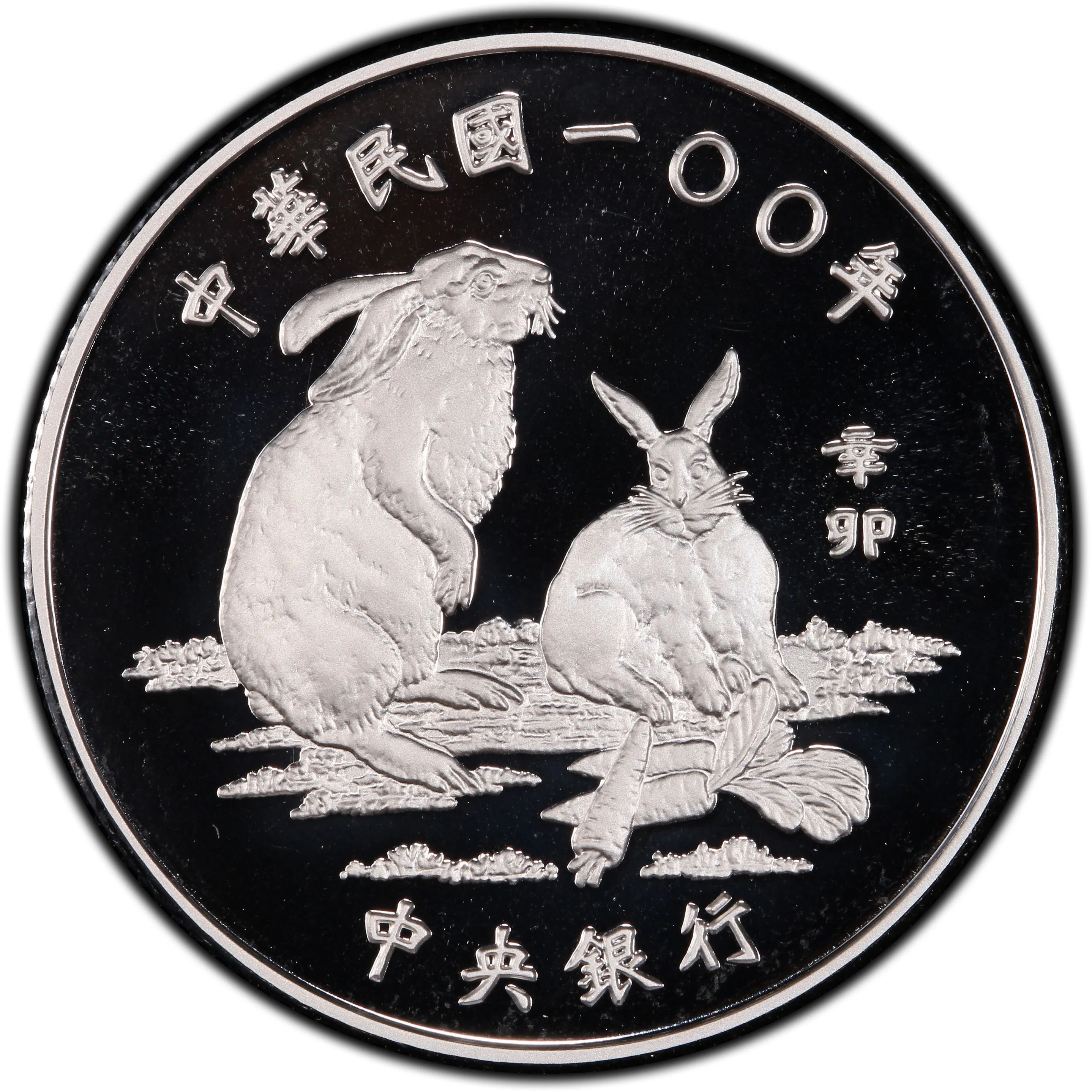
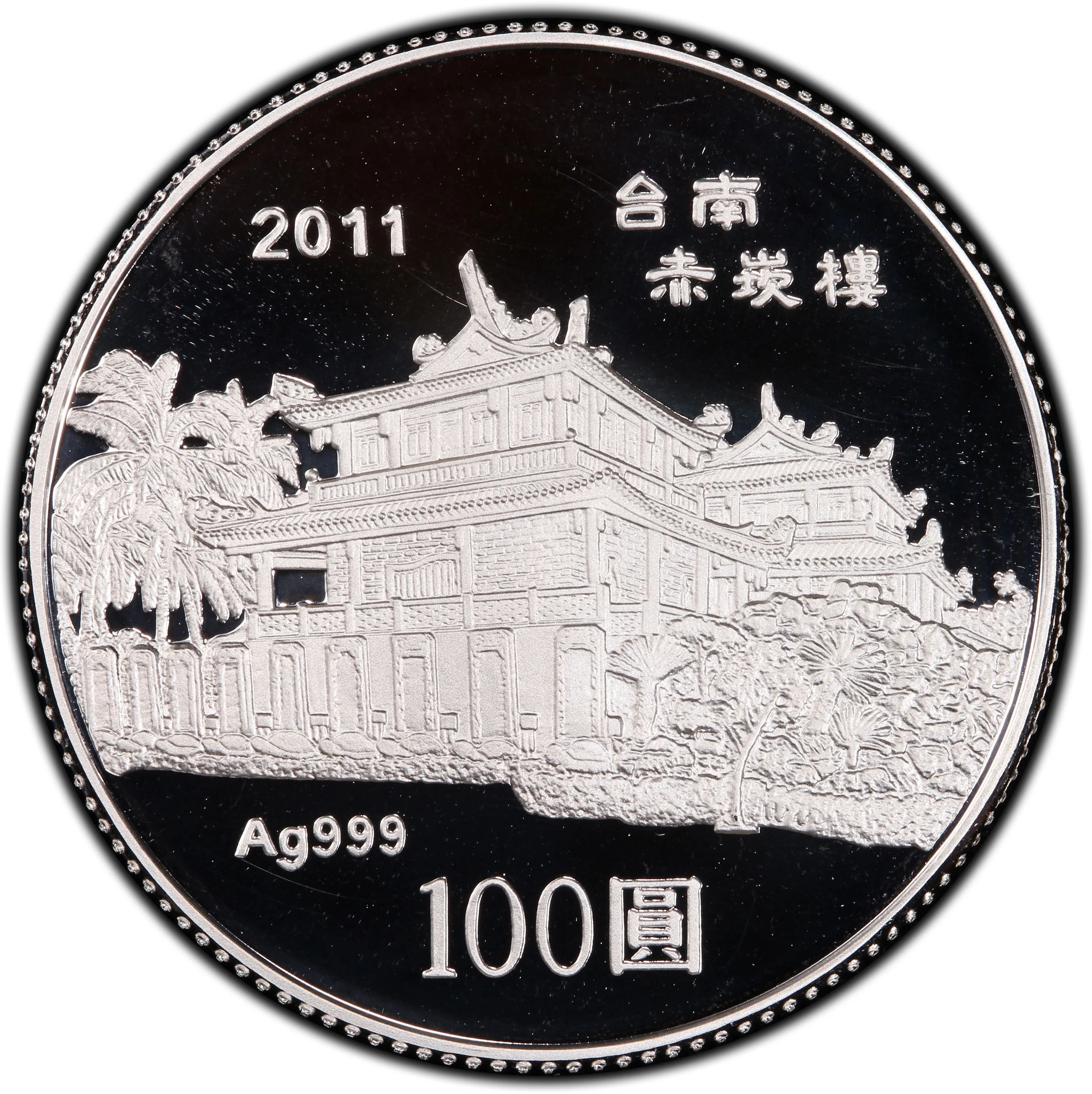
100 Yuan – Taiwan
Non-circulating coins
Commemoration: Lunar Year of the Rabbit
China
Context


Material
Diameter: 38 mm
Weight: 31.14 g
Silver weight: 31.11 g
Shape: Round
Composition: 99.9% Silver
Standard: Silver ounce
Magnetic: No
Technique: Milled
References
Y: #Click to copy to clipboard589
Numista: #106224
Value
Exchange value: 100 TWD
Bullion value: $88.33
Inflation-adjusted value: 131.76 TWD
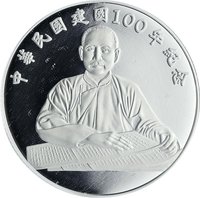
Obverse
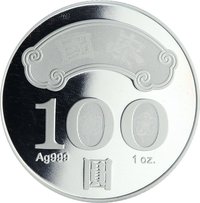
Reverse
Edge
Mintings
| Year | Mint Mark | Mintage | Quality | Collection |
|---|---|---|---|---|
| 2011 | — | 150,000 |
Historical background
In 2011, the currency situation in Taiwan was characterized by the New Taiwan Dollar (TWD) facing significant upward pressure against the US Dollar, driven by strong capital inflows and a robust export-led economic recovery from the global financial crisis. Taiwan's central bank, the Central Bank of the Republic of China (CBC), actively intervened in the foreign exchange market to moderate the pace of appreciation. This policy aimed to maintain the competitiveness of Taiwan's crucial export sector, particularly for its flagship electronics and semiconductor industries, which were major drivers of economic growth that year.
The CBC's management strategy involved routine interventions to smooth volatility and accumulate foreign reserves, which grew substantially. This approach was also influenced by regional dynamics, as many Asian central banks were engaged in similar actions to prevent their currencies from rising too rapidly against the Japanese Yen, especially after the Great East Japan Earthquake and tsunami in March 2011. Domestically, the strong TWD helped curb imported inflation, which was a global concern, but policymakers remained wary of potential asset bubbles forming from the influx of speculative "hot money."
Overall, the 2011 currency narrative was one of controlled appreciation. The CBC successfully balanced competing priorities: allowing enough currency strength to combat inflation and reflect economic fundamentals, while strategically tempering rises to protect exporters. This careful stewardship resulted in a relatively stable TWD within a managed float regime, contributing to Taiwan's economic stability and a growth rate of approximately 3.8% for the year, despite ongoing global economic uncertainties.
The CBC's management strategy involved routine interventions to smooth volatility and accumulate foreign reserves, which grew substantially. This approach was also influenced by regional dynamics, as many Asian central banks were engaged in similar actions to prevent their currencies from rising too rapidly against the Japanese Yen, especially after the Great East Japan Earthquake and tsunami in March 2011. Domestically, the strong TWD helped curb imported inflation, which was a global concern, but policymakers remained wary of potential asset bubbles forming from the influx of speculative "hot money."
Overall, the 2011 currency narrative was one of controlled appreciation. The CBC successfully balanced competing priorities: allowing enough currency strength to combat inflation and reflect economic fundamentals, while strategically tempering rises to protect exporters. This careful stewardship resulted in a relatively stable TWD within a managed float regime, contributing to Taiwan's economic stability and a growth rate of approximately 3.8% for the year, despite ongoing global economic uncertainties.
✨ Legendary