

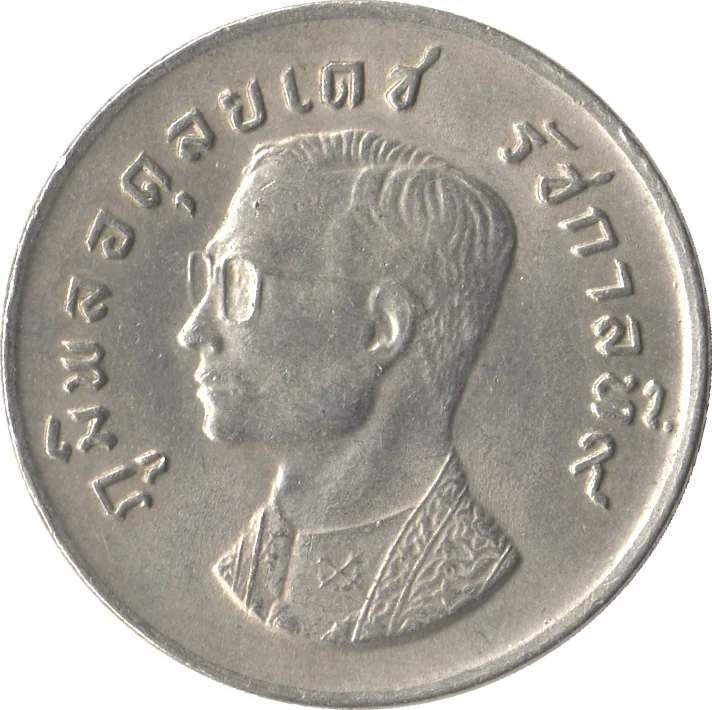
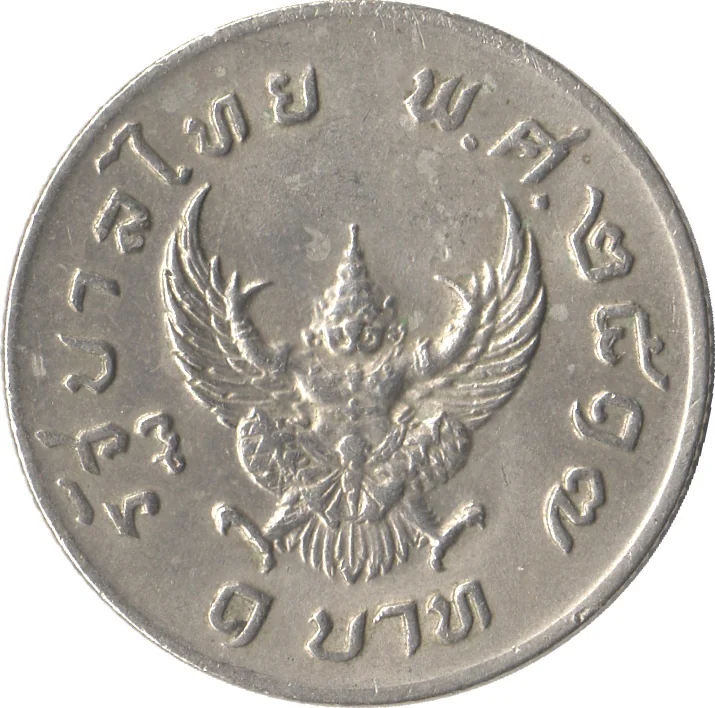
1 Baht – Thailand
Thailand
Context
Year: 1974
Thai Year: 2517
Issuer: Thailand 
Ruler: Bhumibol Adulyadej
Currency:
(since 1897)
Demonetized: Yes
Total mintage: 248,978,000
Material
Diameter: 25 mm
Weight: 7 g
Thickness: 1.81 mm
Shape: Round
Composition: Copper-nickel
Technique: Milled
Alignment: Coin alignment
flip
References
Y: #Click to copy to clipboard100
Numista: #1641
Value
Exchange value: 1 THB = $0.03
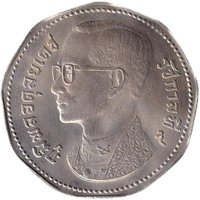
Obverse
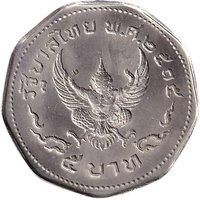
Reverse
Edge
Reeded
Categories
| Mythology> Fantastic animal |
| Person> Monarch |
Mintings
| Year | Mint Mark | Mintage | Quality | Collection |
|---|---|---|---|---|
| 1974 | — | 248,978,000 |
Historical background
In 1974, Thailand's currency situation was characterized by a managed exchange rate system under the auspices of the Bank of Thailand, with the baht pegged to the U.S. dollar. This period followed the 1971 Nixon Shock and the subsequent collapse of the Bretton Woods system, which had destabilized global fixed exchange rates. Thailand responded by shifting its peg from a strict gold-dollar standard to a more flexible arrangement, initially setting the baht at approximately 20.8 to the dollar. This peg was maintained through active intervention in the foreign exchange market, aiming to provide stability for an economy that was still largely agricultural but with growing export sectors like textiles and rice.
The domestic economic landscape presented significant challenges. The year 1974 was one of global stagflation, with high oil prices following the 1973 oil crisis driving inflation worldwide. Thailand experienced pronounced domestic inflation, which put downward pressure on the baht's real value and strained the fixed exchange rate. The cost of imports, particularly essential petroleum, surged, worsening the trade balance and creating a dilemma for monetary authorities. They had to balance defending the peg with foreign reserves against the need to control inflation through tighter monetary policy, a difficult task in a politically volatile year that saw a transition back to civilian rule after the 1973 student uprising.
Consequently, the currency regime of 1974 was one of underlying tension. The official peg provided a facade of stability crucial for trade and investment confidence, but it was maintained at the cost of depleting foreign reserves and imposing capital controls. These controls included restrictions on foreign exchange transactions to curb speculative outflows. The situation highlighted the baht's vulnerability to external shocks and set the stage for future pressures that would, decades later, culminate in the 1997 Asian Financial Crisis. The policies of 1974 thus reflected a transitional phase, where Thailand sought to shield its economy from global turbulence while navigating the complex trilemma of independent monetary policy, a fixed exchange rate, and open capital flows.
The domestic economic landscape presented significant challenges. The year 1974 was one of global stagflation, with high oil prices following the 1973 oil crisis driving inflation worldwide. Thailand experienced pronounced domestic inflation, which put downward pressure on the baht's real value and strained the fixed exchange rate. The cost of imports, particularly essential petroleum, surged, worsening the trade balance and creating a dilemma for monetary authorities. They had to balance defending the peg with foreign reserves against the need to control inflation through tighter monetary policy, a difficult task in a politically volatile year that saw a transition back to civilian rule after the 1973 student uprising.
Consequently, the currency regime of 1974 was one of underlying tension. The official peg provided a facade of stability crucial for trade and investment confidence, but it was maintained at the cost of depleting foreign reserves and imposing capital controls. These controls included restrictions on foreign exchange transactions to curb speculative outflows. The situation highlighted the baht's vulnerability to external shocks and set the stage for future pressures that would, decades later, culminate in the 1997 Asian Financial Crisis. The policies of 1974 thus reflected a transitional phase, where Thailand sought to shield its economy from global turbulence while navigating the complex trilemma of independent monetary policy, a fixed exchange rate, and open capital flows.
🌱 Very Common