

5 bahts – Thailand
Add to wishlist
Thailand
Context
Years: 1988–2008
Issuer: Thailand
Ruler: Bhumibol Adulyadej
Currency:
(since 1897)
Total mintage: 1,719,493,300
Material
References
Y: #
Numista: #1640
Value
Exchange value: 5 THB
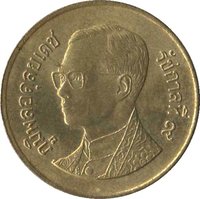
Obverse
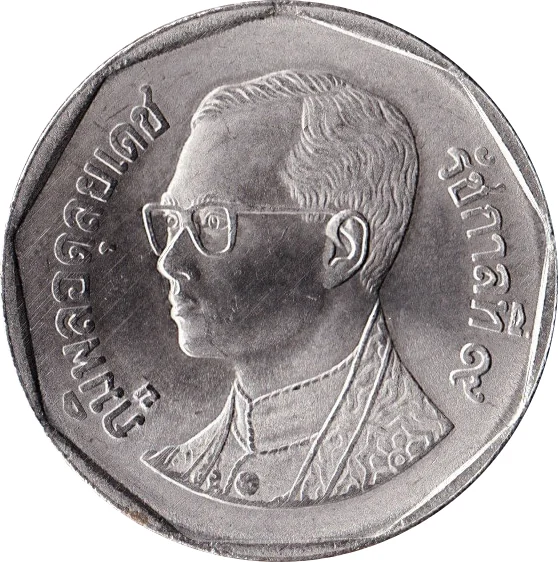
Description:
Bust of King Bhumibol Adulyadej, left profile.
Inscription:
ภูมิพลอดุลยเดช รัชกาลที่ ๙
Translation:
Bhumibol Adulyadej, the 9th Reign.
Script: Thai
Language: Thai
Engraver: Wuthichai Saengngoen
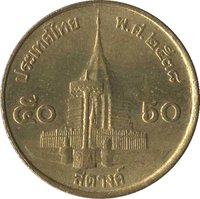
Reverse
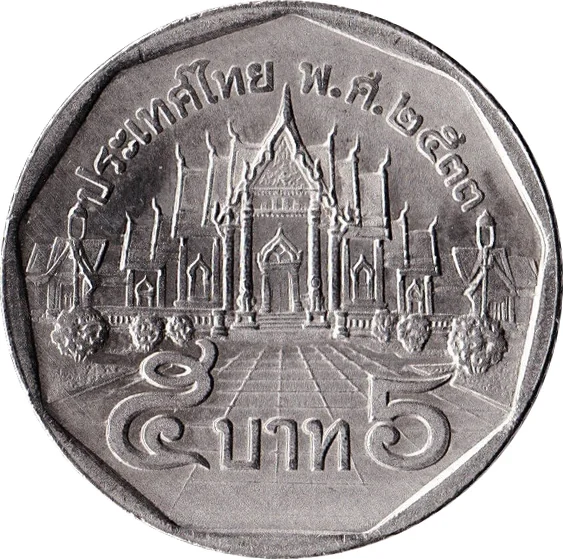
Description:
Wat Benchamabophit (The Marble Temple) façade. Denomination below.
Inscription:
ประเทศไทย พ.ศ.๒๕๓๓
๕ บาท 5
๕ บาท 5
Translation:
Thailand B.E. 2533
5 Baht 5
5 Baht 5
Script: Thai
Language: Thai
Engraver: Supab Aun-aree
Edge
Reeded.
Categories
| Building> Religious building |
Mints
| Name | Mark |
|---|---|
| Pathum Thani | — |
Mintings
| Year | Mint Mark | Mintage | Quality | Collection |
|---|---|---|---|---|
| 1988 | — | 44,503,000 | ||
| 1989 | — | 86,339,000 | ||
| 1990 | — | 38,005,000 | ||
| 1991 | — | 68,520,380 | ||
| 1992 | — | 48,939,620 | ||
| 1993 | — | 46,992,000 | ||
| 1994 | — | 123,443,000 | ||
| 1995 | — | 105,100,000 | ||
| 1996 | — | 28,485,000 | ||
| 1997 | — | 10,600 | ||
| 1998 | — | 7,863,000 | ||
| 1999 | — | 50,760,000 | ||
| 2000 | — | 146,920,000 | ||
| 2001 | — | 76,566,000 | ||
| 2002 | — | 29,601,500 | ||
| 2003 | — | 182,000 | ||
| 2003 | — | 5,000 | In sets | |
| 2004 | — | 120,187,000 | ||
| 2005 | — | 91,079,000 | ||
| 2006 | — | 254,403,000 | ||
| 2007 | — | 131,126,000 | ||
| 2008 | — | 220,463,200 |
Historical background
In 1988, Thailand's currency situation was characterized by relative stability and strength, underpinned by a period of robust economic growth and prudent monetary policy. The Thai baht (THB) was pegged to a basket of currencies, heavily weighted toward the US dollar, a managed exchange rate regime administered by the Bank of Thailand. This system provided predictability for trade and investment, which was crucial as Thailand was rapidly transforming into a newly industrialized economy, fueled by strong exports, foreign direct investment, and a burgeoning tourism sector. Inflation was under control, and the country's foreign exchange reserves were growing, reflecting a healthy balance of payments.
This stability, however, existed within a context of mounting external pressures and internal economic imbalances. Thailand's "economic miracle" led to a significant current account deficit, as the demand for imported capital goods and machinery to fuel industrialization outpaced export earnings. Furthermore, large-scale capital inflows, attracted by high domestic interest rates and a booming stock and property market, began to create challenges for monetary management. The fixed exchange rate peg, while stable, made the baht potentially vulnerable to speculative pressures if investor sentiment were to shift.
Consequently, 1988 stands as a pivotal calm before the storm. The apparent strength of the baht and the managed regime masked underlying vulnerabilities that would intensify in the coming years. The very success of the export-led growth model, combined with liberalized financial markets, was creating conditions of overheating and over-reliance on short-term foreign capital. These unresolved tensions would eventually culminate in the 1997 Asian Financial Crisis, which forced the abandonment of the baht peg. Thus, the currency situation in 1988 was one of surface-level stability, quietly setting the stage for a profound financial reckoning a decade later.
This stability, however, existed within a context of mounting external pressures and internal economic imbalances. Thailand's "economic miracle" led to a significant current account deficit, as the demand for imported capital goods and machinery to fuel industrialization outpaced export earnings. Furthermore, large-scale capital inflows, attracted by high domestic interest rates and a booming stock and property market, began to create challenges for monetary management. The fixed exchange rate peg, while stable, made the baht potentially vulnerable to speculative pressures if investor sentiment were to shift.
Consequently, 1988 stands as a pivotal calm before the storm. The apparent strength of the baht and the managed regime masked underlying vulnerabilities that would intensify in the coming years. The very success of the export-led growth model, combined with liberalized financial markets, was creating conditions of overheating and over-reliance on short-term foreign capital. These unresolved tensions would eventually culminate in the 1997 Asian Financial Crisis, which forced the abandonment of the baht peg. Thus, the currency situation in 1988 was one of surface-level stability, quietly setting the stage for a profound financial reckoning a decade later.
🌱 Very Common