

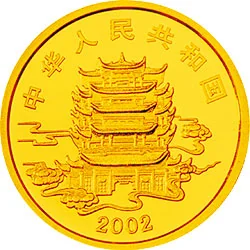
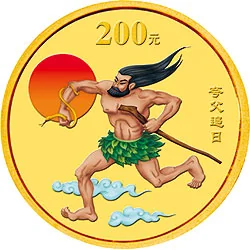
200 Yuan – People's Republic of China
China
Context
Year: 2002
Country: China 
Issuer: People's Republic of China
Period:
(since 1949)
Currency:
(since 1955)
Total mintage: 8,800
Material
Weight: 15.5 g
Gold weight: 15.48 g
Shape: Round
Composition: 99.9% Gold
Standard: Silver half ounce
Magnetic: No
Technique: Milled
Alignment: Medal alignment
flip
References
KM: #Click to copy to clipboard1431
Numista: #163913
Value
Exchange value: 200 CNY = $29.23
Bullion value: $2586.96
Inflation-adjusted value: 323.16 CNY
Mintings
| Year | Mint Mark | Mintage | Quality | Collection |
|---|---|---|---|---|
| 2002 | — | 8,800 |
Historical background
In 2002, the currency situation in the People's Republic of China was defined by a period of remarkable stability and controlled management under a fixed exchange rate regime. The Chinese yuan (Renminbi, RMB) was pegged strictly to the US dollar at an official rate of approximately 8.28 RMB/USD, a policy maintained since the Asian Financial Crisis of 1997-98. This peg provided a crucial anchor for trade and investment, fostering a surge in export-led growth and attracting massive foreign direct investment as China solidified its position within the World Trade Organization, which it had entered in late 2001. The primary focus for monetary authorities was not exchange rate flexibility, but rather managing the immense balance of payments surpluses and building up foreign exchange reserves, which were growing rapidly.
However, this rigid peg was increasingly seen by international trading partners, particularly the United States and the European Union, as a source of global economic imbalances. They argued that the yuan was significantly undervalued, giving Chinese exporters an unfair price advantage and contributing to large trade deficits. Internally, the People's Bank of China (PBOC) faced the complex task of sterilizing the influx of foreign capital to prevent domestic inflation, while also navigating the competing pressures of maintaining stability and preparing for future financial system reforms. The fixed rate limited independent monetary policy and created tensions as China's economic weight grew.
Thus, 2002 represented the calm before a significant policy shift. While the exchange rate itself showed almost no movement, it was a year of mounting internal and external pressure that set the stage for future reform. Discussions within China's leadership and financial institutions were increasingly focused on moving toward a more flexible, market-oriented exchange rate mechanism. This groundwork would culminate just three years later, in July 2005, with the historic revaluation of the yuan and the shift to a managed float against a basket of currencies, marking the end of the strict dollar peg era.
However, this rigid peg was increasingly seen by international trading partners, particularly the United States and the European Union, as a source of global economic imbalances. They argued that the yuan was significantly undervalued, giving Chinese exporters an unfair price advantage and contributing to large trade deficits. Internally, the People's Bank of China (PBOC) faced the complex task of sterilizing the influx of foreign capital to prevent domestic inflation, while also navigating the competing pressures of maintaining stability and preparing for future financial system reforms. The fixed rate limited independent monetary policy and created tensions as China's economic weight grew.
Thus, 2002 represented the calm before a significant policy shift. While the exchange rate itself showed almost no movement, it was a year of mounting internal and external pressure that set the stage for future reform. Discussions within China's leadership and financial institutions were increasingly focused on moving toward a more flexible, market-oriented exchange rate mechanism. This groundwork would culminate just three years later, in July 2005, with the historic revaluation of the yuan and the shift to a managed float against a basket of currencies, marking the end of the strict dollar peg era.
✨ Legendary