

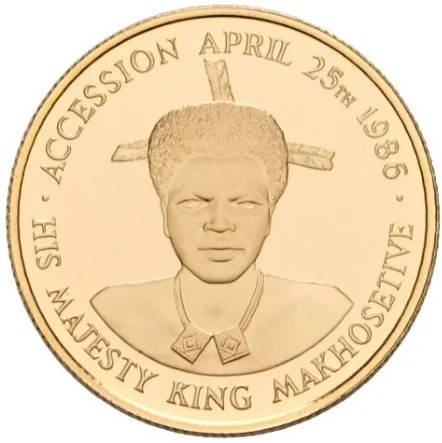
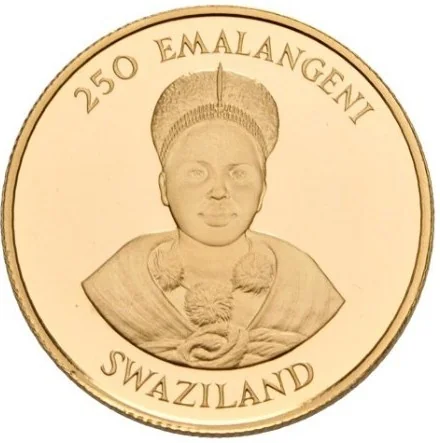
250 Emalangeni – Kingdom of Swaziland
Non-circulating coins
Commemoration: Accession of King Makhosetive
Eswatini
Context
Year: 1986
Country: Eswatini 
Issuer: Kingdom of Swaziland
Ruler: Mswati III
Currency:
(1974—2018)
Demonetization: 1 February 2016
Total mintage: 500
Material
References
KM: #Click to copy to clipboard38
Numista: #106131
Value
Exchange value: 250 SZL
Bullion value: $2436.29
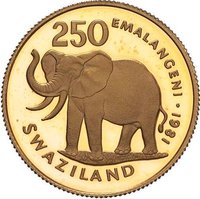
Obverse
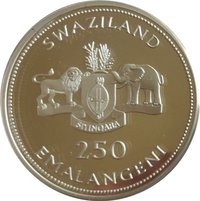
Reverse
Edge
Reeded
Mintings
| Year | Mint Mark | Mintage | Quality | Collection |
|---|---|---|---|---|
| 1986 | — | 250 | ||
| 1986 | — | 250 | Proof |
Historical background
In 1986, the Kingdom of Swaziland (renamed Eswatini in 2018) operated within a complex and dependent monetary framework, as it was a member of the Common Monetary Area (CMA) with South Africa and Lesotho. The cornerstone of its currency situation was the Lilangeni (plural: Emalangeni), which was pegged at par to the South African Rand. This peg meant the Lilangeni was not an independent currency but effectively a local denomination of the Rand, which circulated freely and interchangeably within Swaziland. This arrangement provided monetary stability and facilitated seamless trade with its dominant economic neighbor, but it also meant Swaziland ceded control over its monetary policy to the South African Reserve Bank.
The year 1986 was significant as it marked the formalization of this relationship under the Tripartite Monetary Agreement, which succeeded the earlier Rand Monetary Area. This agreement legally cemented the fixed 1:1 parity, guaranteed the free flow of funds, and outlined compensation for Swaziland and Lesotho for the seigniorage income lost by using the Rand. For the Swazi government under King Mswati III, who had ascended the throne the previous year, this system offered crucial economic stability amidst a period of political consolidation and regional tensions, particularly regarding apartheid South Africa.
However, this currency situation also underscored Swaziland's constrained economic sovereignty. While the CMA provided a buffer against inflation and exchange rate volatility, it locked the country's economic fortunes closely to South Africa's, making it vulnerable to economic shocks and policy decisions originating in Pretoria. Furthermore, the dual circulation of both currencies meant that any loss of confidence in the Lilangeni could lead to a preference for the Rand domestically. Thus, in 1986, Swaziland's currency was a symbol of both pragmatic regional integration and the limitations of a small, landlocked monarchy's economic autonomy within the Southern African landscape.
The year 1986 was significant as it marked the formalization of this relationship under the Tripartite Monetary Agreement, which succeeded the earlier Rand Monetary Area. This agreement legally cemented the fixed 1:1 parity, guaranteed the free flow of funds, and outlined compensation for Swaziland and Lesotho for the seigniorage income lost by using the Rand. For the Swazi government under King Mswati III, who had ascended the throne the previous year, this system offered crucial economic stability amidst a period of political consolidation and regional tensions, particularly regarding apartheid South Africa.
However, this currency situation also underscored Swaziland's constrained economic sovereignty. While the CMA provided a buffer against inflation and exchange rate volatility, it locked the country's economic fortunes closely to South Africa's, making it vulnerable to economic shocks and policy decisions originating in Pretoria. Furthermore, the dual circulation of both currencies meant that any loss of confidence in the Lilangeni could lead to a preference for the Rand domestically. Thus, in 1986, Swaziland's currency was a symbol of both pragmatic regional integration and the limitations of a small, landlocked monarchy's economic autonomy within the Southern African landscape.
✨ Legendary