

100 euro (Bank of Finland) – Finland
Add to wishlist
Non-circulating coins
Commemoration: Bank of Finland 200 years
Finland
Context
Material
References
KM: #
Numista: #106042
Value
Exchange value: 100 EUR
Bullion value: $797.56
Inflation-adjusted value: 135.35 EUR
Obverse
Description:
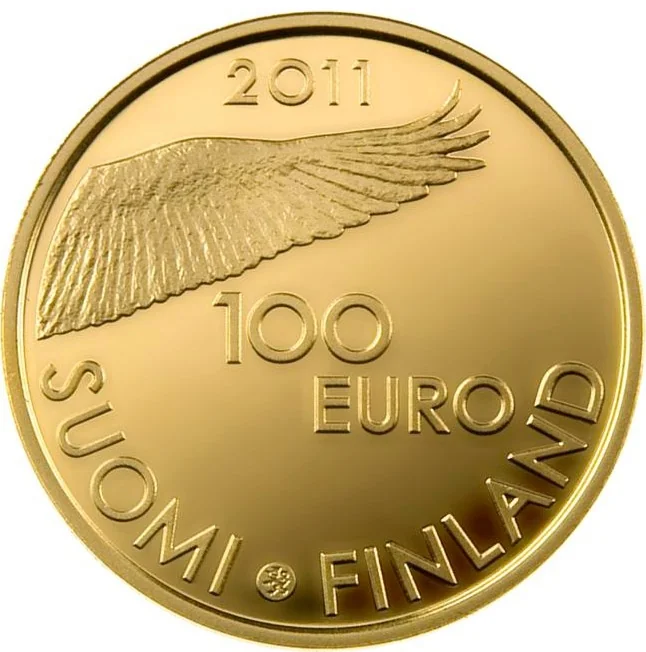
A swan's wing with the year, face value, and "SUOMI FINLAND."
Inscription:
2011
100 EURO
SUOMI FINLAND
100 EURO
SUOMI FINLAND
Translation:
2011
100 EURO
SUOMI FINLAND
100 EURO
SUOMI FINLAND
Script: Latin
Engraver: Hannu Veijalainen
Reverse
Description:
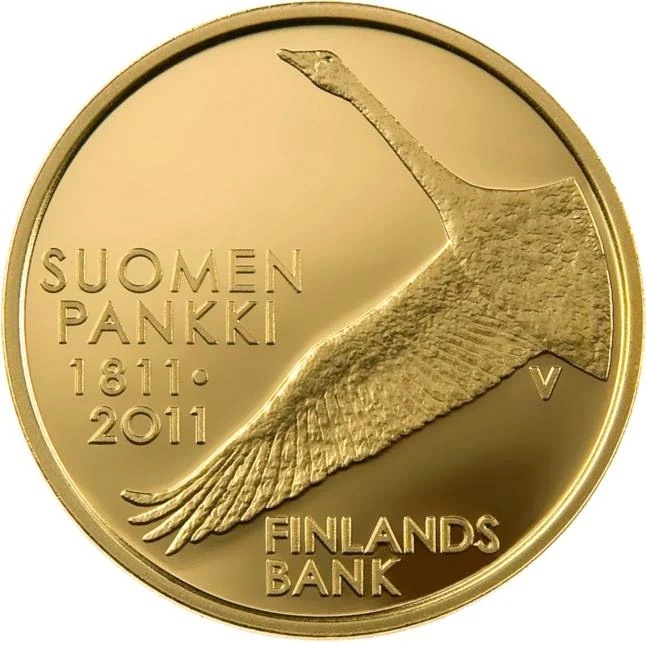
Finland's swan symbol.
Inscription:
SUOMEN PANKKI
1811·
2011
V
FINLANDS
BANK
1811·
2011
V
FINLANDS
BANK
Script: Latin
Engraver: Hannu Veijalainen
Edge
Plain
Mints
| Name | Mark |
|---|---|
| Mint of Finland | — |
Mintings
| Year | Mint Mark | Mintage | Quality | Collection |
|---|---|---|---|---|
| 2011 | — | 8,000 | Proof |
Historical background
In 2011, Finland was a full and established member of the Eurozone, having adopted the euro as its sole legal tender in 2002. The country's currency situation was therefore intrinsically tied to the European Central Bank's (ECB) monetary policy and the wider stability of the euro. Domestically, Finland's economy was recovering from the severe global financial crisis of 2008-2009, but it fared significantly better than many of its European peers, maintaining a AAA credit rating and a relatively strong fiscal position. This strength, however, created a specific tension: Finnish policymakers and the public grew increasingly concerned about the ECB's crisis-fighting measures, which they perceived as potentially exposing Finnish taxpayers to the debts of struggling Eurozone members.
The dominant currency issue for Finland in 2011 was the escalating European sovereign debt crisis. As fears over Greek insolvency intensified, Finland took a notably hardline stance in EU bailout negotiations. The Finnish government, reflecting strong parliamentary and public skepticism, demanded and received collateral from Greece in exchange for its participation in the second bailout package. This "collateral deal" became a symbol of Finland's tough approach, causing friction with other EU partners who saw it as undermining solidarity and complicating rescue efforts. The crisis underscored the core dilemma of a shared currency: Finland's sound economic management was now directly linked to the fiscal troubles of southern Europe.
Consequently, the domestic debate in Finland centered on the costs and benefits of euro membership. While there was no serious political movement to leave the euro, the crisis fueled discussion about the need for stricter Eurozone fiscal rules and greater national responsibility. The year 2011 thus represented a period where Finland, while operating within the stable framework of the euro, was actively and assertively shaping its position within the currency union's crisis response, prioritizing risk mitigation and fiscal discipline over deeper financial integration. This stance would define its role in the Eurozone for the remainder of the crisis.
The dominant currency issue for Finland in 2011 was the escalating European sovereign debt crisis. As fears over Greek insolvency intensified, Finland took a notably hardline stance in EU bailout negotiations. The Finnish government, reflecting strong parliamentary and public skepticism, demanded and received collateral from Greece in exchange for its participation in the second bailout package. This "collateral deal" became a symbol of Finland's tough approach, causing friction with other EU partners who saw it as undermining solidarity and complicating rescue efforts. The crisis underscored the core dilemma of a shared currency: Finland's sound economic management was now directly linked to the fiscal troubles of southern Europe.
Consequently, the domestic debate in Finland centered on the costs and benefits of euro membership. While there was no serious political movement to leave the euro, the crisis fueled discussion about the need for stricter Eurozone fiscal rules and greater national responsibility. The year 2011 thus represented a period where Finland, while operating within the stable framework of the euro, was actively and assertively shaping its position within the currency union's crisis response, prioritizing risk mitigation and fiscal discipline over deeper financial integration. This stance would define its role in the Eurozone for the remainder of the crisis.
💎 Extremely Rare