

5 Shillings – Jamaica
Circulating commemorative coins
Commemoration: 1966 Commonwealth Games, Kingston
Jamaica
Context
Year: 1966
Issuer: Jamaica 
Ruler: Elizabeth II
Currency:
(1655—1969)
Demonetized: Yes
Total mintage: 210,000
Material
Diameter: 38.6 mm
Weight: 28.3 g
Shape: Round
Composition: Copper-nickel
Technique: Milled
Alignment: Medal alignment
flip
References
KM: #Click to copy to clipboard40
Numista: #16274
Obverse
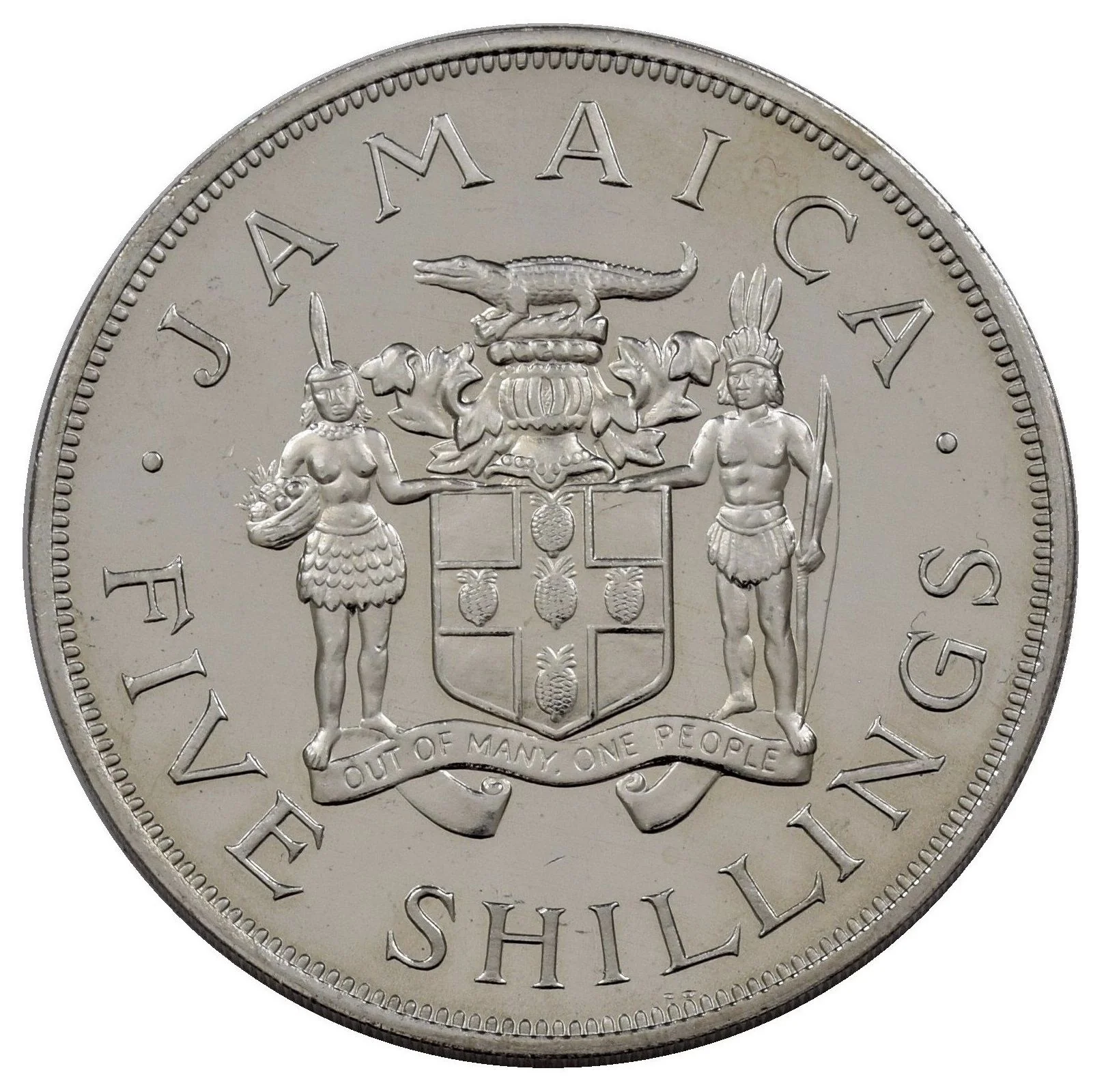
Description:
Jamaican coat of arms on a toothed rim.
Inscription:
· JAMAICA ·
FIVE SHILLINGS
OUT OF MANY ONE PEOPLE
FIVE SHILLINGS
OUT OF MANY ONE PEOPLE
Translation:
· JAMAICA ·
FIVE SHILLINGS
OUT OF MANY ONE PEOPLE
FIVE SHILLINGS
OUT OF MANY ONE PEOPLE
Script: Latin
Language: English
Engraver: Paul Vincze
Reverse
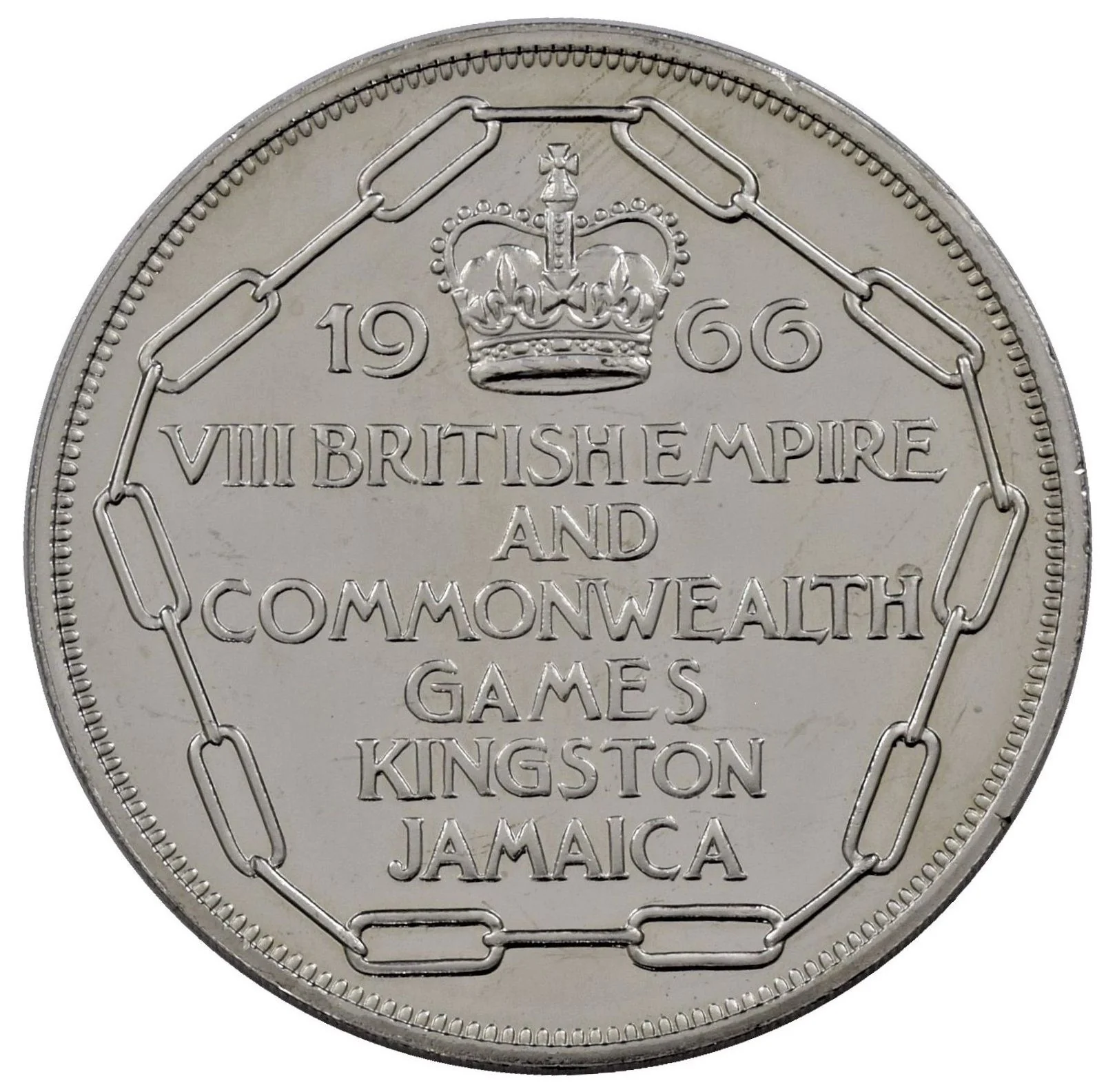
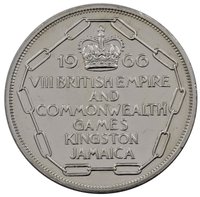
Description:
Crown dividing date above inscription within chain link.
Inscription:
1966
VIII BRITISH EMPIRE
AND
COMMONWEALTH
GAMES
KINGSTON
JAMAICA
VIII BRITISH EMPIRE
AND
COMMONWEALTH
GAMES
KINGSTON
JAMAICA
Script: Latin
Engraver: Paul Vincze
Edge
Reeded
Categories
| Sport> Commonwealth Games |
| Symbol> Crown |
| Symbols> Coat of Arms |
Mints
| Name | Mark |
|---|---|
| Royal Mint (Tower Hill) | — |
Mintings
| Year | Mint Mark | Mintage | Quality | Collection |
|---|---|---|---|---|
| 1966 | — | 190,000 | ||
| 1966 | — | 20,000 | Proof |
Historical background
In 1966, Jamaica stood on the cusp of a significant monetary transition, operating under the framework of the British Caribbean Currency Board (BCCB). This system, established in 1950, issued a common currency—the British Caribbean dollar (BWI$)—that was pegged to sterling and used across several Eastern Caribbean territories. While this provided stability and facilitated trade within the region, it was increasingly seen as an anachronism for a nation that had gained political independence from the United Kingdom in 1962. The BCCB system offered Jamaica little control over its own monetary policy, as currency issuance was strictly tied to foreign reserves, limiting the government's ability to manage the economy proactively.
The push for a distinct national currency was driven by both symbolic and economic imperatives. Symbolically, it was a key step in asserting full economic sovereignty and national identity. Economically, the post-independence government, led by Prime Minister Sir Alexander Bustamante and later by Donald Sangster, sought the tools to pursue independent development goals, manage balance of payments, and potentially finance growth through more flexible credit policies. Preparations were therefore well underway in 1966 for the establishment of the Bank of Jamaica as the central bank, which would assume control over monetary policy and currency issuance.
Consequently, 1966 was a final year of monetary continuity under the old colonial system, but one filled with imminent change. The British Caribbean dollar remained legal tender, but the institutional and legislative groundwork was being laid for its replacement. The following year, in 1967, the Bank of Jamaica would officially open, and the Jamaican dollar (J$) would be introduced, severing the formal currency link to other territories and marking a definitive step in Jamaica's post-colonial economic journey.
The push for a distinct national currency was driven by both symbolic and economic imperatives. Symbolically, it was a key step in asserting full economic sovereignty and national identity. Economically, the post-independence government, led by Prime Minister Sir Alexander Bustamante and later by Donald Sangster, sought the tools to pursue independent development goals, manage balance of payments, and potentially finance growth through more flexible credit policies. Preparations were therefore well underway in 1966 for the establishment of the Bank of Jamaica as the central bank, which would assume control over monetary policy and currency issuance.
Consequently, 1966 was a final year of monetary continuity under the old colonial system, but one filled with imminent change. The British Caribbean dollar remained legal tender, but the institutional and legislative groundwork was being laid for its replacement. The following year, in 1967, the Bank of Jamaica would officially open, and the Jamaican dollar (J$) would be introduced, severing the formal currency link to other territories and marking a definitive step in Jamaica's post-colonial economic journey.
🌱 Common