

50 pence – Falkland Islands
Add to wishlist
Non-circulating coins
Commemoration: Gentoo Penguin
United Kingdom
Context
Year: 2018
Country: United Kingdom
Issuer: Falkland Islands
Ruler: Elizabeth II
Currency:
(since 1971)
Total mintage: 7,500
Material
Diameter: 27.3 mm
Weight: 8 g
Thickness: 1.78 mm
Shape: Equilateral curve heptagon
Composition: Copper-nickel
Alignment: Medal alignment
flip

References
KM: #
Numista: #162737
Value
Exchange value: 0.50 FKP
Inflation-adjusted value: 0.67 FKP
Obverse
Description:
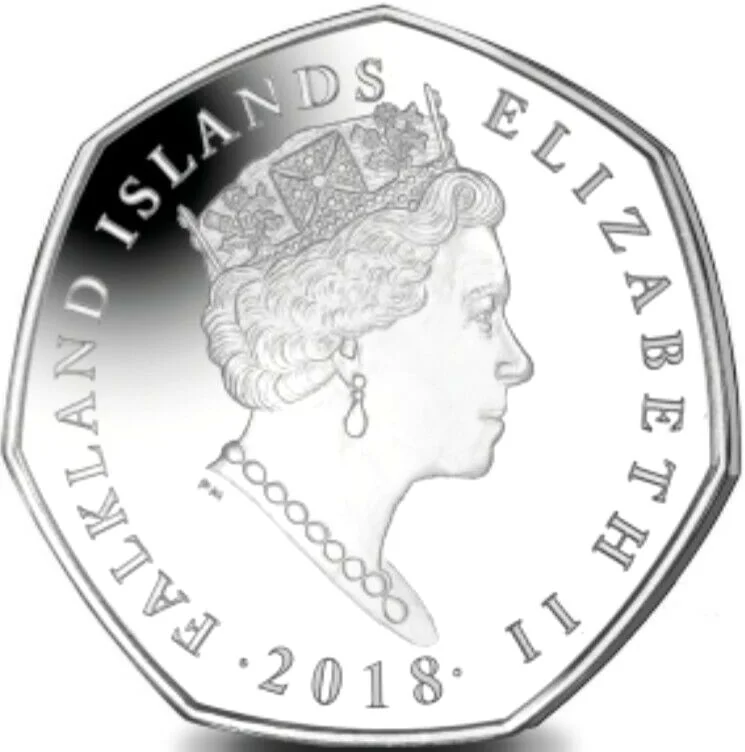
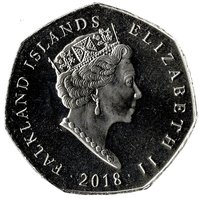
The coin bears the exclusive Pobjoy Mint effigy of Queen Elizabeth II.
Inscription:
FALKLAND ISLANDS
ELIZABETH II
PM
. 2018 .
ELIZABETH II
PM
. 2018 .
Script: Latin
Reverse
Description:
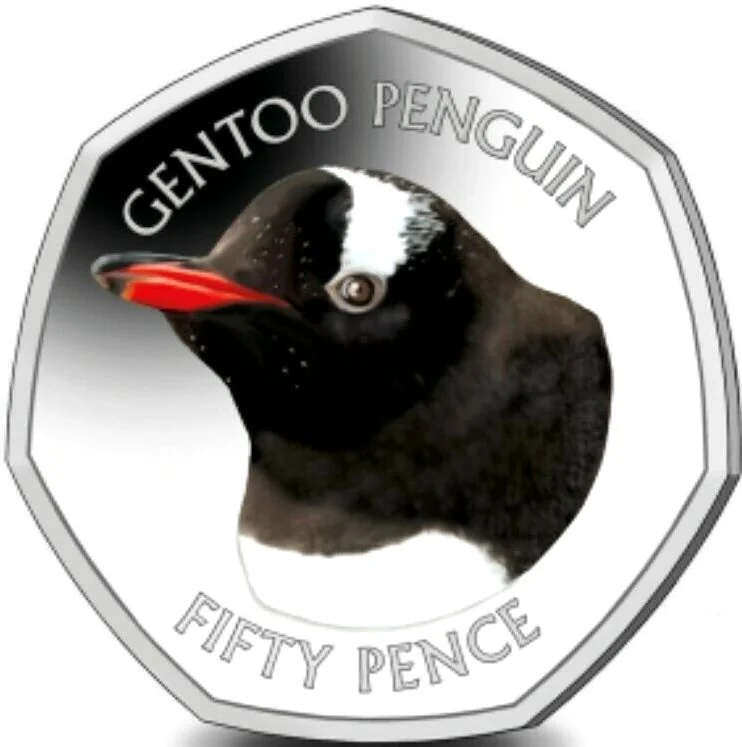
The coin features a color headshot of a Gentoo penguin, highlighting its distinctive white crown bar.
Inscription:
GENTOO PENGUIN
FIFTY PENCE
FIFTY PENCE
Script: Latin
Edge
Mints
| Name | Mark |
|---|---|
| Pobjoy Mint | (PM) |
Mintings
| Year | Mint Mark | Mintage | Quality | Collection |
|---|---|---|---|---|
| 2018 | PM | 7,500 |
Historical background
In 2018, the currency situation in the Falkland Islands remained stable and unique, characterised by a dual-currency system. The official currency is the Falkland Islands pound (FKP), which is pegged at par value to the British pound sterling (GBP). This one-to-one parity, maintained by the Falkland Islands Government, ensured that both currencies circulated interchangeably and were accepted for all transactions within the territory. The local government issued its own banknotes and coins, which were physically distinct from UK sterling but held the same value.
The economy's heavy reliance on fisheries licensing, tourism, and agriculture, alongside significant UK government support for defence and infrastructure, underpinned this currency stability. The peg provided economic predictability for trade and investment, with the majority of imports sourced from the United Kingdom and Chile. Importantly, the Falkland Islands pound was not legal tender in the United Kingdom, but sterling from the UK was freely used on the islands, simplifying financial transactions for the resident population and visiting tourists.
There were no significant currency crises or policy shifts in 2018. The system functioned effectively, with the local economy benefiting from the credibility and low inflation associated with the sterling peg. Discussions about economic diversification and potential hydrocarbon exploration in the surrounding waters were ongoing, but these long-term prospects did not impact the day-to-day currency regime, which continued to be a cornerstone of the islands' financial stability and link to the United Kingdom.
The economy's heavy reliance on fisheries licensing, tourism, and agriculture, alongside significant UK government support for defence and infrastructure, underpinned this currency stability. The peg provided economic predictability for trade and investment, with the majority of imports sourced from the United Kingdom and Chile. Importantly, the Falkland Islands pound was not legal tender in the United Kingdom, but sterling from the UK was freely used on the islands, simplifying financial transactions for the resident population and visiting tourists.
There were no significant currency crises or policy shifts in 2018. The system functioned effectively, with the local economy benefiting from the credibility and low inflation associated with the sterling peg. Discussions about economic diversification and potential hydrocarbon exploration in the surrounding waters were ongoing, but these long-term prospects did not impact the day-to-day currency regime, which continued to be a cornerstone of the islands' financial stability and link to the United Kingdom.
⭐ Rare