

1 crown – Isle of Man
Add to wishlist
Non-circulating coins
Commemoration: Platinum Wedding Annversary Queen Elizabeth II and Prince Philip
Context
Year: 2017
Country: British Crown dependencies
Issuer: Isle of Man
Ruler: Elizabeth II
Currency:
(since 1971)
Subdivision: 1 crown = 5 Pounds
Material
Diameter: 38.6 mm
Weight: 28.28 g
Shape: Round
Composition: Copper-nickel
Technique: Milled
Alignment: Medal alignment
flip
References
KM: #
Numista: #162707
Value
Exchange value: 5 IMP
Obverse
Description:
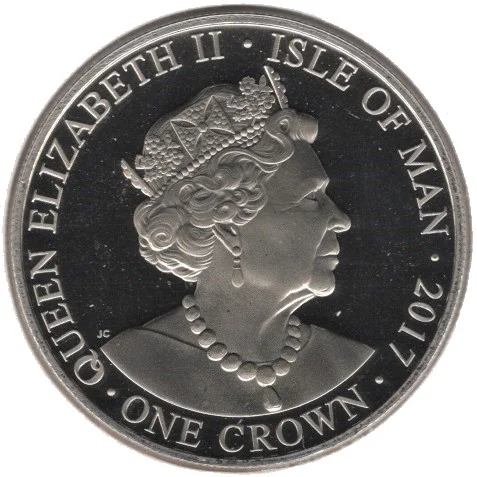
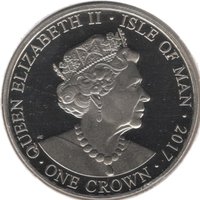
Right-facing bust of Queen Elizabeth II in the George IV State Diadem and Victorian Coronation Necklace, surrounded by legend and date, with denomination below.
Inscription:
QUEEN ELIZABETH II
ISLE OF MAN
2017
ONE CROWN
ISLE OF MAN
2017
ONE CROWN
Script: Latin
Designer: Jody Clark
Reverse
Description:
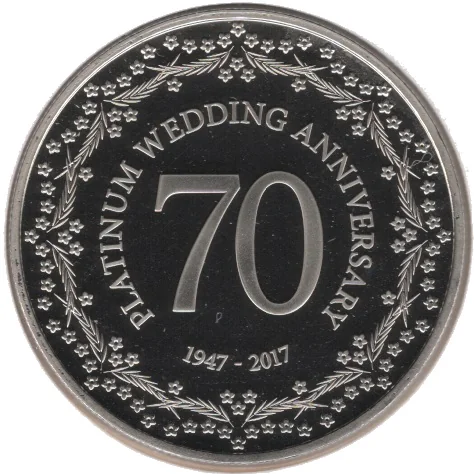
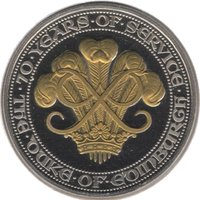
Floral-framed 70
Inscription:
PLATINUM WEDDING ANNIVERSARY
70
1947-2017
70
1947-2017
Script: Latin
Engraver: Michael Guilfoyle
Edge
Reeded
Mints
| Name | Mark |
|---|---|
| Tower Mint | — |
Mintings
| Year | Mint Mark | Mintage | Quality | Collection |
|---|---|---|---|---|
| 2017 | — | — |
Historical background
In 2017, the Isle of Man's currency situation remained stable and closely aligned with the United Kingdom, a continuation of its long-standing monetary framework. The Manx pound (£) was pegged at par with the British pound sterling (GBP), and while the Isle of Man government issued its own distinctive banknotes and coins, sterling was also legal tender and circulated interchangeably on the island. This arrangement provided economic stability and seamless trade with the UK, the island's largest economic partner, but also meant the Isle of Man had no independent monetary policy and was directly exposed to UK monetary decisions and economic fluctuations.
The year was, however, significantly shaped by the aftermath of the UK's 2016 vote to leave the European Union. While not an EU member itself, the Isle of Man's relationship with the UK and its status within the "Common Travel Area" meant Brexit created considerable uncertainty. Key concerns for 2017 included potential impacts on financial services—a cornerstone of the Manx economy—and the future of customs arrangements for its manufacturing sector. The government engaged in talks with Westminster to safeguard the island's interests, emphasizing the need for a smooth transition to maintain economic confidence.
Furthermore, 2017 saw ongoing discussions about the health of the Manx economy beyond currency, with a focus on diversification. While the peg to sterling was unquestioned, there was a strategic push to develop sectors like aerospace, technology, and e-gaming to ensure robust public finances. The stability of the currency peg provided a reliable foundation, but the broader economic narrative of the year was defined by proactive planning for the post-Brexit landscape and efforts to future-proof the island's fiscal resilience.
The year was, however, significantly shaped by the aftermath of the UK's 2016 vote to leave the European Union. While not an EU member itself, the Isle of Man's relationship with the UK and its status within the "Common Travel Area" meant Brexit created considerable uncertainty. Key concerns for 2017 included potential impacts on financial services—a cornerstone of the Manx economy—and the future of customs arrangements for its manufacturing sector. The government engaged in talks with Westminster to safeguard the island's interests, emphasizing the need for a smooth transition to maintain economic confidence.
Furthermore, 2017 saw ongoing discussions about the health of the Manx economy beyond currency, with a focus on diversification. While the peg to sterling was unquestioned, there was a strategic push to develop sectors like aerospace, technology, and e-gaming to ensure robust public finances. The stability of the currency peg provided a reliable foundation, but the broader economic narrative of the year was defined by proactive planning for the post-Brexit landscape and efforts to future-proof the island's fiscal resilience.
💎 Extremely Rare