

5 Euro (Manhattan) – Netherlands
Non-circulating coins
Commemoration: 400th Anniversary of Manhattan
Netherlands
Context

Material
References
KM: #Click to copy to clipboard283
Numista: #16201
Value
Exchange value: 5 EUR = $5.91
Inflation-adjusted value: 7.23 EUR
Obverse
Description:
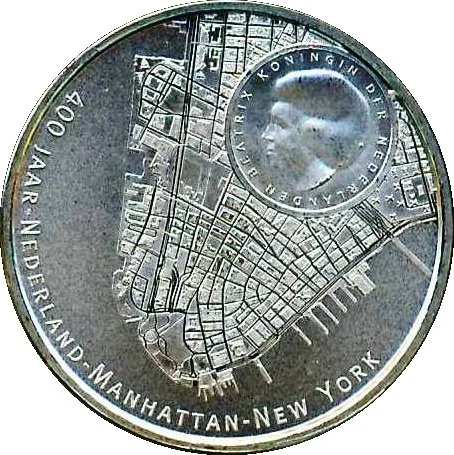
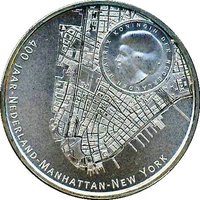
2009 aerial map of lower Manhattan with inset.
Inscription:
400 JAAR - NEDERLAND - MANHATTAN - NEW YORK
BEATRIX KONINGIN DER NEDERLANDEN
BEATRIX KONINGIN DER NEDERLANDEN
Translation:
400 YEARS - NETHERLANDS - MANHATTAN - NEW YORK
BEATRIX QUEEN OF THE NETHERLANDS
BEATRIX QUEEN OF THE NETHERLANDS
Script: Latin
Engraver: R. van Tienhoven
Reverse
Description:
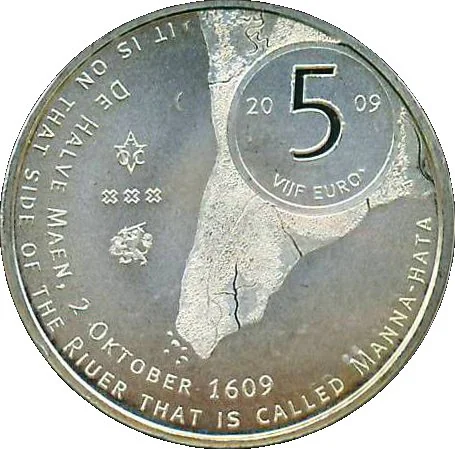
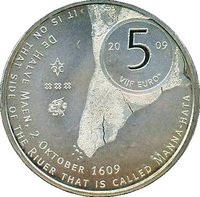
Manhattan, 1609 aerial view. Value inset top right.
Inscription:
DE HALVE MAEN, 2 OKTOBER 1609
IT IS ON THAT SIDE OF THE RIUER THAT IS CALLED MANNA-HATA
20 5 09
VIJF EURO
IT IS ON THAT SIDE OF THE RIUER THAT IS CALLED MANNA-HATA
20 5 09
VIJF EURO
Translation:
THE HALF MOON, 2 OCTOBER 1609
IT IS ON THAT SIDE OF THE RIVER THAT IS CALLED MANNA-HATA
20 5 09
FIVE EURO
IT IS ON THAT SIDE OF THE RIVER THAT IS CALLED MANNA-HATA
20 5 09
FIVE EURO
Script: Latin
Engraver: R. van Tienhoven
Edge
Mintings
| Year | Mint Mark | Mintage | Quality | Collection |
|---|---|---|---|---|
| 2009 | — | 303,209 |
Historical background
In 2009, the Netherlands was a core member of the Eurozone, having adopted the euro as its official currency in 2002, replacing the Dutch guilder. The global financial crisis, which began in 2008, profoundly shaped the economic and currency landscape that year. While the Netherlands did not face a sovereign debt crisis like some southern Eurozone nations, its economy was hit hard, contracting by 3.7% in 2009. The stability of the euro itself was a primary concern, as the crisis exposed structural weaknesses within the monetary union, though the Dutch guilder was not under consideration for reintroduction.
Domestically, the euro's value and the European Central Bank's (ECB) monetary policy were central to the Netherlands' economic strategy. The ECB, to which the Netherlands had ceded monetary control, implemented significant interest rate cuts and unconventional measures to stimulate the eurozone economy. For the Dutch, this meant very low interest rates and a relatively strong euro compared to other global currencies, which impacted the important export sector. The government's focus was on fiscal stimulus and bank bailouts, notably for ING and ABN AMRO, within the constraints of the EU's Stability and Growth Pact.
The year also saw growing Dutch scrutiny of Eurozone fiscal policies, planting seeds for future tensions. As a fiscally conservative nation with a low debt-to-GDP ratio, there was increasing public and political unease over the risks of potential bailouts for less disciplined member states. This sentiment foreshadowed the Netherlands' role as a leading "frugal" voice during the subsequent European debt crisis, advocating for strict conditionality in any financial assistance to protect the integrity and value of the shared currency. Thus, 2009 was a period of navigating a severe recession within the euro framework while nascent concerns about Eurozone solidarity began to surface.
Domestically, the euro's value and the European Central Bank's (ECB) monetary policy were central to the Netherlands' economic strategy. The ECB, to which the Netherlands had ceded monetary control, implemented significant interest rate cuts and unconventional measures to stimulate the eurozone economy. For the Dutch, this meant very low interest rates and a relatively strong euro compared to other global currencies, which impacted the important export sector. The government's focus was on fiscal stimulus and bank bailouts, notably for ING and ABN AMRO, within the constraints of the EU's Stability and Growth Pact.
The year also saw growing Dutch scrutiny of Eurozone fiscal policies, planting seeds for future tensions. As a fiscally conservative nation with a low debt-to-GDP ratio, there was increasing public and political unease over the risks of potential bailouts for less disciplined member states. This sentiment foreshadowed the Netherlands' role as a leading "frugal" voice during the subsequent European debt crisis, advocating for strict conditionality in any financial assistance to protect the integrity and value of the shared currency. Thus, 2009 was a period of navigating a severe recession within the euro framework while nascent concerns about Eurozone solidarity began to surface.

🌟 Uncommon