

1 Crown – Gibraltar
Non-circulating coins
Commemoration: Royal Wedding of Prince William & Catherine Middleton
United Kingdom
Context
Material
Diameter: 38.61 mm
Weight: 28.28 g
Shape: Round
Composition: Copper-nickel
Technique: Milled
Alignment: Medal alignment
flip
References
KM: #Click to copy to clipboard1477
Numista: #161896
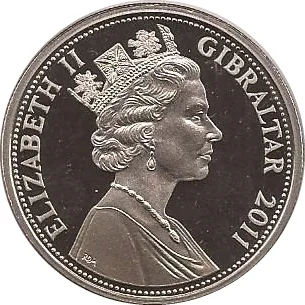
Obverse
Description:
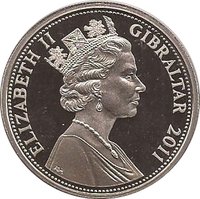
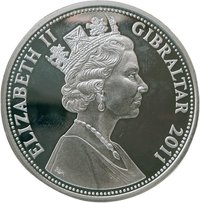
Queen Elizabeth II right-facing bust in George IV State Diadem, with legend and date.
Inscription:
ELIZABETH II GIBRALTAR 2011
RDM
RDM
Script: Latin
Engraver: Raphael David Maklouf
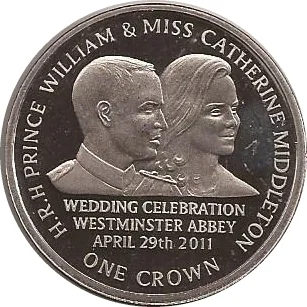
Reverse
Description:
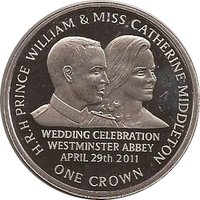
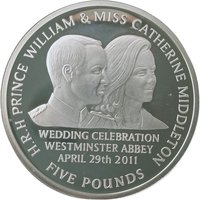
Prince William and Catherine Middleton
Inscription:
H.R.H. PRINCE WILLIAM & MISS CATHERINE MIDDLETON
WEDDING CELEBRATION
WESTMINSTER ABBEY
APRIL 29th 2011
ONE CROWN
WEDDING CELEBRATION
WESTMINSTER ABBEY
APRIL 29th 2011
ONE CROWN
Script: Latin
Edge
Reeded
Categories
| Marriage |
Mints
| Name | Mark |
|---|---|
| Tower Mint | — |
Mintings
| Year | Mint Mark | Mintage | Quality | Collection |
|---|---|---|---|---|
| 2011 | — | — |
Historical background
In 2011, Gibraltar's currency situation was defined by its unique constitutional position and its practical economic dependencies. As a British Overseas Territory, its official currency was (and remains) the Gibraltar pound (GIP), issued by the Government of Gibraltar and pegged at par with the Pound Sterling (GBP). While Sterling circulated interchangeably with local notes for everyday transactions, the Gibraltar pound was not legal tender in the United Kingdom, creating a one-sided fungibility. This system underscored Gibraltar's political link to Britain while allowing for a degree of fiscal autonomy, including the issuance of its own distinctive banknotes and coins.
The year saw Gibraltar operating within the broader context of the European Union, of which it was a part through the UK's membership. As such, it was within the EU's single market for financial services, but crucially, it was outside the Eurozone and had an opt-out from adopting the euro. This position was strategically important, as Gibraltar's economy, heavily reliant on finance, online gaming, and tourism, benefited from the stability and familiarity of its Sterling link. The peg provided monetary stability, which was particularly valued against the backdrop of the ongoing Eurozone sovereign debt crisis, which was causing significant volatility in European currencies at the time.
Furthermore, 2011 highlighted the practical realities of Gibraltar's cross-border economy with Spain. While the official currencies were GIP and GBP, the euro was widely accepted in many retail sectors due to the influx of daily workers and tourists from Spain. This de facto tri-currency environment reflected Gibraltar's economic interdependence with its neighbour, even amidst periodic political tensions. Consequently, the currency landscape in 2011 was a functional hybrid, balancing symbolic sovereignty, economic stability, and the pragmatic needs of a small, open territory at the intersection of British and European spheres.
The year saw Gibraltar operating within the broader context of the European Union, of which it was a part through the UK's membership. As such, it was within the EU's single market for financial services, but crucially, it was outside the Eurozone and had an opt-out from adopting the euro. This position was strategically important, as Gibraltar's economy, heavily reliant on finance, online gaming, and tourism, benefited from the stability and familiarity of its Sterling link. The peg provided monetary stability, which was particularly valued against the backdrop of the ongoing Eurozone sovereign debt crisis, which was causing significant volatility in European currencies at the time.
Furthermore, 2011 highlighted the practical realities of Gibraltar's cross-border economy with Spain. While the official currencies were GIP and GBP, the euro was widely accepted in many retail sectors due to the influx of daily workers and tourists from Spain. This de facto tri-currency environment reflected Gibraltar's economic interdependence with its neighbour, even amidst periodic political tensions. Consequently, the currency landscape in 2011 was a functional hybrid, balancing symbolic sovereignty, economic stability, and the pragmatic needs of a small, open territory at the intersection of British and European spheres.
✨ Legendary