

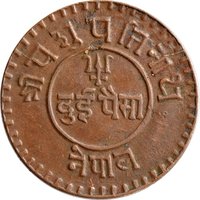
1 Paisa – Nepal
Nepal
Context
Years: 1918–1919
Issuer: Nepal 
Ruler: Tribhuvan Bir Bikram Shah
Currency:
(1546—1932)
Demonetized: Yes
Material
References
KM: #Click to copy to clipboard687.4
Numista: #161365
Obverse
Description:
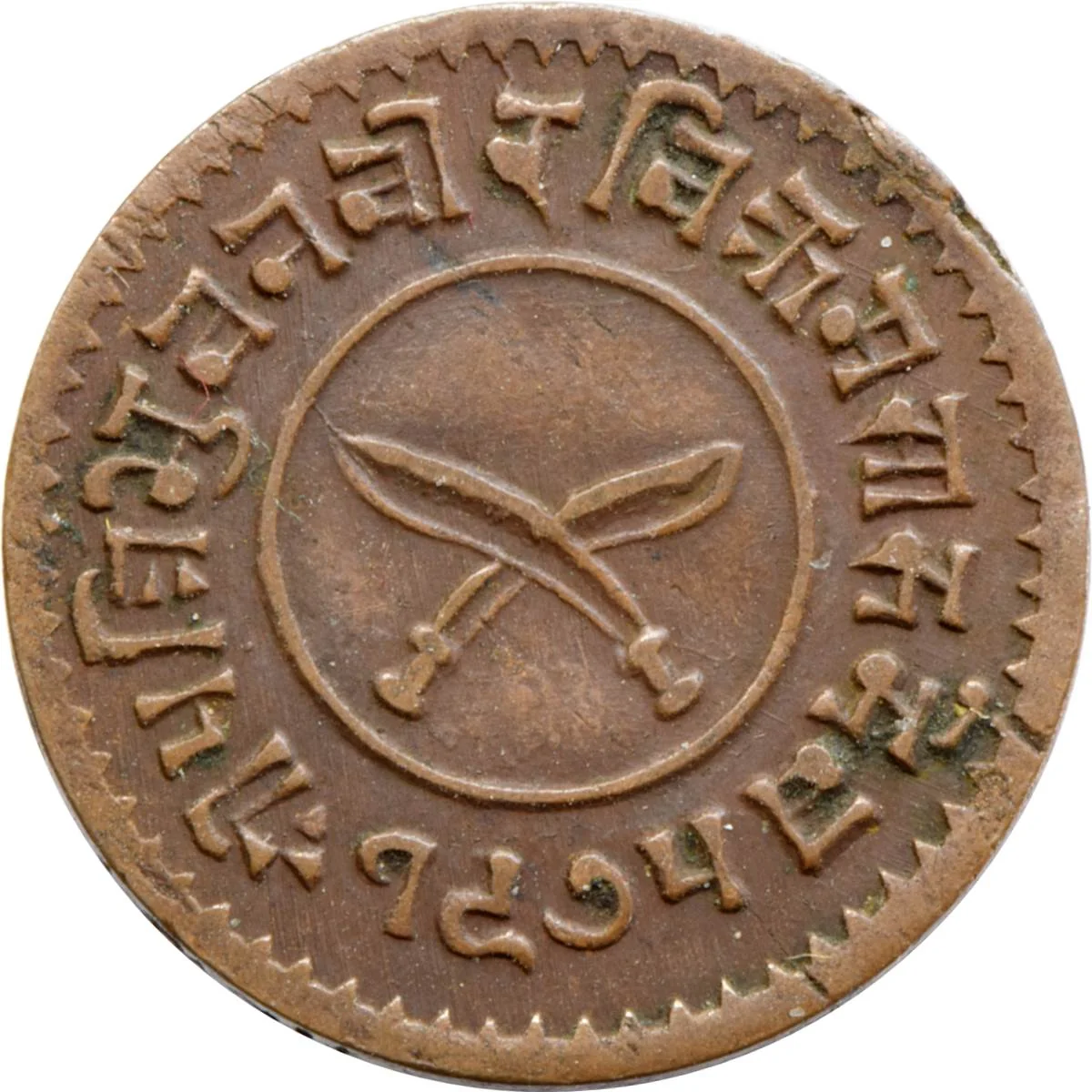
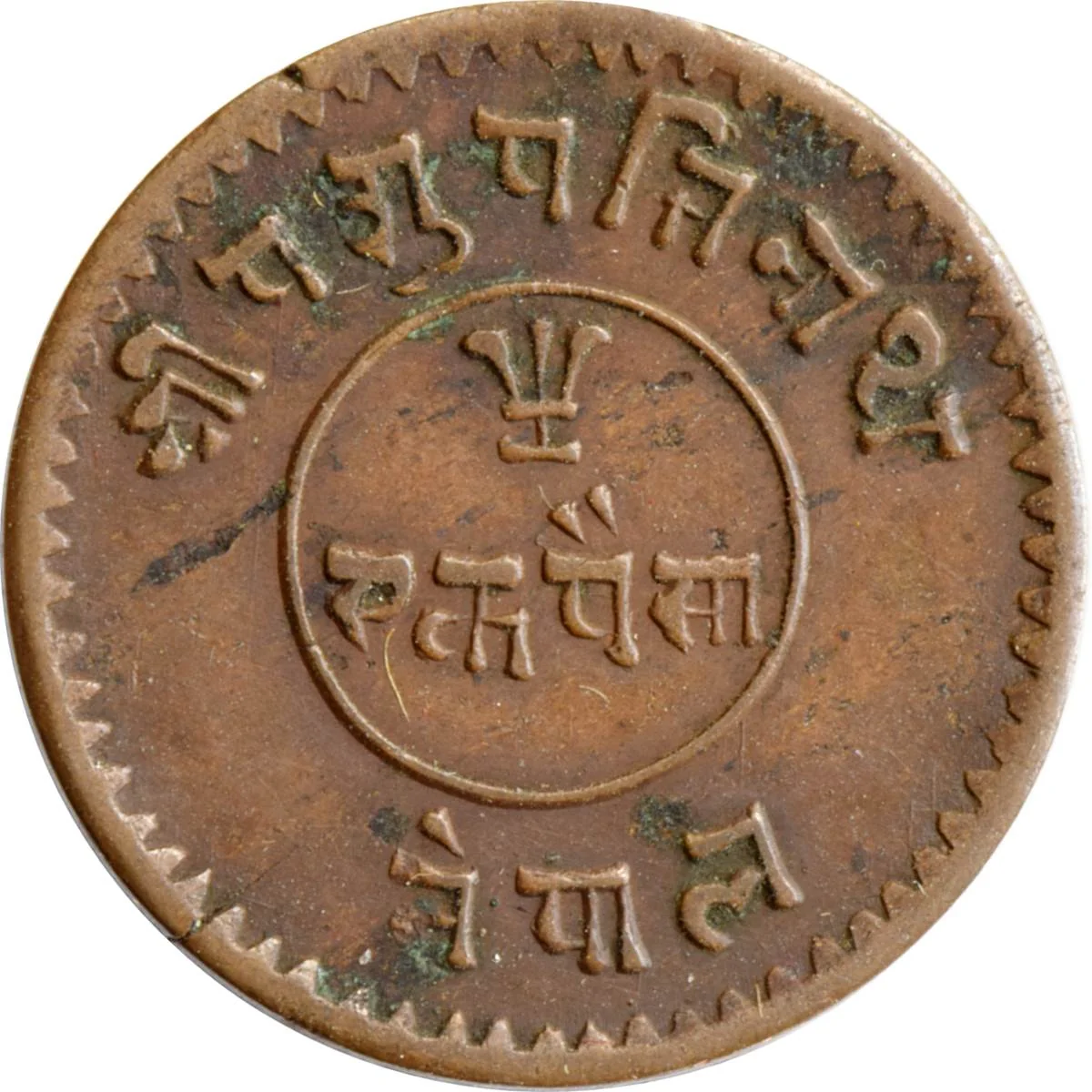
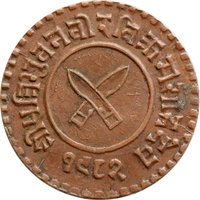
Inside circle: Crossed khukris (right over left), fine style. Outside circle: Devnagari legend: Shree 5 Tribhuvan Veer Vikram Shahdev. Date below.
Inscription:
श्री ५ त्रिभुवन वीर विक्रम शाहदेव
१९७५
१९७५
Translation:
Shri 5 Tribhuvan Veer Vikram Shah Dev
1975
1975
Language: Nepali
Reverse
Edge
Plain
Mintings
| Year | Mint Mark | Mintage | Quality | Collection |
|---|---|---|---|---|
| 1918 | — | — | ||
| 1919 | — | — |
Historical background
In 1918, Nepal's currency situation was defined by its dual monetary system and its economic subordination to British India. The nation circulated both the silver Mohar (and its subunit, the Dam) for smaller, internal transactions, and the Nepalese Rupee (NRs) for larger trade. Crucially, the Nepalese Rupee was pegged at a fixed parity to the Indian Rupee (INR) at a rate of 1 NRs = 1 INR, a linkage established in the early 20th century. This peg was essential because India was Nepal's overwhelmingly dominant trading partner, and the Indian Rupee served as the region's key trade currency.
This monetary arrangement was not merely economic but also political, reflecting the terms of the 1816 Sugauli Treaty and subsequent agreements that made Nepal a protectorate under British influence. The fixed exchange rate facilitated the heavy flow of goods, labor (particularly from Gurkha recruits into the British Indian Army), and capital across the open border. However, it also meant Nepal effectively ceded control of its monetary policy to British India, as the value and stability of its primary currency were directly tied to decisions made in Calcutta.
Internally, the currency system was complex and somewhat archaic. While government accounts and larger commerce used the Nepalese Rupee, the older silver Mohar coins remained in widespread rural use, creating a bimetallic environment. The state treasury, the Gorkha Bhansaar Khana, managed coin minting, but the scarcity of modern minting technology and the reliance on imported silver bullion created limitations. Thus, in 1918, Nepal's currency was a hybrid system: externally anchored to the Indian economy for stability and trade, while internally maintaining historical coinage that reflected its pre-modern fiscal traditions.
This monetary arrangement was not merely economic but also political, reflecting the terms of the 1816 Sugauli Treaty and subsequent agreements that made Nepal a protectorate under British influence. The fixed exchange rate facilitated the heavy flow of goods, labor (particularly from Gurkha recruits into the British Indian Army), and capital across the open border. However, it also meant Nepal effectively ceded control of its monetary policy to British India, as the value and stability of its primary currency were directly tied to decisions made in Calcutta.
Internally, the currency system was complex and somewhat archaic. While government accounts and larger commerce used the Nepalese Rupee, the older silver Mohar coins remained in widespread rural use, creating a bimetallic environment. The state treasury, the Gorkha Bhansaar Khana, managed coin minting, but the scarcity of modern minting technology and the reliance on imported silver bullion created limitations. Thus, in 1918, Nepal's currency was a hybrid system: externally anchored to the Indian economy for stability and trade, while internally maintaining historical coinage that reflected its pre-modern fiscal traditions.
💎 Very Rare