


5 dollars – Australia
Add to wishlist
Non-circulating coins
Commemoration: AFL - Australia's Own Game
Australia
Context
Material

References
KM: #
Numista: #105875
Value
Exchange value: 5 AUD
Inflation-adjusted value: 8.80 AUD
Obverse
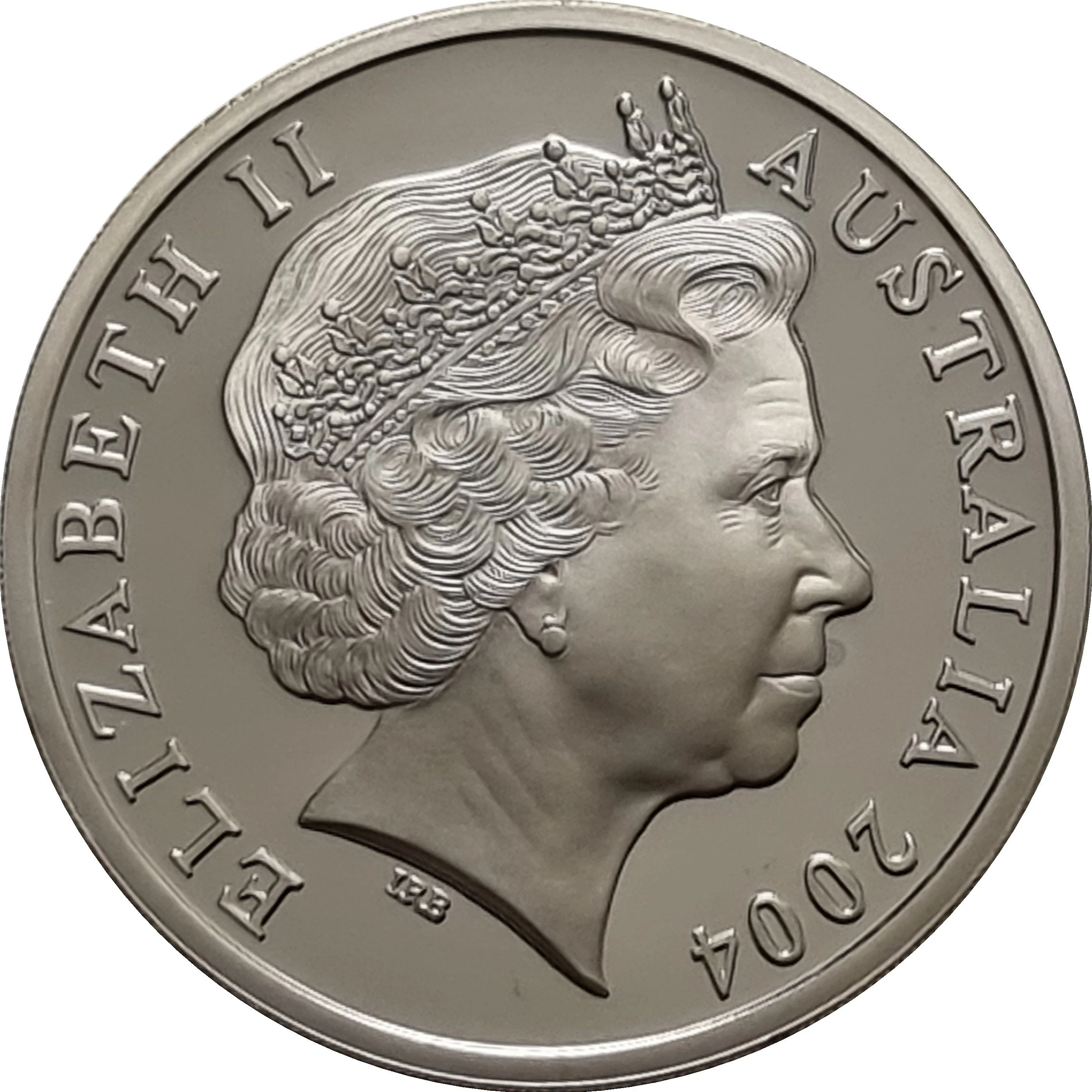
Description:
Queen Elizabeth IV, facing right, wearing the Girls of Great Britain and Ireland Tiara.
Inscription:
ELIZABETH II
AUSTRALIA 2004
IRB
AUSTRALIA 2004
IRB
Script: Latin
Designer: Ian Rank-Broadley
Reverse
Description:
The Premiership Cup within an oval, flanked by two AFL footballs on the gold-plated sections.
Inscription:
Australia's Own Game
AFL AFL
AUSTRALIAN FOOTBALL LEAGUE
PREMIERSHIP CUP
Five Dollars
AFL AFL
AUSTRALIAN FOOTBALL LEAGUE
PREMIERSHIP CUP
Five Dollars
Script: Latin
Designer: Royal Australian Mint
Edge
Milled
Categories
| Sport |
Mints
| Name | Mark |
|---|---|
| Royal Australian Mint | — |
Mintings
| Year | Mint Mark | Mintage | Quality | Collection |
|---|---|---|---|---|
| 2004 | — | 14,350 | Proof |
Historical background
In 2004, Australia's currency situation was characterised by a strong and steadily appreciating Australian dollar (AUD), driven primarily by a historic commodities boom. The rapid industrialisation of China created insatiable demand for Australia's key exports, particularly iron ore and coal, pushing their prices significantly higher. This surge in terms of trade, combined with relatively high domestic interest rates set by the Reserve Bank of Australia (RBA), attracted substantial foreign capital inflows, placing sustained upward pressure on the currency. The AUD, which had traded around US$0.50 in the early 2000s, broke through the US$0.70 mark in 2003 and continued its climb, averaging around US$0.73 for much of 2004 and peaking near US$0.80 by year's end.
This appreciation presented a complex economic picture. While it helped contain inflation by making imports cheaper and increased the nation's purchasing power abroad, it exerted considerable pressure on trade-exposed sectors of the economy. Manufacturers, tourism, and education services found it increasingly difficult to compete internationally, as their goods and services became more expensive for foreign buyers. The RBA, under Governor Ian Macfarlane, acknowledged this "two-speed" dynamic but maintained a focus on managing domestic demand and inflation, which remained within its 2-3% target band. Monetary policy was in a tightening cycle, with a 0.25% rate hike in March and again in December, partly to cool a buoyant housing market.
Overall, the 2004 currency environment reflected Australia's deepening integration with the Asian economy and the benefits and challenges of a resource-driven boom. The strong dollar was a clear symptom of the nation's economic strength and favourable global positioning, but it also forced structural adjustments and sparked ongoing debate about economic diversification. This period solidified the AUD's reputation as a commodity-linked "risk" currency in global foreign exchange markets, a correlation that would become even more pronounced in the following years.
This appreciation presented a complex economic picture. While it helped contain inflation by making imports cheaper and increased the nation's purchasing power abroad, it exerted considerable pressure on trade-exposed sectors of the economy. Manufacturers, tourism, and education services found it increasingly difficult to compete internationally, as their goods and services became more expensive for foreign buyers. The RBA, under Governor Ian Macfarlane, acknowledged this "two-speed" dynamic but maintained a focus on managing domestic demand and inflation, which remained within its 2-3% target band. Monetary policy was in a tightening cycle, with a 0.25% rate hike in March and again in December, partly to cool a buoyant housing market.
Overall, the 2004 currency environment reflected Australia's deepening integration with the Asian economy and the benefits and challenges of a resource-driven boom. The strong dollar was a clear symptom of the nation's economic strength and favourable global positioning, but it also forced structural adjustments and sparked ongoing debate about economic diversification. This period solidified the AUD's reputation as a commodity-linked "risk" currency in global foreign exchange markets, a correlation that would become even more pronounced in the following years.

💎 Extremely Rare