

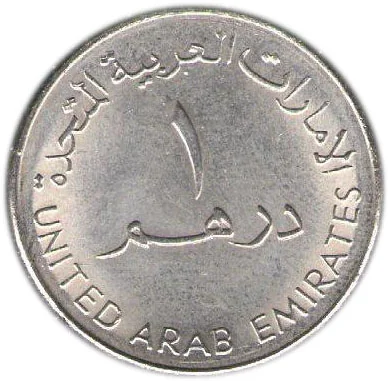
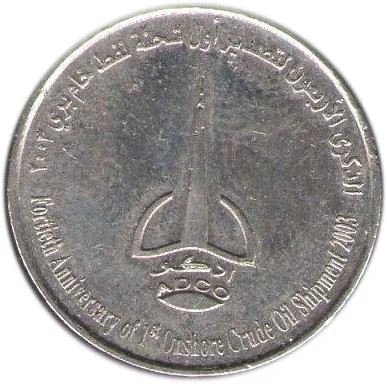
1 dirham (First Onshore Crude Oil Shipment in Abu Dhabi) – United Arab Emirates
Add to wishlist
Circulating commemorative coins
Commemoration: The 40th Anniversary of the First Onshore Crude Oil Shipment in the Emirate of Abu Dhabi
United Arab Emirates
Context
Year: 2003
Issuer: United Arab Emirates
Ruler: Zayed bin Sultan Al Nahyan
Currency:
(since 1973)
Total mintage: 250,000
Material
Diameter: 23.8 mm
Weight: 6.4 g
Thickness: 1.9 mm
Shape: Round
Composition: Copper-nickel
Technique: Milled
Alignment: Medal alignment
flip
References
KM: #
Numista: #16047
Value
Exchange value: 1 AED
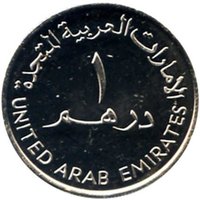
Obverse
Reverse
Edge
Reeded
Mints
| Name | Mark |
|---|---|
| Royal Mint | — |
Mintings
| Year | Mint Mark | Mintage | Quality | Collection |
|---|---|---|---|---|
| 2003 | — | 250,000 |
Historical background
In 2003, the currency situation in the United Arab Emirates was defined by its long-standing and unwavering peg to the United States Dollar. This fixed exchange rate regime, established in the late 1970s and formally set at AED 3.6725 per USD 1 in 1997, provided crucial stability for the UAE's oil-dependent, open economy. It anchored monetary policy, eliminated currency risk for foreign investors, and facilitated the massive import and expatriate labor flows underpinning the nation's rapid development. The peg was considered a cornerstone of economic policy, fostering confidence in Dubai and Abu Dhabi's burgeoning trade, tourism, and financial services sectors.
The context of 2003, however, was marked by a significant external pressure: the dollar's broad depreciation. As the USD weakened against major currencies like the Euro and the Pound Sterling, the UAE Dirham effectively weakened in tandem. This imported inflation became a growing concern, as it increased the cost of imports from non-dollar zones, particularly for construction materials and consumer goods critical to the UAE's economic boom. While the hydrocarbon sector benefited from dollar-denominated oil revenues, the declining purchasing power of the dirham began to affect the cost of living for the large expatriate population and the project economics of the non-oil sector.
Despite these inflationary pressures, 2003 saw no serious official consideration of abandoning the dollar peg. The UAE monetary authorities, particularly the Central Bank, consistently reaffirmed their commitment to the fixed rate, valuing its stability benefits over the speculative risks of a revaluation or float. The policy priority remained managing inflation through other means, while the dollar peg continued to serve as a key tool for attracting foreign capital and financing the nation's ambitious infrastructure and diversification projects, which were accelerating dramatically in the early 2000s.
The context of 2003, however, was marked by a significant external pressure: the dollar's broad depreciation. As the USD weakened against major currencies like the Euro and the Pound Sterling, the UAE Dirham effectively weakened in tandem. This imported inflation became a growing concern, as it increased the cost of imports from non-dollar zones, particularly for construction materials and consumer goods critical to the UAE's economic boom. While the hydrocarbon sector benefited from dollar-denominated oil revenues, the declining purchasing power of the dirham began to affect the cost of living for the large expatriate population and the project economics of the non-oil sector.
Despite these inflationary pressures, 2003 saw no serious official consideration of abandoning the dollar peg. The UAE monetary authorities, particularly the Central Bank, consistently reaffirmed their commitment to the fixed rate, valuing its stability benefits over the speculative risks of a revaluation or float. The policy priority remained managing inflation through other means, while the dollar peg continued to serve as a key tool for attracting foreign capital and financing the nation's ambitious infrastructure and diversification projects, which were accelerating dramatically in the early 2000s.
🌱 Fairly Common