

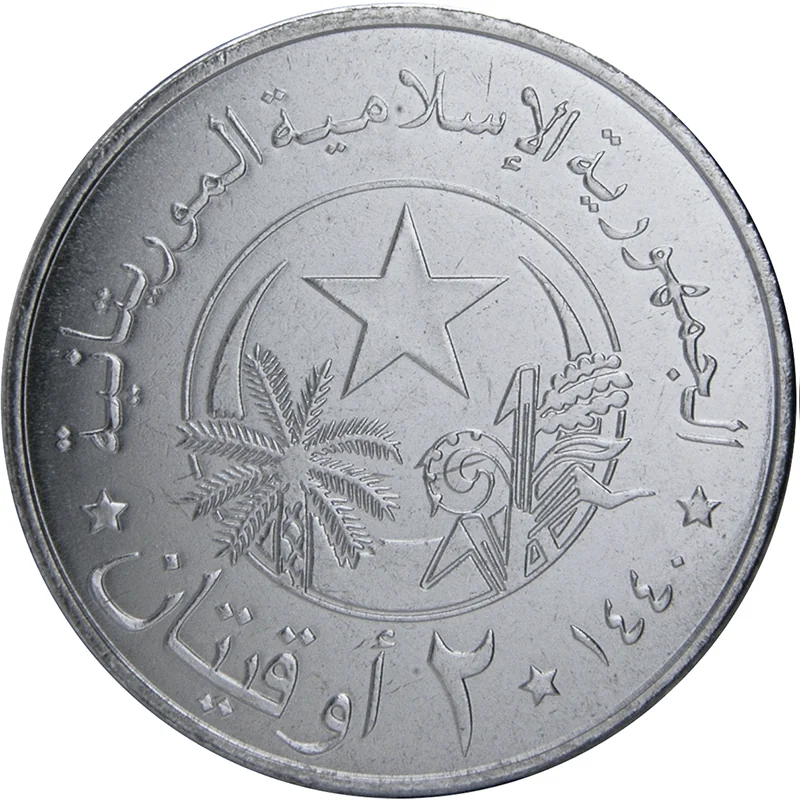
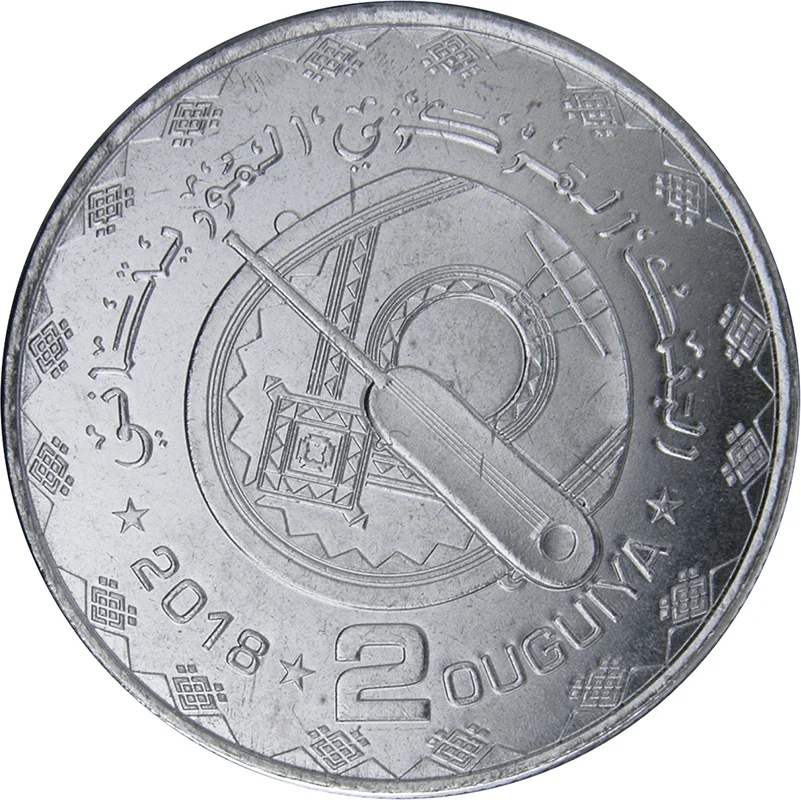
2 ouguiya – Mauritania
Add to wishlist
Mauritania
Context
Year: 2018
Islamic (Hijri) Year:: 1440
Issuer: Mauritania
Period:
(since 1960)
Currency:
(since 2018)
Material
Diameter: 24 mm
Weight: 5.65 g
Thickness: 1.9 mm
Shape: Round
Composition: Stainless steel
Technique: Milled
Alignment: Coin alignment
flip
References
KM: #
Numista: #160359
Value
Exchange value: 2 MRU
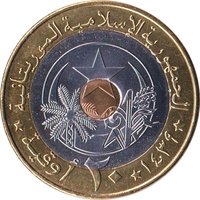
Obverse
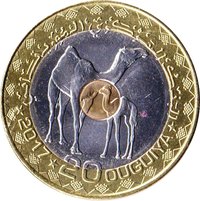
Reverse
Edge
Reeded
Categories
| Art> Music |
| Symbols> Coat of Arms |
Mintings
| Year | Mint Mark | Mintage | Quality | Collection |
|---|---|---|---|---|
| 2018 | — | — |
Historical background
In 2018, Mauritania's currency situation was characterized by relative stability of the Ouguiya (MRU), but within a context of ongoing structural economic challenges. The year marked a significant milestone: the completion of a currency re-denomination that began in 2017, where 1 new Ouguiya (MRU) replaced 10 old Ouguiyas (MRO). This technical reform aimed to simplify transactions, restore confidence in the national currency, and modernize the financial system, with 2018 being the year the transition fully settled into daily economic life.
Economically, the country benefited from a rebound in global prices for its key exports, particularly iron ore, which improved foreign exchange reserves and helped stabilize the Ouguiya's peg to the US dollar. The Central Bank of Mauritania (BCM) maintained a fixed exchange rate regime, which provided predictability for importers and helped control inflation. However, this stability was somewhat artificial, underpinned by strict capital controls and limited convertibility, which constrained the formal foreign exchange market and perpetuated a disparity with the parallel market rate.
Despite this surface stability, underlying vulnerabilities persisted. The economy remained heavily dependent on extractive industries, exposing it to commodity price swings. High unemployment, poverty, and a large informal sector continued to limit the broader population's engagement with the formal banking system. Furthermore, while inflation was moderate compared to previous years, pressures from food prices and fiscal deficits posed ongoing risks, meaning the currency's stability in 2018 was not yet synonymous with broad-based economic resilience or diversification.
Economically, the country benefited from a rebound in global prices for its key exports, particularly iron ore, which improved foreign exchange reserves and helped stabilize the Ouguiya's peg to the US dollar. The Central Bank of Mauritania (BCM) maintained a fixed exchange rate regime, which provided predictability for importers and helped control inflation. However, this stability was somewhat artificial, underpinned by strict capital controls and limited convertibility, which constrained the formal foreign exchange market and perpetuated a disparity with the parallel market rate.
Despite this surface stability, underlying vulnerabilities persisted. The economy remained heavily dependent on extractive industries, exposing it to commodity price swings. High unemployment, poverty, and a large informal sector continued to limit the broader population's engagement with the formal banking system. Furthermore, while inflation was moderate compared to previous years, pressures from food prices and fiscal deficits posed ongoing risks, meaning the currency's stability in 2018 was not yet synonymous with broad-based economic resilience or diversification.
🌱 Common