

10 yuan – Yunnan Province
Add to wishlist
Circulating commemorative coins
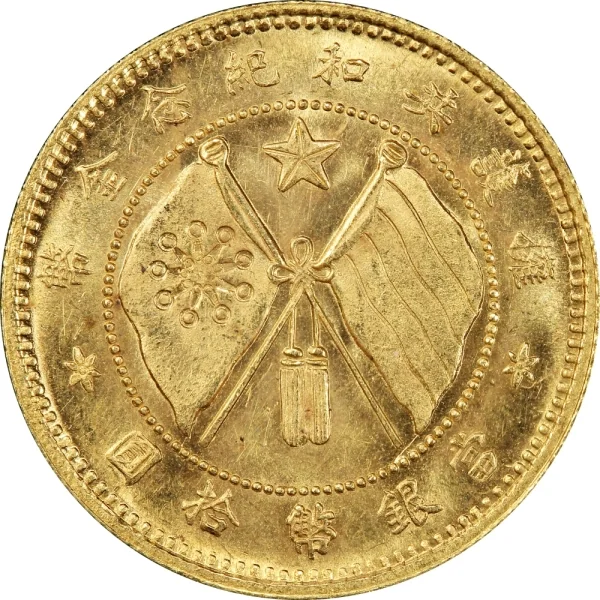
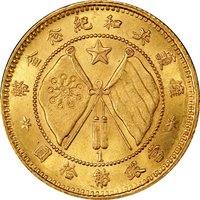
Commemoration: Support the Republic
China
Context
Year: 1919
Country: China
Issuer: Yunnan Province
Period:
(1912—1949)
Currency:
(1908—1949)
Demonetized: Yes
Material
References
Y: #
Numista: #15986
Value
Bullion value: $992.50
Obverse
Description:
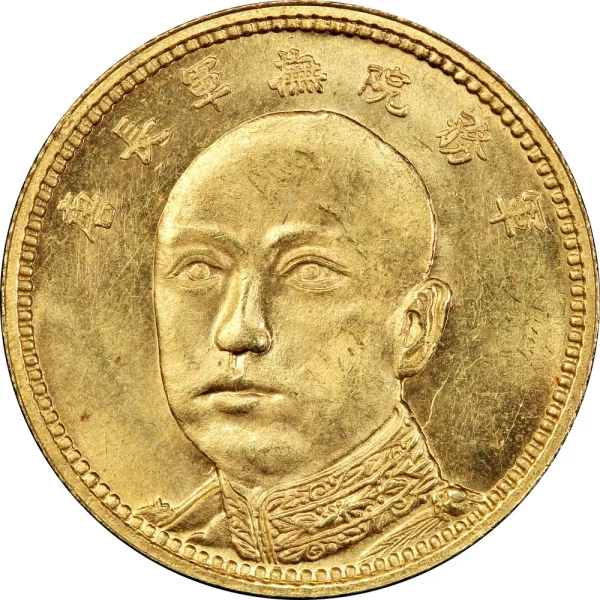
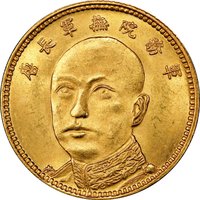
Bust of Tang Jiyao facing left, Chinese characters above.
Inscription:
唐長軍撫院務軍
Translation:
Tang, Military Commissioner of the Changjun Army, overseeing military affairs of the Grand Coordinator's office.
Script: Chinese
Language: Classical Chinese
Reverse
Edge
Categories
| Person> Politician |
| Symbol> Flag |
Mintings
| Year | Mint Mark | Mintage | Quality | Collection |
|---|---|---|---|---|
| 1919 | — | — |
Historical background
In 1919, Yunnan Province existed within the fractured monetary landscape of the early Chinese Republic, a situation exacerbated by its geographical and political semi-autonomy. While nominally part of the Republic, Yunnan was under the firm control of the Yunnan Clique, led by Tang Jiyao, who maintained substantial independence from the weak central government in Beijing. This autonomy extended directly to finance, as the province issued its own currency, the Yunnan Dollar (滇幣), which circulated alongside a confusing array of other mediums. The value of this local currency was not pegged to the national silver dollar but was instead based on its intrinsic silver content, which often varied.
The monetary system in the province was a complex and unstable hierarchy of metal and paper. At its base was physical silver, both in the form of sycee (shoe-shaped ingots) and Yunnan-minted silver dollars and half-dollars. Circulating alongside these were copper cash coins, essential for small daily transactions. Critically, the provincial bank—the Yunnan Provincial Bank (富滇銀行)—issued convertible banknotes, but their value and acceptance were largely confined to the province's borders. This created significant exchange difficulties with other regions and undermined broader trade. Furthermore, the financial strain of Yunnan's military expeditions, including its costly involvement in the Constitutional Protection War, led the provincial government to increasingly resort to printing currency to cover deficits, planting the seeds for future inflation.
Therefore, the 1919 currency situation in Yunnan was characterized by fragmented sovereignty and mounting instability. The coexistence of local banknotes, heterogeneous silver coinage, and traditional copper cash reflected a provincial economy operating with one foot in the modern banking system and the other in a bullion-based past. This system functioned for internal purposes but was fragile, isolated from national monetary currents, and increasingly vulnerable to devaluation due to the fiscal pressures of the local military regime. It stood as a microcosm of the wider Chinese "warlord era" problem: political fragmentation directly causing monetary disorder.
The monetary system in the province was a complex and unstable hierarchy of metal and paper. At its base was physical silver, both in the form of sycee (shoe-shaped ingots) and Yunnan-minted silver dollars and half-dollars. Circulating alongside these were copper cash coins, essential for small daily transactions. Critically, the provincial bank—the Yunnan Provincial Bank (富滇銀行)—issued convertible banknotes, but their value and acceptance were largely confined to the province's borders. This created significant exchange difficulties with other regions and undermined broader trade. Furthermore, the financial strain of Yunnan's military expeditions, including its costly involvement in the Constitutional Protection War, led the provincial government to increasingly resort to printing currency to cover deficits, planting the seeds for future inflation.
Therefore, the 1919 currency situation in Yunnan was characterized by fragmented sovereignty and mounting instability. The coexistence of local banknotes, heterogeneous silver coinage, and traditional copper cash reflected a provincial economy operating with one foot in the modern banking system and the other in a bullion-based past. This system functioned for internal purposes but was fragile, isolated from national monetary currents, and increasingly vulnerable to devaluation due to the fiscal pressures of the local military regime. It stood as a microcosm of the wider Chinese "warlord era" problem: political fragmentation directly causing monetary disorder.
✨ Legendary