

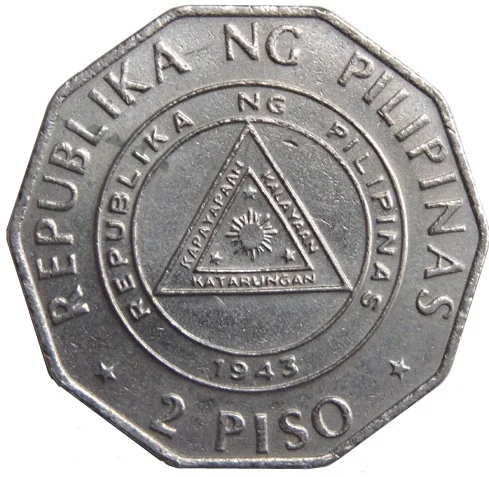
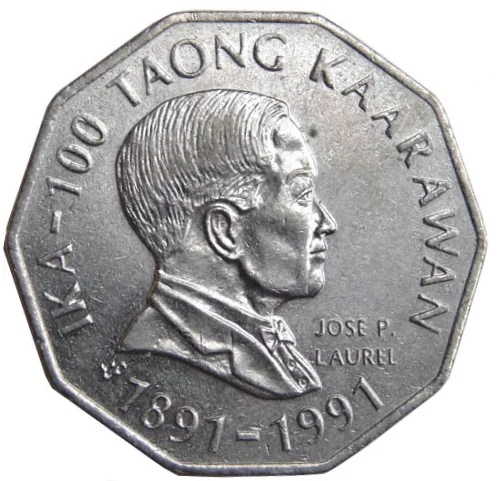
2 Pesos (José P. Laurel) – Philippines
Circulating commemorative coins
Commemoration: 100th Birth Anniversary of José P. Laurel
Philippines
Context
Year: 1991
Issuer: Philippines 
Period:
(since 1946)
Currency:
(since 1967)
Demonetization: 2 January 1998
Material
Diameter: 31 mm
Weight: 12 g
Thickness: 2 mm
Shape: Decagonal
Composition: Copper-nickel
Technique: Milled
Alignment: Medal alignment
flip
References
KM: #Click to copy to clipboard256
Numista: #15980
Value
Exchange value: 2 PHP = $0.03
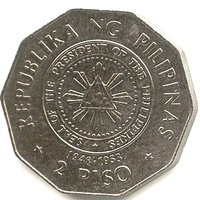
Obverse
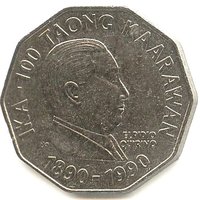
Reverse
Edge
Plain
Categories
| Person> Politician |
Mints
| Name | Mark |
|---|---|
| BSP Security Plant Complex | (PI) |
Mintings
| Year | Mint Mark | Mintage | Quality | Collection |
|---|---|---|---|---|
| 1991 | PI | — |
Historical background
In 1991, the Philippines was navigating a fragile economic recovery under the administration of President Corazon Aquino, following the political turmoil of the 1986 People Power Revolution and the debt crisis of the 1980s. The country's currency, the Philippine Peso (PHP), operated under a managed float system, but was under persistent pressure due to structural weaknesses. Key challenges included a large national debt burden, chronic trade deficits, and low foreign exchange reserves, which left the peso vulnerable to speculation and depreciation. The economy was also reeling from the combined shocks of the 1990 oil price spike, a major earthquake in Luzon, and the catastrophic eruption of Mount Pinatubo in June 1991, which caused billions in damages and further strained fiscal resources.
The Central Bank of the Philippines, led by Governor Jose Cuisia Jr., was engaged in a continuous struggle to stabilize the peso and curb inflation, which hovered around 18-19% for the year. Monetary policy was tight, with high interest rates aimed at defending the currency and attracting capital. However, these measures also constrained economic growth. The peso's value was not freely determined by the market alone; the Central Bank actively intervened in the foreign exchange market to smooth out volatility and prevent a disorderly decline. Despite these efforts, the peso experienced a gradual but significant depreciation throughout the year, moving from approximately ₱27.5 to the US dollar at the start of 1991 to nearly ₱29 by year's end, reflecting underlying economic stresses and a loss of investor confidence.
This currency situation was set against the backdrop of pivotal political events, most notably the Senate's rejection of the Treaty of Friendship, Cooperation and Security in September, which led to the closure of U.S. military bases at Subic Bay and Clark. This decision had immediate financial repercussions, as it cut off a significant source of foreign exchange and employment. Consequently, 1991 ended with the Philippine economy in a precarious state, setting the stage for the more severe currency crisis that would erupt in the following years. The pressures of 1991 highlighted the fundamental need for deeper structural reforms, which would become a central focus for the incoming Ramos administration in 1992.
The Central Bank of the Philippines, led by Governor Jose Cuisia Jr., was engaged in a continuous struggle to stabilize the peso and curb inflation, which hovered around 18-19% for the year. Monetary policy was tight, with high interest rates aimed at defending the currency and attracting capital. However, these measures also constrained economic growth. The peso's value was not freely determined by the market alone; the Central Bank actively intervened in the foreign exchange market to smooth out volatility and prevent a disorderly decline. Despite these efforts, the peso experienced a gradual but significant depreciation throughout the year, moving from approximately ₱27.5 to the US dollar at the start of 1991 to nearly ₱29 by year's end, reflecting underlying economic stresses and a loss of investor confidence.
This currency situation was set against the backdrop of pivotal political events, most notably the Senate's rejection of the Treaty of Friendship, Cooperation and Security in September, which led to the closure of U.S. military bases at Subic Bay and Clark. This decision had immediate financial repercussions, as it cut off a significant source of foreign exchange and employment. Consequently, 1991 ended with the Philippine economy in a precarious state, setting the stage for the more severe currency crisis that would erupt in the following years. The pressures of 1991 highlighted the fundamental need for deeper structural reforms, which would become a central focus for the incoming Ramos administration in 1992.
🌱 Fairly Common